Bulb base sizes: E27, E14, GU10, the clear guide
This article is also available in French: Taille culot ampoule
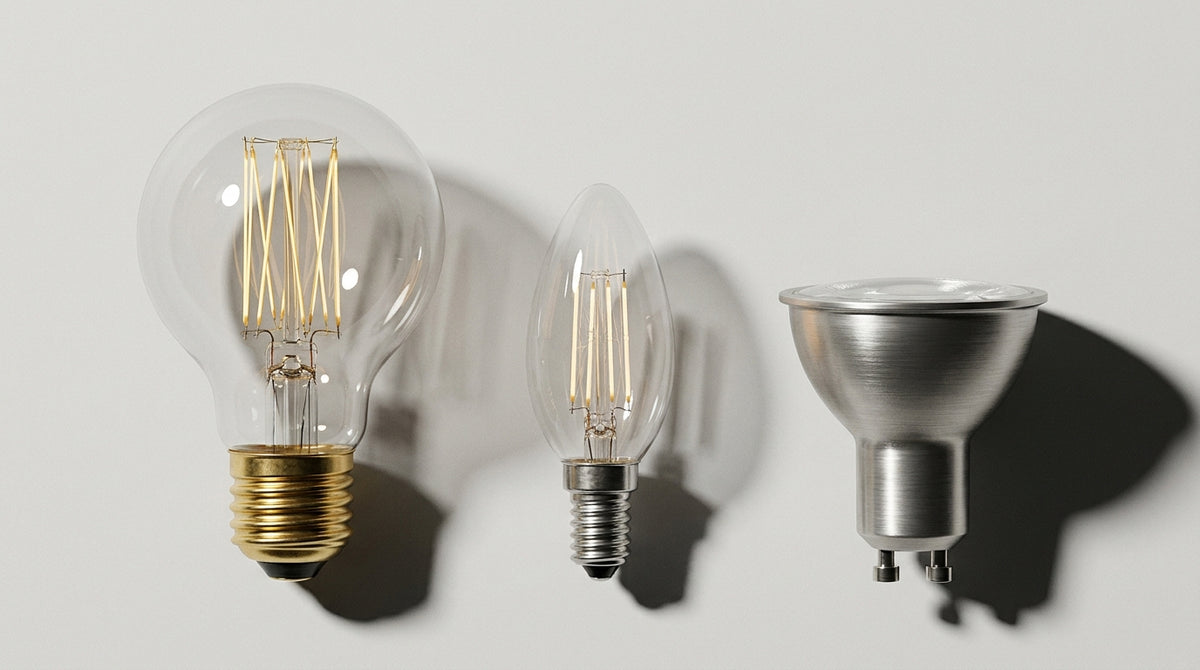
Take a ruler and measure the socket: 27 mm in diameter for an E27, 14 mm for an E14, 22 mm for a B22. In a base name, the number gives the diameter in millimetres and the letter indicates the fitting. Note the measurement before ordering: it saves you from a batch of bulbs that will not fit.
How do you find out a bulb's base size?
Measure the diameter of the socket with the bulb removed: 27 mm for an E27 screw base, 14 mm for an E14. On a pin base, measure the gap between the two pins, not their length. The measurement identifies the family, the letter confirms the fitting.
A ruler laid flat across the socket settles most doubts, even on an old light fitting. Our Designix tips and inspirations gather the other useful reference points before buying: mounting height, wattage and light colour.
How do you measure a base without taking the light fitting apart?
When the socket is hidden inside the shade, the bulb in place is your reference. Three steps are enough.
- Switch off the power at the circuit breaker.
- Remove the bulb, then lay the ruler flat against the thread or the pins.
- Compare the measurement with the name moulded on the socket, often on the inside.
The E27, E14 or GU10 marking is almost always printed on the bulb you have removed. To read it without hesitation, identifying the right bulb base takes you through this identification in pictures.
What is the standard bulb base?
The standard base in France is E27, 27 mm in diameter, screw fitting. It is found on most pendants, ceiling lights and floor lamps. A light fitting sold without a bulb is almost always E27 unless its product page says otherwise.
The choice follows the base: the E27 Bulb Base collection lists 96 references recorded on 30 September 2026, from filament to dimmable models. To compare wattage, colour and base, the LED bulb comparison table is a handy shortcut.
What is the difference between E27 and E14?
The diameter. The E27 measures 27 mm, the E14 measures 14 mm: the thread pitch is the same, only the scale changes. An E14 will not screw into an E27 socket without an adapter. Wattage, colour and glass shape can be chosen freely within each family.
The E27 lights a wide area: pendants, ceiling lights, floor lamps. Its socket takes large globes as well as high-wattage bulbs. Everything about the size of an E27 bulb details the available volumes in this format.
The E14 fits narrow sockets, wall lights, bedside lamps and bathroom light fittings. It often calls for a shorter glass, because there is little room under the shade. Choosing an E14 LED bulb means looking for wattage in a small volume.
Both families are equal in quality: it is the size that decides. Our selection of E14 LED bulbs covers warm whites as well as high-wattage models.
Three letters are all you need to read a base
The letter tells you the fitting, the number tells you the diameter in millimetres. E for screw, G for pins, B for bayonet. E27: 27 mm. E14: 14 mm. GU10: 10 mm between the pins. B22: 22 mm. Three letters, one dimension, no more doubt when you order.
| Letter | Fitting | Examples | Where you come across it |
|---|---|---|---|
| E | Screw, Edison type | E27, E14 | Pendants, ceiling lights, floor lamps |
| G | Pins | GU10, G9, G4 | Recessed spotlights, tracks, wall lights |
| B | Bayonet | B22, B15 | Older and imported light fittings |
On a light fitting with an exposed socket, how legible the base is matters as much as the line of the shade. La maison Designix shows how to match the two, room by room.
Beyond the base, the shape of the glass changes the look and the spread of light. The different types of bulb compare globes, candles, spotlights and tubes on the same basis.
A visible bulb becomes a decorative object. Design bulbs are chosen for their shape, their filament or their smoked glass, provided you keep the right base.
GU10, G9, B22: why a batch of bulbs may not fit
Because the base name is a dimension, not a family. A GU10 will not go into a G9 socket: the pin spacing and the fixing system differ. A B22 bayonet rejects a screw base. This is the case that comes up most often when advising on a bulb purchase.
A pin base is not a screw base
A pin base clicks in with a quarter turn, a screw base screws in. Both run on 230 V mains, but they cannot be swapped without an adapter. Four formats cover the home.
- GU10: two pins 10 mm apart, the standard for recessed spotlights and tracks.
- G9: pins 9 mm apart, common on small wall lights and bathroom light fittings.
- B22: 22 mm bayonet, two lugs to push then turn.
- G4: very fine pins, reserved for low-voltage light fittings.
Replacing a GU10 recessed spotlight takes no tools, provided you switch off the power and respect the pin spacing.
A tired spotlight is often fixed with a simple bulb: our GU10 LED bulbs gather the models with 10 mm pins.
Narrower sockets have their own section, with G4 and G9 bulbs for small formats.
What can be replaced and what cannot
A bulb can be replaced, a socket is changed with the light fitting. Three points decide whether a replacement works.
- Dimmer compatibility: an LED not designed for it buzzes or flickers on a dimmer.
- Heat: a shade tight around the base shortens the bulb's life.
- Colour rendering: with the same base, light quality varies a great deal from one model to another.
Adapters exist: E27 to E14 to reduce, E14 to E27 to enlarge, GU10 to E27 for a light fitting without a suitable socket. They get an older model out of trouble, provided you check the space available and the load the shade can take.
If your light fitting comes from an import or a flea market and the base is still uncertain, the team answers compatibility questions before any purchase. A photo of the base is all you need to ask the Designix team.
For bulbs already in stock, Designix's Google listing opens in one click and lets you read buyer feedback, with no rating copied here.
Your base identified: the bulbs that screw into it


Which base for which room?
The base depends on the socket, the colour depends on the use. An E27 at 2700 K for the living room, a GU10 at 3000 K for the kitchen, an E14 at 2700 K for the bedroom. The room sets the tone, the light fitting sets the base.
| Room | Base you find most | Recommended colour |
|---|---|---|
| Living room and lounge | E27 | 2700 K, warm white |
| Dining room | E27, sometimes GU10 | 2700 to 3000 K |
| Bedroom | E14, E27 | 2700 K |
| Kitchen and island | GU10, E27 | 3000 to 4000 K |
| Bathroom | GU10 or E27 depending on the zone | 3000 K, IP44 minimum |
| Outdoors | E27 | 2700 to 3000 K, IP44 and above |
The lounge takes a pendant that spreads light widely, often E27 with two or three sockets. That is where a pendant light does most for the atmosphere, provided you choose a consistent colour across all the sockets.
Colour matters as much as the base: warm or cool light changes how an entire room feels, with the same bulb.
To lower the brightness in the evening, the bulb must be designed to dim and the dimmer must accept it: dimmable or variable bulb explains the compatibilities to check before buying.
The models concerned are gathered in our selection of dimmable bulbs, across all bases.
Which base does the light fitting you want to equip have?
One last thing before you order: choosing your bulbs well means matching base, wattage and colour, not just the shape of the glass.
In stock · shipping costs shown at checkout · up to 30% off in your cart


Ready to turn inspiration into reality?
Tell us about your room, your style and your budget, and we will show you the pieces that truly suit your project.
Get guidance in 30 seconds →