Small E14 LED bulb: choosing the right one
This article is also available in French: Ampoule led e14 petite taille
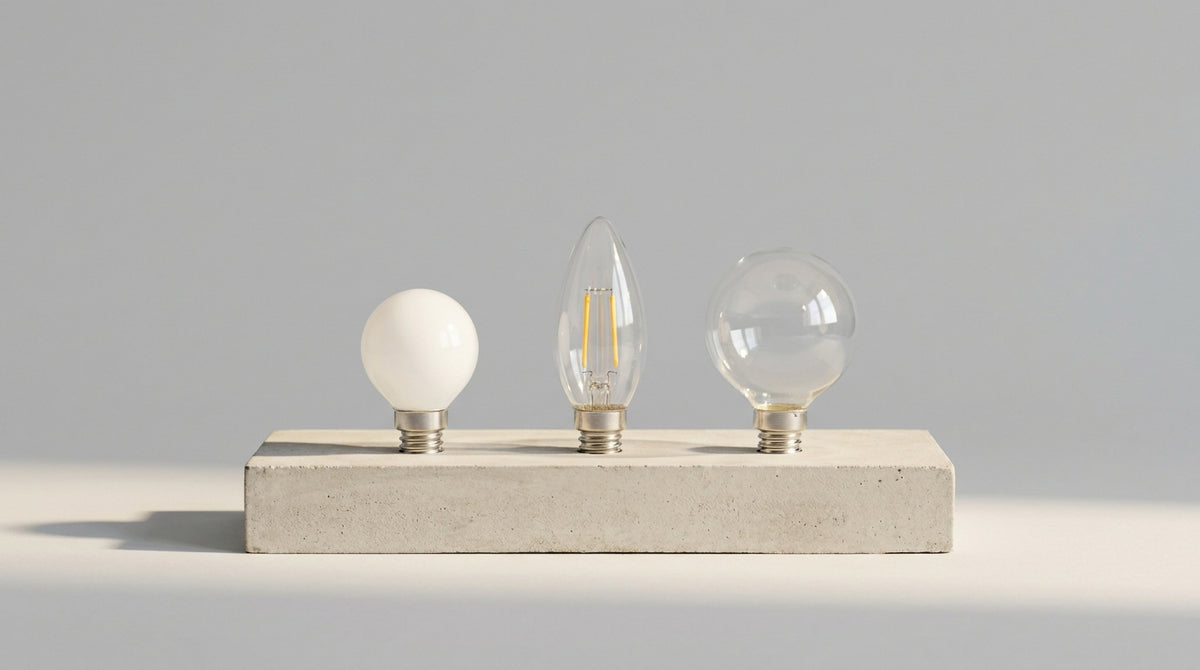
First measure the clear height under the shade, then the diameter of the socket: an E14 measures 14 mm. For a small wall light or a bedside lamp, choose a mini globe or a candle, which fit where a standard bulb bumps against the shade. It is the dimension that decides, not the wattage.
What is the size of an E14 bulb?
The E14 cap measures 14 mm in outer diameter, hence its name. It is the small screw thread, the one used on oven bulbs, extractor hood bulbs and most accent lamps. The overall height, however, follows no standard: between a candle and a globe, the difference can reach several centimetres.
Our collection of E14 LED bulbs contains 41 references as of 28 September 2026, from warm white to cool white. The format is there, short silhouettes included.
What is the size of a small bulb?
A compact E14 often comes in under 80 mm tall, but no standard sets this dimension: two references with the same cap can differ by twice the length. Compare the stated height with the space available before you commit.
Our article on bulb cap sizes details the matches between E14, E27, G9 and G4, useful when the socket is not identified.
Mini E14 LED bulb: which light fittings accept it?
A compact bedside lamp, a hallway wall light or a fitting with an exposed socket only has limited clearance. Four families live with these short bulbs:
- Wall lights and reading lights, whose socket sits almost against the wall
- Bedside lamps with a small base, where a long bulb sticks out above the base
- Table lamps in glass, ceramic or brass, with a narrow neck
- Pendants with a bare socket, when the bulb stays visible and is part of the decor
If you are hesitating between several silhouettes, our guide to the bulb for a bedside lamp shows the ones that fit anywhere.
On a wall, the reasoning changes: depth matters more than height. Our selection of wall lights groups the models with low clearance.
A sketch is worth more than a spec sheet: overlay the profile of your current bulb on the new one. Our lighting advice covers the configurations that come up most often in the workshop.
What is the equivalent of an E14 bulb?
An E14 LED bulb of 5 to 7 W replaces an E14 halogen bulb of 40 to 50 W: you compare lumens, never watts. The cap says nothing about wattage, only the diameter of the thread. So there are low-output E14 bulbs for ambient light and high-output E14 bulbs for working light.
High-output E14 LED bulb: what lumens change
Lumens measure the light actually produced, watts the consumption. An E14 at 400 lumens and an E14 at 800 lumens share the same cap but not the same use. For reading or working, aim for the second; for ambient light, the first is enough.
All families exist in E14: candle, globe, spot, tube. Our guide to types of LED bulbs explains what each shape changes in the result.
Where the price difference between two E14 bulbs comes from
Two bulbs with the same cap do not have the same manufacturing cost. Four criteria move the price:
- The technology: a filament LED costs more to produce than a diffuser LED
- The finish: clear glass, frosted glass, opal globe, brushed metal
- The dimmer: a dimmable bulb carries extra electronics
- The shape: an E14 candle is less common than a globe
The decorative result matters as much as the technical side: a filament LED bulb shows its filaments and changes the look of a pendant with an exposed socket.
Small E14 LED bulbs: the workshop selection


See the whole selection: E14 LED bulb, Warm White, Cool White, High Output
How do you choose the right bulb?
Start from the room, not the bulb. A bedroom calls for warm, soft light; a worktop calls for neutral, directed light. Note three values (lumens, colour temperature, cap), check dimmer compatibility, and choose the shape last.
The bulb does not make up for a poorly chosen fitting. An opaque shade concentrates, frosted glass diffuses: before you choose your light fitting, know whether you want ambient light or working light.
How do you choose the wattage of an LED bulb?
Useful power is read in lumens. An E14 at 400 lumens suits a night light or a hallway; an E14 at 800 lumens lights a desk or a medium-sized room. The surface, the wall colour and the diffusion of the shade shift these benchmarks. Our guide to the number of lumens for a bedroom gives the benchmarks room by room.
Which colour temperature for which room?
The higher the number, the more the light leans blue. The choice is made by use, not by taste.
| Temperature | Result | Room |
|---|---|---|
| 2700 K | Amber warm white, close to halogen | Bedroom, living room, bedside |
| 3000 K | Neutral warm white | Kitchen, dining room |
| 4000 K | Neutral white, no cast | Office, bathroom, hallway |
| 6500 K | Slightly bluish cool white | Workshop, garage, outdoors |
On a designer lamp with a light shade, a temperature that is too cool betrays the assembly and hardens the interior decoration. When in doubt, stay at 2700 K in rooms for rest.
If you are still hesitating between a mini globe and a candle for your fitting, describe the socket and the shade to us: you can write to the workshop and the answer arrives before the purchase, not after.
A successful bulb is a compromise between several dimensions, and no two people have the same ones. Our guide to choosing bulbs without getting it wrong sets out the method in order.
Which light fitting are you going to equip?
Which bulbs are the most economical?
LEDs, without hesitation. An LED bulb turns almost all its electricity into light, whereas a halogen bulb dissipates a large part of it as heat. The real expense is not the bulb but the consumption accumulated over the years. So the question is about use, not purchase.
Why does an LED use less than a halogen?
An LED produces light through a semiconductor; a halogen heats a filament until it glows. The second spends part of its energy on heat, not light. At comparable brightness, the LED therefore needs much less power.
Pair it with a dimmer and you no longer light at full intensity when it is not needed. Not all bulbs support this setup: a dimmable bulb carries the necessary electronics, the others do not.
Our article on telling a dimmable or variable bulb apart covers the buzzing observed with an old dimmer.
Lifespan: what really matters
Longevity depends on three things: the quality of the components, heat dissipation and the number of switch-ons. A bulb enclosed in a closed fitting heats up and ages faster than in the open air, even if the spec sheet claims the same resistance.
- Dissipation: a metal cap dissipates better than a plastic cap
- Cycles: switching on and off constantly wears more than continuous operation
- The dimmer: an incompatible dimmer wears out the electronics
- The warranty: our bulbs are covered for 2 or 5 years depending on the model
The CE marking and the IP20 rating appear on our spec sheets: the first certifies conformity, the second reminds you that a bare bulb is intended for dry rooms.
A doubt about a reference you have already received? Our help and after-sales service answers questions about compatibility, returns and warranty.
Still hesitating about a shape? The customer reviews on our Google listing can be checked in one click, with no rating copied here.
In stock · shipping costs shown at checkout · up to 30% off in your cart


Ready to turn inspiration into reality?
Tell us about your room, your style and your budget, and we will show you the pieces that truly suit your project.
Get guidance in 30 seconds →