Wiring an LED transformer: 12 V, 24 V or 230 V?
This article is also available in French: Brancher transformateur led
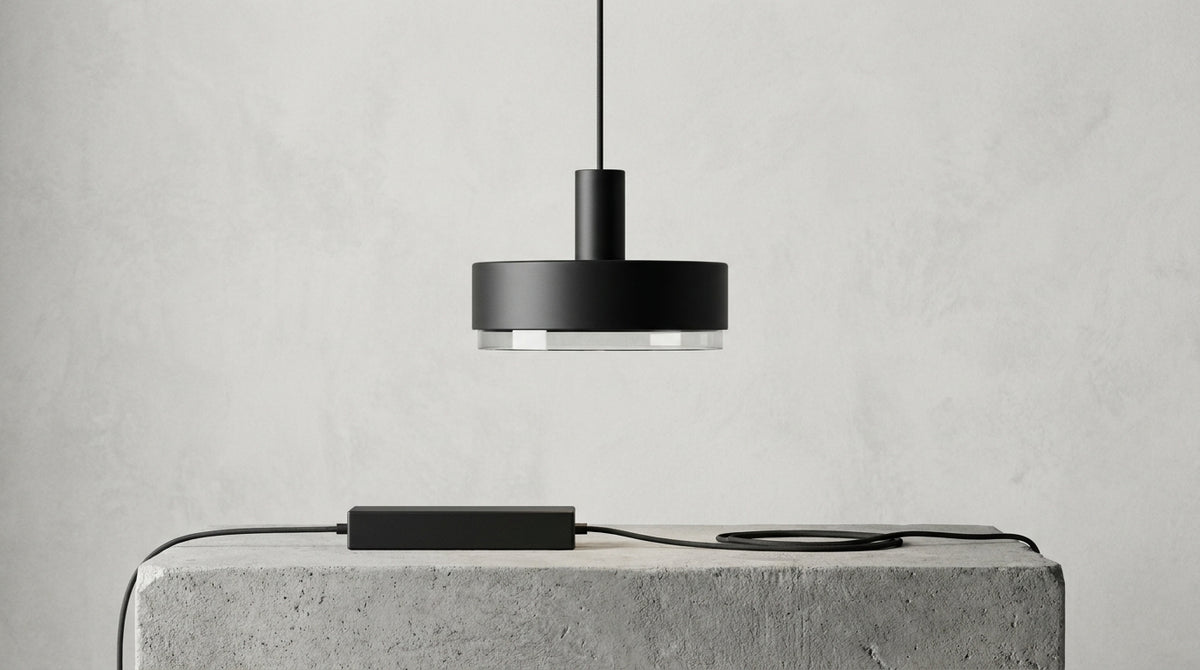
Locate the primary side, marked L and N, then the secondary side, marked + and −. Check that the output voltage matches the luminaire, 12 V or 24 V, and that the stated power covers all the connected LEDs. A reversed primary destroys the transformer, a reversed secondary simply leaves the LED off with no damage.
Why use an LED transformer, and when do you really need one?
A transformer is only needed if the luminaire runs on low voltage, 12 V or 24 V. A pendant, a wall light or a ceiling light on 230 V connects directly, with no intermediate box. In a survey of 250 product listings from our catalogue on 28 September 2026, the E27 base is stated on 26% and the LED base on 26%.
Installers who validate a site before installation will find our terms and our support on the Designix trade area.
Wiring 12 V to 220 V: what really happens
Without a transformer, a 12 V module connected to 230 V receives a voltage far above what it was designed for: the LED burns out immediately, sometimes with a slight pop. The reverse breaks nothing, a 230 V luminaire fed with 12 V simply stays off. The box steps the voltage down, it never steps it up. The details of mains connections are covered in our article on wiring an LED to 220 V.
How do you identify the terminals of a transformer?
Two separate zones are printed on the casing: the primary, on the mains side, and the secondary, on the LED side. The primary carries an L and an N, sometimes an earth terminal. The secondary carries a + and a −, or two wires of different colours.
- Mains input: L, N and earth terminals, fed with 230 V
- Low voltage output: + and − terminals, reserved for LED modules
- Output voltage: 12 V or 24 V printed on the casing, never guess it
- Power: value in watts, to compare with the total of the connected LEDs
Identification is always done with the power off. Our guide to wiring a luminaire details the order of checks before switching on.
How do you wire several LED spots together?
A single transformer is enough for several 12 V spots, provided its power exceeds the sum of the spot powers. They are all wired in parallel on the same output, never one after the other. One power supply per spot remains possible, but costs more in cable and boxes.
- Total power: add up the watts of each spot before choosing the box
- Single output: all the feeds start from the same + and the same −
- Cable length: the longer the run, the more the voltage drops at the end of the line
- Headroom: a slightly oversized box heats up less than one that is just enough
Wiring an LED transformer to a switch
The switch is not fitted on the secondary side: it cuts the 230 V upstream, on the primary side. The secondary stays permanently wired to the spots. A low voltage unit fed by a poorly matched dimmer hums or flickers. The ceiling installation step is the same as for wiring a ceiling light.
Wiring diagram for a 12 V and 24 V LED transformer
The diagram is the same for 12 V and 24 V: mains supply to L and N, low voltage output to the spots in parallel. Only the output voltage changes, and it must match that of the modules. A 12 V module placed on a 24 V output is damaged within moments.
If the circuit must also supply other light points, the connection of several lamps on a single supply is prepared upstream, at the consumer unit.
Should LEDs be wired in series or in parallel?
In parallel, always, for low voltage spots or strip. Each module then receives the same voltage and keeps working if another one goes out. A series setup adds up the voltages and cuts everything as soon as one element fails, which is of no use in domestic lighting.
| Criterion | In series | In parallel |
|---|---|---|
| Voltage per module | adds up | identical for each |
| If one module burns out | everything goes out | the others stay on |
| Common use | rare indoors | standard on 12 V spots and strips |
| Power supply | a single one, constrained | a single one, sized on the total |
Tapping into the supply cable is described step by step in our guide to wiring spots in parallel.
Wiring an LED spot transformer: one transformer for several spots
Add up the total power, add some headroom, then choose the box. A transformer that constantly runs at its upper limit heats up and ages badly. Also note the cable length: over several metres at 12 V, the brightness fades at the end of the line.
If you would rather start from a luminaire whose power supply is already provided, the selection of LED luminaires brings together models with E27, E14 and GU10 sockets as well as low voltage units. When installation is entrusted to an electrician, our team can have your diagram checked by the team before purchase.
Wiring an LED strip transformer: length matters
A strip uses more than a spot: the power stated per metre is multiplied by the total length. Over a long length, the strip is fed from both ends, or cut into two sections. The join between two pieces is often made without an intermediate part, as explained in our method for connecting an LED strip without a connector.
How do you know if a transformer is LED compatible?
Three points are enough: an output voltage equal to that of the luminaire, a direct current output designed for LEDs, and an available power greater than the total of the modules. A box designed for halogen, on alternating current, makes some LEDs flicker or burn out.
- Output voltage: 12 V or 24 V, identical to the one stated on the luminaire data sheet
- Current type: direct output, marked DC, for LED modules
- Available power: always greater than the total of the connected LEDs
- Warranty: 2 years stated on 100% of the survey of 250 listings on 28 September 2026
Which way round should I wire an LED?
An LED has a polarity: + to +, − to −. Wired the wrong way round, it does not light up, but it does not burn out. Most strips and modules are protected against reverse polarity, not all boxes are. For a single module, our article on wiring an LED at home goes through the identification wire by wire.
Choosing your LED luminaire before its power supply
The simplest approach is to start from a luminaire whose power supply is already thought through. The survey of 250 listings on 28 September 2026 shows what the catalogue really carries: LED technology on almost all of them, a 2 year warranty on 100%, and an IP20 protection rating on 94%. In a wet room, that rating is not enough: near a bath or a shower, an IP44 or IP65 model is required, as in our selection for bathroom lighting.
In a living room, pendant lights often incorporate the low voltage unit in their casing. On the ceiling, LED ceiling lights mostly arrive with their driver already fitted. An LED wall light connects to 230 V with no extra box, and a floor lamp brings its own power supply without touching the ceiling circuit.
LED luminaires with a socket or built-in power supply


What is your wiring case?
In stock · shipping costs shown at checkout · up to 30% off in your cart


Ready to turn inspiration into reality?
Tell us about your room, your style and your budget, and we will show you the pieces that truly suit your project.
Get guidance in 30 seconds →