Wiring an LED at home: the step-by-step guide
This article is also available in French: Brancher une LED

Switch off the circuit breaker, then screw the LED bulb into its socket or connect the strip to its transformer. A household LED is never wired bare to 230 V: it goes through a socket, a driver or a power supply. Identify live and neutral, tighten the terminals, switch the power back on.
How do you wire an LED to 230 V without getting it wrong?
There are three setups. A bayonet or screw-base LED bulb screws straight onto 230 V, a strip goes through a 12 V or 24 V transformer, and a bare LED is reserved for models and batteries. For a household light fitting, stick to the socket or the driver supplied with the product.
| Setup | Power supply | Where you find it | Good to know |
|---|---|---|---|
| Bulb with socket | 230 V direct | Pendant, ceiling light, wall light | No calculation, no driver |
| LED strip | 12 V or 24 V | Under cabinet, ceiling, alcove | Transformer to be sized |
| Bare LED | 2 to 3 V | Model making, 9 V battery | Series resistor required |
The three possible connections, from simplest to most technical
A household connection comes down to screwing in a bulb. The other cases need a little more care.
- GU10 or E27 socket: you unscrew the old bulb, screw in the LED, and you are done
- Adhesive strip: the connector sets the direction, you just choose the length and the transformer
- Bare LED module: two legs, one resistor, a test holder, never 230 V
Choosing a complete LED light fitting removes these questions: the bulb, the socket and the driver are designed to work together.
Before taking anything apart, switch off at the circuit breaker and check with a tester. The method for wiring a light fitting to the ceiling uses the same steps, terminal by terminal.
Wiring an LED to 220 V or 12 V: which should you choose?
230 V powers everything fixed to the wall or ceiling. 12 V is for strips and recessed spotlights, which are thinner and easier to hide.
- 230 V: pendant, ceiling light, wall light, no visible transformer
- 12 V: strip and recessed spotlight, transformer to be housed in a false ceiling or a cabinet
- Battery: movable objects, no mains connection
On a new circuit, the 230 V connection follows the same logic as wiring a lamp to the ceiling: live, neutral, earth, and nothing else.
The table above can be checked in one visit: our range comes as pendants, ceiling lights and wall lights, and each product page states the socket required.
Which way round should an LED be wired, and what happens if it is reversed?
An LED has a polarity. The anode, the longer leg, goes to plus; the cathode, the shorter one, goes to minus. Wired the wrong way round, it stays off without burning out in most cases. On a bulb with a socket or a strip, the connector already sets the direction.
Anode and cathode: recognising the right direction on a bare LED
- Long leg: anode, the plus side
- Short leg: cathode, the minus side
- Flat on the body: it marks the negative side when the legs have been cut
- Multimeter in diode mode: one contact is enough to confirm the direction
The threshold voltage changes with colour: about 2 V for a red LED, 3 V for a white or blue one. A good quality white LED strip therefore shows a higher supply voltage than a red strip of the same length.
How do you wire an LED to a switch?
The switch cuts the live wire, never the neutral. When several light points share a single control, the logic stays the same as with conventional wiring: the control cuts the common feed, and each light fitting stays supplied with neutral.
To take over the wiring of an existing two-way circuit, the method given in wiring several lamps to a switch applies to LEDs as it stands.
How do you wire LEDs without a socket?
An LED strip is powered by a transformer connected to a socket, or by a battery when no socket is within reach. Battery or USB battery models stick under a cabinet, in a staircase, under a headboard. Runtime depends on how many LEDs are lit.
LED strip and LED tape: the role of the transformer
The transformer, or driver, converts 230 V to 12 V or 24 V. Its power must cover the length of strip installed, with a margin to stop it overheating.
- 12 V driver: short strips, under cabinet, alcove
- 24 V driver: lengths of several metres, limited voltage drop
- LED connectors: they avoid soldering and keep the strip watertight
Several strips on the same transformer are wired in parallel, exactly as for wiring spotlights in series.
Outdoor string lights: which ingress protection rating should you choose?
The ingress protection rating decides where the strip can live. Out of a survey of 24 pendants in our catalogue on 25 September 2026, 88% are IP20 and 13% are IP65.
- IP20: dry interior only, bedroom, living room, hallway
- IP44: covered terrace, bathroom outside shower zones
- IP65: outdoor exposed to rain, facade, garden
For a balcony or a facade, a watertight LED string light lasts all year. Indoors, a LED ceiling light covers a whole room in a single installation, and a wall light replaces the strip where the wall is left bare.
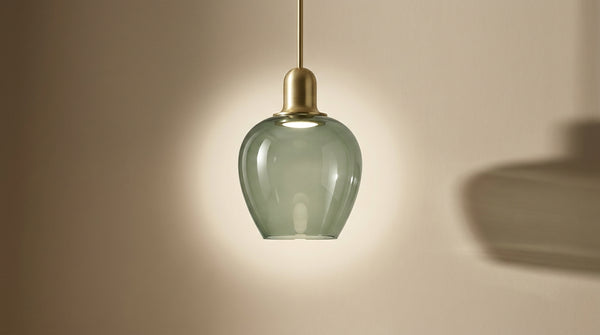
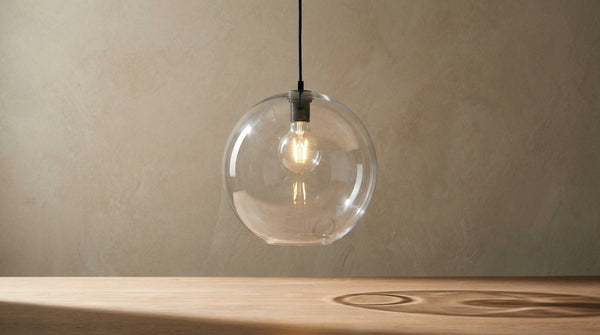
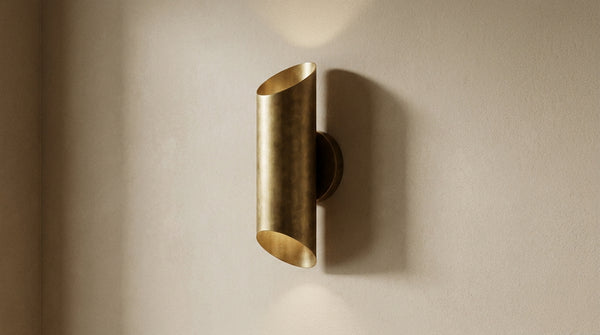
LED light fittings to wire, chosen for their accessible terminal block
 K3333SS black 13 cm round lampshade
 Detachable glass lampshade I15467S – Handmade smoked glass for E27 light fittings
 Dimmable smoked bulb with E27 socket 120 lumens 1800 kelvins 4.5 watts
 Oeroe 4113ZW 1-light black wall spotlight / wall light with E14 socket
 Dimmable smoked bulb with E27 socket 140 lumens 1800 kelvins 4.5 watts
What is an LED and how much does wiring it cost?
An LED is a light-emitting diode: a component that produces light when current passes through it, with no filament to heat. The wiring itself costs no more than a conventional connection: the expense lies in the bulb and the power supply.
What exactly is an LED?
Two electrodes, a semiconductor between them, and light as soon as the current flows the right way. An LED does not burn out when switched on like a filament bulb, it wears out slowly. Of the 24 pendants surveyed in our catalogue on 25 September 2026, all carry the CE marking.
How much does connecting an LED cost?
No charge applies to the step itself: a screw-in bulb is changed in thirty seconds. The budget goes on the light fitting itself, and the warranty period matters more than the difference in purchase price. In the same survey, the stated warranty is 2 years on 54% of product pages and 5 years on 46%.
The Affordable Lighting collection has 25,571 references as of 25 September 2026, enough to find the exact socket or ingress protection rating without compromise.
Before climbing the stepladder, one check is enough: if your circuit or your terminal block leaves any doubt, the Designix team replies on the ask the Designix team a question page.
Which socket for an LED bulb?
The socket determines the bulb you can screw in, and it is read on the light fitting's holder. Out of a survey of 24 pendants in our catalogue on 25 September 2026, 50% have a GU10 socket, 38% an E27 and 8% an E14.
- GU10: pin-base bulb, adjustable, ideal for a directed spotlight
- E27: large screw base, the most widespread and the widest choice
- E14: small screw base, for slim light fittings and wall lights
To see clearly between bulb families, the guide to types of bulbs details each format. If you want to adjust the brightness, it is better to know whether your bulb is a dimmable or variable bulb before buying.
Then there is colour temperature, which changes everything in a room: the choice between white or yellow light is made before fixing the light fitting. To check our selection, the business's Google listing shows up-to-date buyer reviews: see the Designix Google listing.
Which type of LED do you want to wire at home?
On the same subject
In stock · shipping costs shown at checkout · up to 30% off in your cart


Ready to turn inspiration into reality?
Tell us about your room, your style and your budget, and we will show you the pieces that truly suit your project.
Get guidance in 30 seconds →