Connecting multiple lamps to a single power supply: a step-by-step diagram
This article is also available in French: Comment Brancher plusieurs lampes sur une Seule arrivée Électrique
Plan for a junction box, 1.5 mm² cable and three conductors run to each lamp: live, neutral, earth. The wiring is done in parallel, never in series. Each light fixture then receives 230 V and stays on even if a bulb blows.
How do you wire several lamps to a single electrical supply?
You start from the supply with three conductors and redistribute them to each light fixture, in parallel: live with live, neutral with neutral, earth with earth. A junction box serves as the distribution point. Each lamp receives 230 V and works independently of the others.
Running from a box rather than stacking connector blocks behind a wall light avoids having to take everything apart the first time a bulb is replaced. The connection stays accessible, and the labelling holds up over time.
In a room with four or five points, this distribution is decided before buying: it is the work carried out in a turnkey lighting project.
What is a junction box for in a lighting setup?
It turns a single supply into several outgoing runs, without stacking connections in the wall.
- Junction box: each outgoing run leaves it cleanly, with its three conductors.
- Terminal block or wago: one strip per colour, live, neutral, earth.
- Labelling: tagging the outgoing run before closing up avoids mistakes during troubleshooting.
- Accessibility: the box must remain accessible, never buried under plaster.
How do you identify the wires before connecting?
Three colours are enough to read the setup: red, brown or black for live, blue for neutral, green-yellow for earth. Switch off the breaker and check that there is no voltage before touching any conductor.
The procedure is detailed step by step in our guide to wiring a light fixture properly, from stripping to tightening the terminals.
How do you wire 3 lamps in series?
At 230 V, three lamps in series share the voltage: each receives about 77 V and barely lights up. Remove one bulb and everything goes out. Series wiring is only suitable for fixtures designed for this operation, typically low-voltage strings.
Wiring spotlights in series: why it does not work at 230 V
A 230 V recessed spotlight needs its full voltage to maintain its light output. Lined up in series, they all dim together and the first fault cuts the entire line.
Series wiring is reserved for low-voltage spotlights powered by a transformer, where chain connection is intended by the manufacturer: wiring spotlights in series only makes sense in that context.
Multiple lighting wiring diagram: the reference to keep
On a multiple lighting wiring diagram, each lamp is drawn as a separate outgoing run from the supply. The wire never passes through one fixture to reach the next.
To remember about shared voltage, two identical lamps in series halve the voltage received, which our article on wiring lights in series explains in detail.
How do you wire several light fittings in parallel?
Each lamp gets its own outgoing run from the common supply: three conductors per fixture, connected live with live, neutral with neutral, earth with earth. A single switch controls the whole set. The 230 V stays the same along the entire line, whichever lamp is on.
Push-in connectors or screw terminal blocks: which to choose?
Push-in connectors accept a solid conductor without screws and install quickly. Screw terminal blocks clamp harder and reopen easily. In both cases, one conductor per terminal, and never two different cross-sections mixed together.
A complete connection, from labelling to closing the boxes, is detailed in our step-by-step guide to wiring spotlights in parallel.
Can the lamps be controlled together?
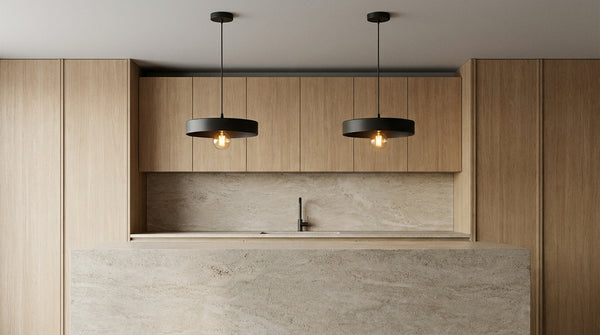
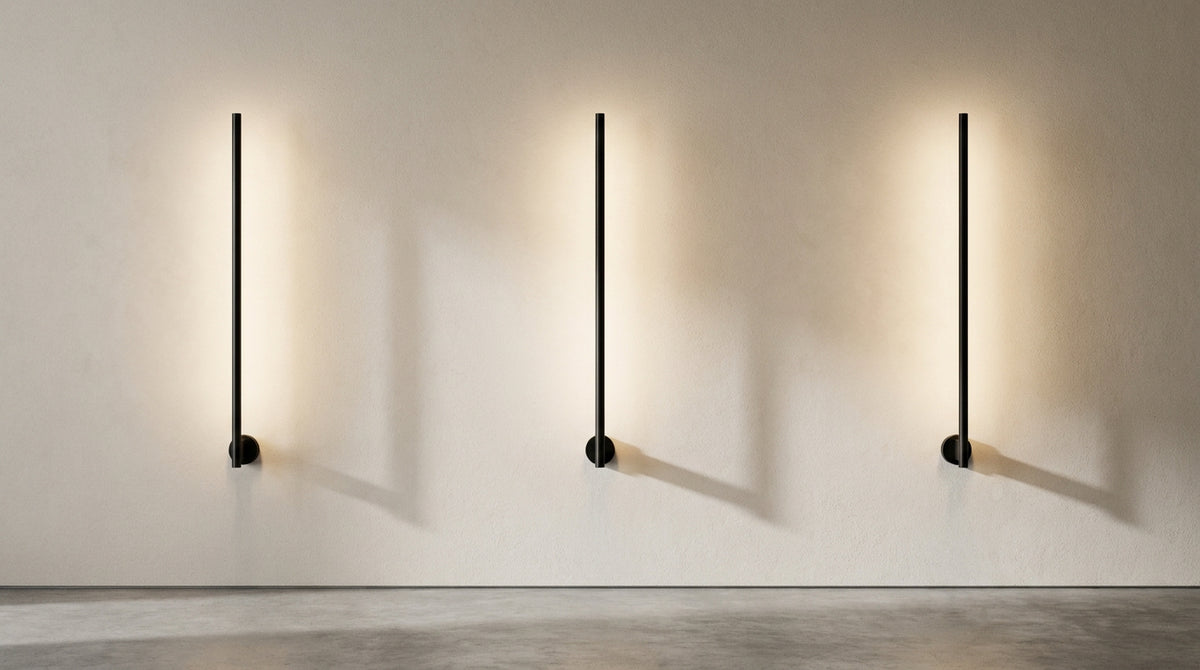
Yes, and it is often the goal: three points lit with one gesture give a coherent room rather than a patchwork. A pendant light above the table and two side wall lights are then controlled from the same switch.
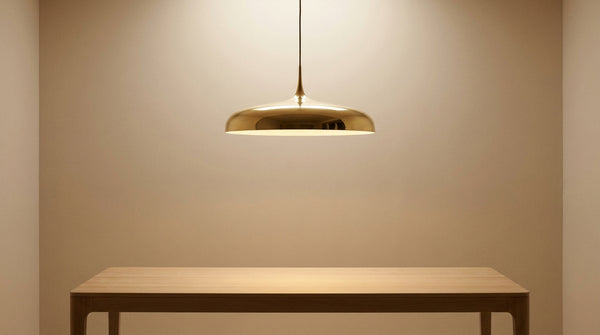
In a dining room, this setup suits a dining room chandelier complemented by secondary points.
| Criterion | Series wiring | Parallel wiring |
|---|---|---|
| Voltage per lamp | divided by the number of lamps | 230 V on each lamp |
| Bulb failure | the whole circuit goes out | the others stay on |
| Cabling | one conductor in a chain | three conductors per outgoing run |
| Common use | low-voltage strings | domestic lighting |
How many lighting points can you branch off one circuit?
The number of points is not the limiting factor: the combined power of LED lighting remains very low. What matters is the length of cable run and the actual space in the boxes. A saturated circuit shows up in the length, not the count.
The fixtures that work well on a shared supply


How do you add a lamp to an existing electrical circuit?
You start from the nearest point, never from a switch. A new junction box fitted on the existing run is enough to create the additional outgoing line.
Can you have two lighting circuits on a single breaker?
Yes, two lighting lines can coexist behind the same protection, as long as the total stays within what that protection accepts.
Several lamps on one switch can also share the control without a second circuit.
Before multiplying the outgoing runs, it is better to size the room: our method to calculate the amount of lighting needed avoids adding unnecessary points.
Once the count is settled, a central LED ceiling light and two wall lights cover most living rooms.
If the point count exceeds what your circuit accepts, it is worth revisiting the room plan: you can describe your room to us in two lines, that is where our lighting projects begin.
How many lamps do you want to switch on together, and in which room?
What are the drawbacks of a parallel wiring setup?
It uses more cable and multiplies the connections, so more points to watch in the boxes. It also does not allow the brightness of a single lamp to be lowered without a dedicated module. In return, it remains the only reliable setup at 230 V.
Dimming: how do you lower one lamp without touching the others?
A wall dimmer controls the whole line, not an isolated point. To individualise, you need a dimmable or variable bulb paired with its own control, or a module per fixture.
Which fixture to choose depending on the setup chosen?
A parallel setup frees the choice: each point can take a different model without disturbing the others. On a survey of 88 wall lights in our catalogue as of 4 October 2026, 47 % are E27, 94 % are IP20 and 55 % are guaranteed for 5 years. The Affordable Wall Lights collection had 1772 references on the same date.
In a living room, a bedroom light or a wall light is wired in exactly the same way, only the format changes.
For a hallway wall, an integrated LED wall lamp avoids having to replace a bulb up high.
When deciding between two models, our public Google listing gathers buyer reviews, available with one click.
On the same topic
In stock · shipping costs shown at checkout · up to 30% off in your cart


Ready to turn inspiration into reality?
Tell us about your room, your style and your budget, and we will show you the pieces that truly suit your project.
Get guidance in 30 seconds →