Green lighting: choosing the right shade, room by room
This article is also available in French: Luminaire vert
Is a green light fixture a colour or an eco-friendly argument?
A colour, nothing more. A green light fixture is chosen like a midnight blue or a terracotta: by the exact shade, the material that receives it and the light that passes through it. No material makes a green more accurate than another, only the shade decides the result in the room.
Sage, olive, dark green light fixture: what are we talking about?
Three families are enough to find your way, and they do not go in the same place.
- Sage green, grey and powdery, forgives bright rooms and off-white walls.
- Olive green, yellow and warm, likes brown woods and warm bulbs.
- Dark green, almost black, frames an entrance or a hallway without taking up space.
Sage on metal leans towards grey, the same sage on glass keeps its transparency. This difference is hard to see on a thumbnail: our collection of light fixtures is meant to be seen in context, not in close-up.
Why green looks better on a light fixture than on a wall
A green wall imposes its colour on the whole room and tires quickly. A green light fixture takes up only a fraction of the surface, it punctuates. And because it emits light, it tints the neighbouring wall in return, which paint cannot do.
Which green for which room?
Dark green for a living room or a hallway, sage for a bedroom, olive for a dining room. The rule fits in one sentence: the less daylight a room receives, the lighter and more desaturated the green must stay, otherwise the shade fades with the room.
A dark green light fixture in a living room or hallway
Dark green structures. In a windowless hallway, a bottle-green wall light stands out better than a white model, and it gives relief to a bare wall. In a living room, keep it for low pieces or pendants above a table, never both at once.
Olive, on the other hand, belongs to interiors that already have wood and a bit of age. It naturally converses with a 1970s vintage light fixture, whose round shapes suit warm greens.
A sage green for a bedroom
Sage lowers contrast and keeps the room calm on waking. Choose it as a bedside lamp rather than a ceiling light: the source is low, the shade stays soft and the halo does not climb to the ceiling.
It pairs effortlessly with the straight lines and light woods of a Scandinavian light fixture. For the bedside lamp, a sage shade on matte metal stays readable at low intensity, which matters in lighting suited to each room.
Pendant, wall light, floor lamp or table lamp?
The format decides more than the shade. A dark green pendant above a table is seen from afar, a green wall light is noticed at eye level, a green floor lamp takes the corner. Choose where the eye goes before choosing the green.
| Shape | Mounting | Room | To check |
|---|---|---|---|
| Pendant | Suspended | Living room, dining room | Drop above the table surface |
| Wall light | Wall-mounted | Hallway, bedroom | Protection rating if damp room |
| Floor lamp | Freestanding on the floor | Living room, reading corner | Stability and clearance around it |
| Table lamp | On a piece of furniture | Bedside, console | Lampshade diameter |
A green wall light, on the wall
The wall light is the most cost-effective format for a strong green: small surface, immediate effect, and nothing to move. Place it at shoulder height in a hallway, a little higher above a headboard. In a bathroom, choose at least IP44 outside zones 0 and 1, as a saturated green does not cope well with damp marks.
The green models in our selection of green wall lights mostly play with metal and tinted glass, two materials that keep the shade even when switched off.
Green floor lamp: the living room
The green floor lamp acts like a piece of furniture: it takes the corner, it structures the sofa area, it is noticed even before it is switched on. A dark green on a slim stand works anywhere, a light green needs a neutral wall behind it.
On a sample of 250 listings from our catalogue as of 10 November 2026, suspended mounting accounts for 42% and wall mounting for 38%: the floor lamp remains a minority, which explains why a green shade is rarer and more striking there.
Which light for a green light fixture?
Aim for 2700 K. This temperature keeps deep green deep and sage grey, while an LED at 4000 K and above washes out green and turns olive yellow. On the same light fixture, changing the bulb changes the perceived colour, often more than the wall paint.
The bulb that does not dull the green
The socket matters as much as the light shade. On our sample of 250 references as of 10 November 2026, the E27 socket appears on 26% of listings and the LED mention on 22%: a green light fixture therefore has a good chance of accepting a standard bulb, which you can replace with a warm version.
- 2700 K for a dark green, the shade stays dense in the evening.
- 3000 K tolerated on a sage, never on an olive.
- 4000 K and above to avoid, the green turns grey-blue.
- Dimmer useful: lowering the intensity darkens the green without dulling it.
The choice is made in our 2700 K bulb section, and is easier to understand by comparing white or yellow light on the same wall light.
When the green is in the lampshade
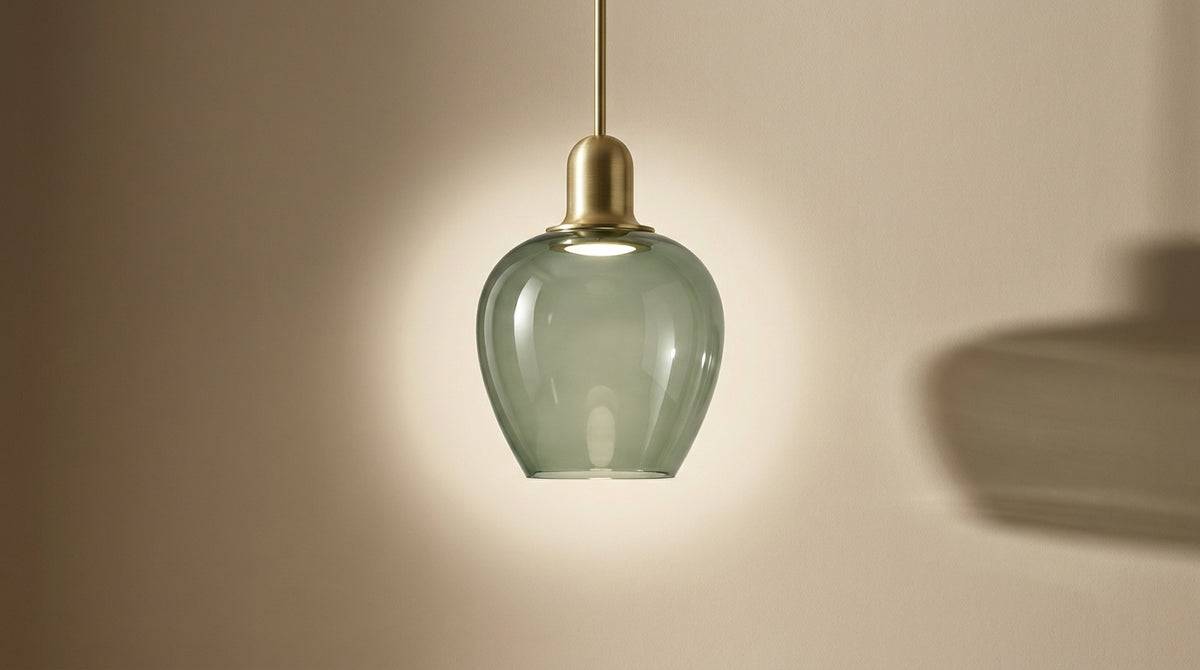
A green lampshade tints the light that comes out: the wall receives a coloured halo, the room changes mood without repainting anything. It is the least risky way to test a strong green, and the easiest to abandon if the shade tires.
Look at green-coloured lampshades, or a amber glass pendant if you want a green warmed by the light rather than a flat green.
If the shade you have in mind does not exist in a standard range, describe your room to us, the wall and the light: we start from your space to frame the project.
Where does your green light fixture go?
What to pair with a green light fixture?
Brass, light wood or beige, never all three together. Green copes badly with competition: one warm material next to it is enough, and two bright colours in the same room cancel it out. The rest must stay neutral so the shade reads clearly.
Green and brass
Brass warms the green, especially on a dark one. The pairing works because the gold sends warm light back onto the painted surface, without ever really lightening it. Be careful though: a bottle green and a very shiny brass in a small dark room give a heavy result.
The models in our range of brass wall lights show this balance well, provided the wall behind them stays fairly light.
Green and wood
With wood, green becomes natural without becoming rustic. A light oak under a sage lampshade, a walnut under an olive: the material absorbs light and prevents the green from cutting too harshly. It is the easiest pairing to get right in an already furnished living room.
To tone down a green that is a little too present, a beige light fixture placed next to it is often enough. And if you hesitate between two eras, these pointers for mixing light fixture styles help avoid a failed combination.
Green light fixtures: the selection to look at closely
 Pendant light | Interlacia
 Pendant light | Nivara
 Pendant light | Ysandre
 Ceiling light | Bruna
 Living room floor lamp | Hyra
 Wall light | Sveva
See the whole selection: Alternative to Luminaire.fr: designer lighting shop | Designix
The real-world result remains the question. Green is checked with a sample in hand, against the wall, switched off then on, because daylight and evening light do not give the same shade. Our selection of designer light fixtures can be browsed shade by shade, and the customer room photos on our Google listing show what a green looks like once placed in someone's home.
In stock · shipping costs shown at checkout · up to 30% off in your cart


Ready to turn inspiration into reality?
Tell us about your room, your style and your budget, and we will show you the pieces that truly suit your project.
Get guidance in 30 seconds →