E14 light bulbs
- Tracked delivery to your country Tracked delivery
- Secure payment at checkout Multiple payment methods
- 14 days to change your mind 14-day returns
- Secure payment Secure payment


Not sure of your style? Find it in 30 seconds
A few questions, and we will show you the pieces made for you.




Frequently asked questions
How do I choose the right product?
What are the delivery times?
Can I return an item?
Can I pay in instalments?

An interior that reflects who you are
Carefully selected pieces, shipped from our warehouses. Our team advises you before you buy, so you choose with confidence.
- Tracked delivery
- Pay in instalments, where available
- 14 days to change your mind
- Advice & showroom in Lyon, France
An E14 bulb screws into a small 14 mm diameter base, the one used by compact light fixtures: wall lights, bedside lamps, pendant lights with a shade, globes and small ceiling lights. Before buying, check the socket of your fixture, then choose the shape and colour temperature that suit the room.
Which light fixtures take an E14 bulb?
The E14 base measures 14 mm in diameter, against 27 mm for an E27. It fits reduced-format fixtures, those whose shade or globe only takes a small bulb. You always choose the fixture first: it dictates the base, the maximum wattage and the available space. Once the fixture is in place, the bulb sets the light. You will find these formats across our full range of light fixtures, and enough to compare bases in the range of bulbs in all bases.
E14 or E27 bulb: how do you recognise the right base?
Measure the thread of the socket: 14 mm means E14; 27 mm means E27. An E14 bulb will not screw into an E27 socket and vice versa, the diameters do not overlap. The visual clue is simple: a small candle or flame shape is almost always E14. To avoid mistakes, compare the two formats in telling E14 and E27 apart.
E14, G9 or G4 bulbs: the other small bases
Not every compact fixture is a screw type. G9 is a small pin base, common on wall lights and slim ceiling lights, and G4 an even smaller pin base, reserved for low-voltage fixtures. Before ordering, look at the socket rather than the size of the fixture: two wall lights of similar dimensions can take different bases. Pin models are grouped in G4 and G9 bulbs.
Which wattage should you choose for an E14 bulb?
The limit does not come from the base but from the socket of the fixture: it carries the maximum wattage, shown on its label or on a label stuck inside the shade. In LED, this selection runs from 1.5 W to 7.5 W, which is enough for everyday home lighting. Stay below the value indicated by the fixture.
E14 40W or 60W bulbs: what should you look at today?
Those references date back to incandescent lighting. An LED bulb of a few watts gives a luminous flux comparable to an old 40 W, with far lower consumption and less heat. The right question is therefore no longer "how many watts" but "how many lumens, and for which room". If you are looking to replace a classic bulb, start from the flux and the colour temperature rather than the wattage.
What is the risk if a bulb is too powerful?
A bulb that exceeds the limit of the socket heats up more than expected. The support, the supply wire and sometimes the shade degrade over time, with abnormal heating as a result. The move is simple: read the maximum wattage printed on the fixture and stay below it, without trying to gain brightness that way.
| Wattage | For which use | Dimmer compatibility |
|---|---|---|
| 1.5 W | Ambience, night light, decorative filament | Depending on the model |
| 2 to 3 W | Wall light, accent lamp, pendant candle | On several models |
| 4 to 5.5 W | Bedside lamp, compact ceiling light, living room wall light | On many models |
| 7 to 7.5 W | Main lighting of a small room | Depending on the model |
What are the different types of E14 bulbs?
Shape is chosen first for the fixture to be dressed, then for the effect you want. A slim silhouette lets light through and shows through a transparent shade; a rounder shape fills a globe and diffuses widely. All the bulbs in this selection are LED, with clear, amber or coloured glass finishes.
E14 candle, flame or spherical bulb: which shape for which fixture?
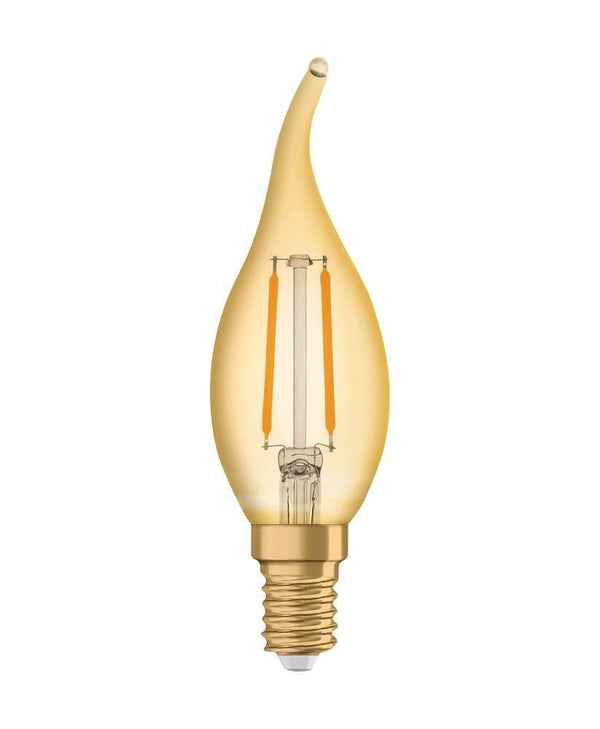
The candle is slim and elongated: it suits wall lights, pendant lights with a shade and multi-point fixtures. The flame, more tapered at the tip, finds its place on candlesticks and dining room pendants. The spherical shape fills globes and bedside lamps. The tube, for its part, goes into linear fixtures and strip lights. To play the decorative card, look at filament bulbs and retro styles.
Amber or clear glass: what light rendering?
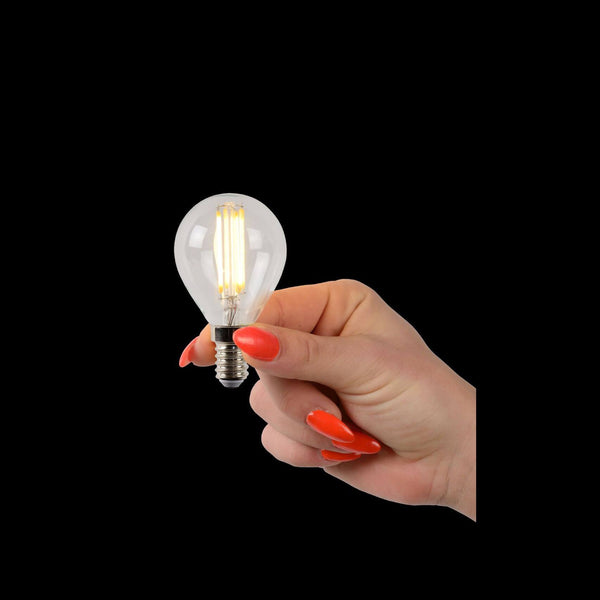
Clear glass lets all the light through: the rendering is sharp, the tint of the light stays as announced. Amber glass filters slightly and warms the light, which suits brass, golden metal or ceramic fixtures. A clear glass globe that shows the filament benefits from a well-finished bulb, such as the E14 candles in amber glass or the 3 W amber bulb. The choice of materials is detailed in glass bulbs.
| Shape | Fixtures concerned | Effect in the room | Temperature available |
|---|---|---|---|
| Candle | Wall lights, pendant lights with a shade, multi-point fixtures | A slim silhouette that lets light through | Warm white |
| Flame | Candlesticks, dining room pendants | An elongated look, close to a real flame | Warm white |
| Spherical | Globes, bedside lamps, compact ceiling lights | A round and even light | Warm white |
| Tube | Linear fixtures, strip light | Light spread over the whole length | Warm white to cool white |
Which light temperature for which room?
Colour temperature is measured in kelvins and describes the tint of the light, not its power. Warm white, around 2700 to 3500 K, gives a golden light close to the old incandescent: it is the reference for the living room, the bedroom and the dining room. Neutral white and cool white light more sharply and suit the kitchen or worktops.
E14 2700K or 3000K bulbs: what is the difference?
The gap is subtle but noticeable: 2700 K leans golden, 3000 K stays warm while being a little sharper. In a bedroom or a living room, either works; 3000 K suits a room where you read or work better. Compare the renderings in our 2700K selection and the 3000K models.
When should you choose an E14 cool white bulb?
Cool white, above 4500 K, gives a very sharp, slightly bluish light. It helps on a worktop, in a hallway or in a utility room where you want to see precisely. In a bedroom, it hardens the mood and tires you at the end of the day. A few models in the selection exist in this tint, including the cool white models.
| Colour temperature | Perceived rendering | Recommended rooms |
|---|---|---|
| Warm white (2700 to 3500 K) | Golden light, close to the old incandescent | Living room, bedroom, dining room, toilet |
| Neutral white (3500 to 4500 K) | Sharp white, with no yellow or blue cast | Kitchen, entrance, hallway |
| Cool white (4500 to 6500 K) | Very sharp white, slightly bluish | Utility rooms, worktops |
How do you know if an E14 bulb is dimmable?
A dimmable E14 bulb carries the dimmer mention on its product sheet and is controlled from a dimmer switch. Not all LEDs are: this is a point to check before buying, not a general feature of the E14 base. A significant part of this selection accepts dimming.
How do you recognise a dimmable E14 bulb?
Look for the mention "dimmable" or "dimmer" in the specifications, not a logo on the box. A non-dimmable bulb wired behind a dimmer does not simply react badly: it can buzz or switch off in fits and starts. Compatible references are grouped in E14 dimmable bulbs and E14 LED dimmable bulbs.
Does the installed dimmer accept an LED bulb?
A dimmer designed for incandescent handles the very low loads of an LED poorly: the light flickers, buzzes or does not go down to the minimum. You need an LED-compatible dimmer, or a suitable module on the installation. The subject goes beyond the choice of the bulb alone and touches on controlling light intensity.
How do you wire 3 bulbs in parallel?
Three bulbs are wired in parallel by connecting the live wires together on one side and the neutrals on the other: each socket then receives the same voltage and the three light normally, regardless of the number of points. This work concerns the electrical installation and is a job for an electrician, not a simple bulb change.
Parallel wiring, step by step
The circuit starts from the supply, the live reaches the first socket then goes on to the second, then the third; the neutral follows the same path on its side. Each socket is therefore supplied directly by the line, and not by the previous bulb. The common switch controls the three points in one move.
Why avoid series wiring?
In series, the current passes through one bulb before reaching the next: the voltage is shared between the points and the brightness weakens, until it becomes uneven from one socket to another. If one bulb goes out, the whole circuit is interrupted. Parallel wiring avoids both effects and remains the reference for several light points on a single switch.
Which E14 bulb should you choose for each room?
You start from the fixture, then from the room. A bedroom wall light calls for a candle or a flame in warm white, a living room globe accepts a spherical shape, a kitchen prefers a sharper light. The material of the fixture also guides the choice: brass and golden metal benefit from a bulb with amber glass.
E14 bulb for living room and dining room
The living room and dining room come alive in the evening: aim for a warm and enveloping light, around 2700 K, with moderate wattage to avoid a spotlight effect. On a multi-point pendant, candles or flames give an even line. Suitable references are in living room bulbs, and the light tints in white coloured bulbs.
E14 bulb for bedroom, kitchen and toilet
In the bedroom, a candle or a flame in warm white suits a bedside lamp or a reading wall light. In the kitchen and toilet, a sharper light helps you see clearly. The style of the fixture also matters: contemporary fixtures go well with simple shapes, as shown by modern bulbs and the bedroom bulbs selection.
What are the drawbacks of LED bulbs?
LEDs consume little for comparable lighting and heat up far less than incandescent. On the other hand, they dislike moisture, sometimes diffuse a more directed light and require a compatible dimmer. The models in this collection are rated IP20, so intended for dry rooms only.
Why does an LED light differently from a classic bulb?
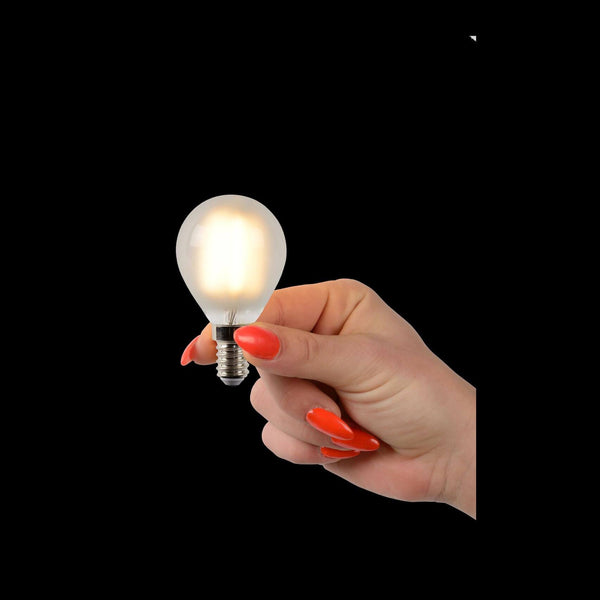
The light of an LED comes from a small surface, whereas a filament lights along its whole length. As a result: depending on the shape of the bulb and the diffuser, the beam can seem more concentrated. A candle or a filament flame, or a frosted glass finish, spreads the light better. See the renderings in LED bulbs.
IP20 rating and damp rooms: what to check
IP20 means the bulb is protected against contact and solid objects, but not against water. It has no place in a bathroom exposed to splashes, nor outdoors without protection. For these uses, look for a higher IP rating on the fixture and bulb sheet before ordering.
Frequently asked questions about E14 bulbs
What is an E14 base?
It is a small screw base 14 mm in diameter, the format of compact fixtures: wall lights, bedside lamps, pendant lights with a shade, globes. It is distinct from the wider E27 base, found on table lamps and large-volume pendants.
What is the difference between E27 and E14?
Both are Edison screw bases: E14 measures 14 mm in diameter, E27 measures 27. The small base fits compact fixtures, E27 fits table lamps, pendants and large-format ceiling lights. An E14 bulb will not screw into an E27 socket.
What is the maximum wattage of an E14 bulb?
It is set by the fixture, not by the base: the socket carries a maximum wattage not to be exceeded. In LED, this selection runs from 1.5 W to 7.5 W, which covers everyday home lighting. Beyond that, the heat puts the socket to the test.
Is it possible to use a 60W bulb instead of a 40W bulb?
Only if the socket of the fixture allows 60 W. With an LED, the question changes nature: you compare luminous flux in lumens, not wattage. An LED bulb of a few watts often replaces a far more power-hungry incandescent bulb.
Which bulb is equivalent to an E14 bulb?
Equivalence is read on the luminous flux in lumens, not on the wattage in watts. An E14 LED bulb of a few watts can replace an incandescent or halogen bulb of the same base, provided it has a comparable flux and the same colour temperature.
What is the risk if a bulb is too powerful?
A bulb more powerful than the socket allows heats up more: the support, the wire and sometimes the shade can degrade, with a risk of abnormal heating. It is enough to stay below the maximum wattage indicated on the fixture.
Which is the most powerful bulb?
In this selection, the most powerful models are 7.5 W bulbs, such as the E14 7.5 W bulb. The right question remains the fixture: its socket sets the maximum wattage not to be exceeded, whatever bulb you choose afterwards.
To go further, the full catalogue of E14 bulbs can be browsed by shape, by temperature and by wattage, and the dimmable models are found in E14 LED dimmable bulbs. Secure payment, tracked delivery, returns and Designix customer service: you order the right reference, and if the base does not match, the exchange stays simple.