Spot design
- Tracked delivery to your country Tracked delivery
- Secure payment at checkout Multiple payment methods
- 14 days to change your mind 14-day returns
- Secure payment Secure payment


Not sure of your style? Find it in 30 seconds
A few questions, and we will show you the pieces made for you.


Frequently asked questions
How do I choose the right light output?
At what height should the light be installed?
What type of bulb?
Compatible with LEDs and dimmers?
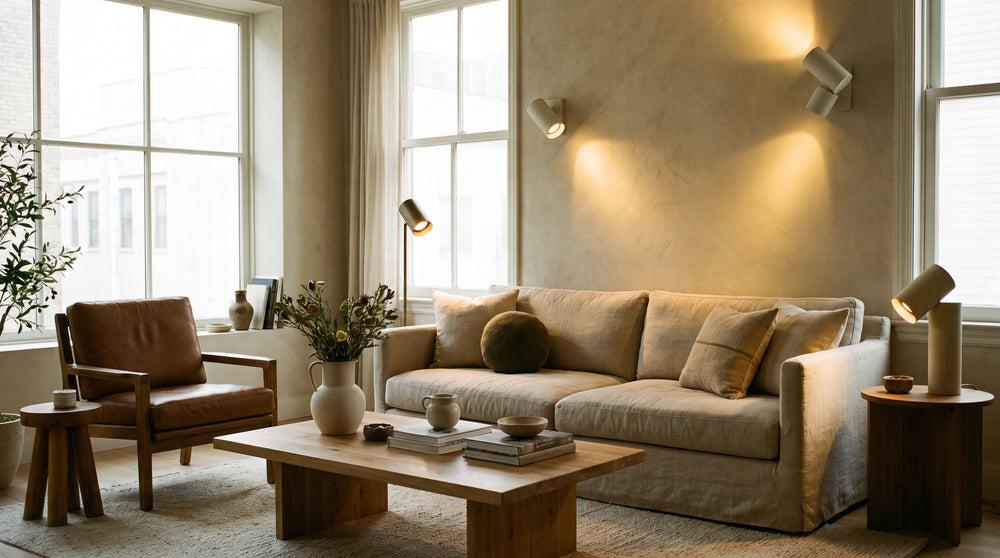
Light changes everything
From statement chandeliers to discreet wall lights, we help you choose the right brightness, height and style for every room.
- Tracked delivery
- Pay in instalments, where available
- 14 days to change your mind
- Advice & showroom in Lyon, France
Designer ceiling spotlights are chosen in this order: the desired light output, the bulb base, then the ceiling mounting. This collection brings together surface-mounted and track spotlights in aluminium, metal, glass, iron or steel, with GU10, E27 or integrated LED, to light a living room, kitchen, bedroom, office or hallway.
- Ceiling or track: the mounting
- Warm white, cool white or your choice of bulb
- Which spotlight for which room
- Recessed, adjustable or wall-mounted
- Colour and material
- GU10, E27 or integrated LED
- Installation and care
- Check before ordering
Designer ceiling spotlight or track spotlight: which mounting should you choose?
The decision comes down to the number of visible points. A line of aligned spotlights breaks up a living room ceiling and is set once and for all; a single spotlight makes more of a statement. The three track models share a compact format and a shallow depth, which makes it easy to space them evenly, with no misalignment from one point to the next.
Designer ceiling spotlight
Fixed directly to the ceiling, the spotlight almost disappears and lets the light do the work. The black track spotlight Losanga plays on a diamond relief, the white track spotlight Texto blends into a pale ceiling, and the Dorvano model with a hammered face asserts a golden presence. The identical format of all three simplifies alignment along the full length of a room.
Adjustable designer spotlight
An adjustable spotlight can be aimed at whatever you want to light: an opening, a worktop, a wall. The Noria cylindrical adjustable spotlight, 11.6 cm, is adjusted by hand; the Nocta spotlight with shutters, 35 cm, frames the beam with its shutters. To compare the families, browse the adjustable models and the rest of the full lighting catalogue.
What light does a designer spotlight give: warm white, cool white or your choice of bulb?
The light comes from the source, not the housing. The Noria with integrated LED comes in warm white 2700-3500 K or cool white 4500-6500 K. GU10 and E27 spotlights take whichever bulb you screw in: the colour temperature is therefore decided when you buy the bulb, not the spotlight.
Designer LED spotlight
Designer LED spotlights cover two approaches. The integrated LED fixes the original light and removes the need to replace bulbs; handy for a room whose mood will not change. A GU10 base, by contrast, leaves every option open. The all designer LED spotlights range brings these solutions together, and dimmer control lets you adjust the intensity according to the time of day.
Designer halogen bulb: what switching to LED changes
Nothing to change on the spotlight: you replace the designer halogen bulb with an LED bulb of the same base, GU10 or E27. The light stays adjustable in the shade you want, and the bulb no longer heats the face of the fitting. On a fixed spotlight as on an adjustable model, the swap is done without dismantling the housing.
Which designer spotlight for the living room, kitchen or bedroom?
In the living room, you align several points and let the spotlight blend into the ceiling. In the kitchen, the beam turns towards the worktop. In the bedroom and office, you look for a soft, directed light. In the bathroom, stay with IP20, away from water spray.
| Model | Material | Base | Format | Colour | Recommended room | Style |
|---|---|---|---|---|---|---|
| Losanga | Aluminium | GU10 | Ø 6 cm, depth 13 cm | Black | Living room, kitchen | Contemporary |
| Texto | Aluminium | GU10 | Ø 6 cm, depth 13 cm | White | Living room, kitchen | Contemporary |
| Dorvano | Aluminium | GU10 | Ø 6 cm, depth 13 cm | Black | Living room, kitchen | Contemporary |
| Nocta | Metal, glass, iron, steel | E27 | 35 cm | Black, grey | Living room, bedroom, kitchen, office | Contemporary, industrial, vintage |
| Noria | Metal, aluminium | Integrated LED | 11.6 cm | White, black | Living room, bedroom, kitchen, bathroom | Contemporary, nordic |
Designer kitchen spotlight
In the kitchen, the spotlight is there to see what you are cutting. A directed beam beats a diffuse light: the spotlights designed for the kitchen are fixed above the worktop, and the modern versions for kitchens make do with a short line. The adjustable Noria and the Nocta with shutters both meet this need.
Designer spotlight for bedroom and office
In a bedroom, the light should not fall straight into your eyes: favour a model aimed at the wall or a reading corner. For the office, the beam is set on the worktop. The bedroom spotlights and living room lighting share this logic of a directed point rather than a uniform ceiling. In a narrow passage, hallways and passages need only two or three aligned points.
Recessed, adjustable or wall-mounted designer spotlight: how do you tell them apart?
These families do not compete, they answer three situations. A recessed spotlight sits in the ceiling and disappears. A surface-mounted or track spotlight stays visible and becomes part of the decor. A wall spotlight lights a vertical surface. This selection brings together surface-mounted and track spotlights.
Recessed designer spotlight
A recessed spotlight requires a cut-out in the support, which means a suitable ceiling. The result hides the fitting entirely, leaving only the cone of light. The recessed ceiling spotlights and their versions dedicated to the living room cover this need, including in black recessed.
Wall-mounted designer spotlight
Fixed to a wall, the spotlight lights a vertical plane: worktop, headboard, picture. It is chosen for the surface it has to make readable, not for the ceiling. The white adjustable models suit pale walls, and an outdoor version is needed as soon as you leave the room.
Which colour and material should you choose for a designer spotlight?
The starting point is the ceiling as it is. A pale ceiling calls for white, which fades into it; a dark ceiling takes black, which underlines it. Grey stays discreet anywhere. The colour is therefore not chosen on its own, but always against the surface that carries it.
Black or white designer spotlight?
Black draws a clean line on the ceiling and structures a large volume. White is less noticeable and suits low or pale ceilings. The matte black version and the white finishes let you decide on this single criterion, before even talking about light.
Metal or aluminium spotlight?
Aluminium dominates this selection: it lightens the body of the spotlight and goes unnoticed. Metal, glass, iron and steel play a more industrial register, visible on the Nocta. The metal spotlights assert this presence, while the modern models stay on simple lines.
Which base for a designer spotlight: GU10, E27 or integrated LED?
Three solutions, three uses. The GU10 base equips ceiling and track spotlights, with a replaceable bulb. The E27 base takes a wider bulb, including filament. The integrated LED cannot be changed: source and fitting are one, which fixes the light from the moment of purchase.
| Source | Replaceable bulb | Stated power | Light temperature | Models concerned | To favour when |
|---|---|---|---|---|---|
| GU10 base | Yes | 10 W | Depending on the bulb fitted | Losanga, Texto, Dorvano | You want to align several spotlights |
| E27 base | Yes | 40 W | Depending on the bulb fitted | Nocta | You want a spotlight with shutters and a wide or filament bulb |
| Integrated LED | No | 12 W | Warm white 2700-3500 K or cool white 4500-6500 K | Noria | You want an adjustable spotlight with no bulb to change |
Designer spotlight with GU10 bulb
The GU10 is the most common base in the selection: it equips the three track spotlights. You screw in the power and shade of your choice, and replace it without tools. It is the flexible solution when a room changes use, or when you want several points matched to the same shade.
Designer spotlight with integrated LED
The integrated LED removes the question of the bulb. The Noria is the example: source included, manual adjustment and two temperatures available as standard. It is the choice for a room whose mood is already settled, and the natural entry point to adjustable LED spotlights.
How do you install and care for a designer spotlight?
All the models in the collection are IP20, so intended for dry interiors, away from water spray. Care is limited to a soft cloth: no abrasive product on a hammered face or on glass. On an adjustable model, set the orientation before tightening, then check that the light falls where you want it.
IP20 designer spotlight: what that implies
IP20 means the fitting is protected against solid objects and nothing more: no water jet, no condensed moisture. It is therefore installed away from a bath or shower, above a unit rather than directly over a water point. In the kitchen, keep it away from the sink for the same reason.
Adjusting and cleaning an adjustable spotlight
Adjustment is done with the spotlight off: turn the head towards the area to be lit, tighten, then switch back on to check that no shadow falls on the worktop. For cleaning, a soft cloth is enough on aluminium; avoid harsh products on glass and hammered finishes.
How can you be sure of your choice before ordering?
Three checks are enough: the format of the support, the base you want and the colour of the ceiling. Payment is secure, delivery is tracked and returns are provided for. Designix customer service answers questions on base, orientation or colour before the order, with no obligation to buy.
Check the base and format before ordering
First note the base you want, GU10 if you want to choose your bulbs, E27 for a wide bulb, integrated LED if you no longer want to think about it. Then check the dimensions: Ø 6 cm by 13 cm deep for the three track spotlights. For the Nocta and the Noria, the dimensions are given on their product page.
Designix customer service
A hesitation between two colours, a question about orientation or bulb compatibility: customer service answers before purchase. To widen your search, compare the designer LED spotlight range and the whole lighting universe.
Frequently asked questions
How do you choose a designer spotlight for the kitchen?
In the kitchen, you want a spotlight that lights the worktop without dazzling. The track models with GU10 bases align on the ceiling, such as Losanga, Texto or Dorvano, and the adjustable cylindrical Noria lets you direct the beam. All are IP20, so suited to a dry indoor kitchen.
Which designer spotlight should you choose for a living room ceiling?
You choose the effect first: a black spotlight underlines a ceiling, a white one fades into it. The three track models, Losanga, Texto and Dorvano, share the same Ø 6 cm format and a depth of 13 cm, which makes it easy to align them evenly along the full length.
Which designer LED spotlight uses the least?
It all depends on the source. The GU10 spotlights, Losanga, Texto and Dorvano, the Noria cylindrical with integrated LED, and the Nocta shutter spotlight with an E27 base draw power according to the bulb fitted. On GU10 and E27 bases, a lower-power LED bulb can be screwed in.
Can a designer spotlight replace a halogen?
Yes, in most cases. The GU10 and E27 spotlights in the collection take a bulb you screw in: you simply replace the designer halogen bulb with an LED bulb of the same base. The Noria cylindrical spotlight, however, already has an integrated LED, with no bulb to change.
Can a designer spotlight be installed in a bathroom?
The models in the collection are IP20, a rating that corresponds to dry interior rooms. In a bathroom, they are therefore placed outside water spray zones, for example above a unit or away from the bath. The Noria cylindrical spotlight is the model in the selection to aim for in this room.