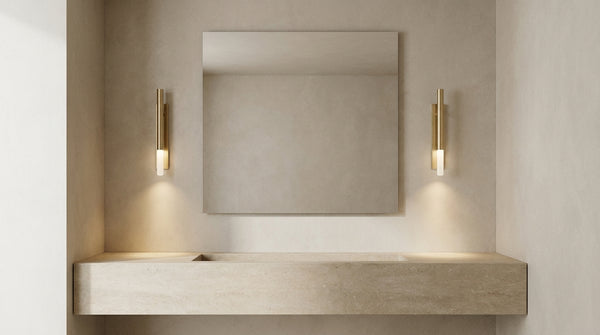
Studio lighting: layering light in a small studio
This article is also available in French: Éclairage studio
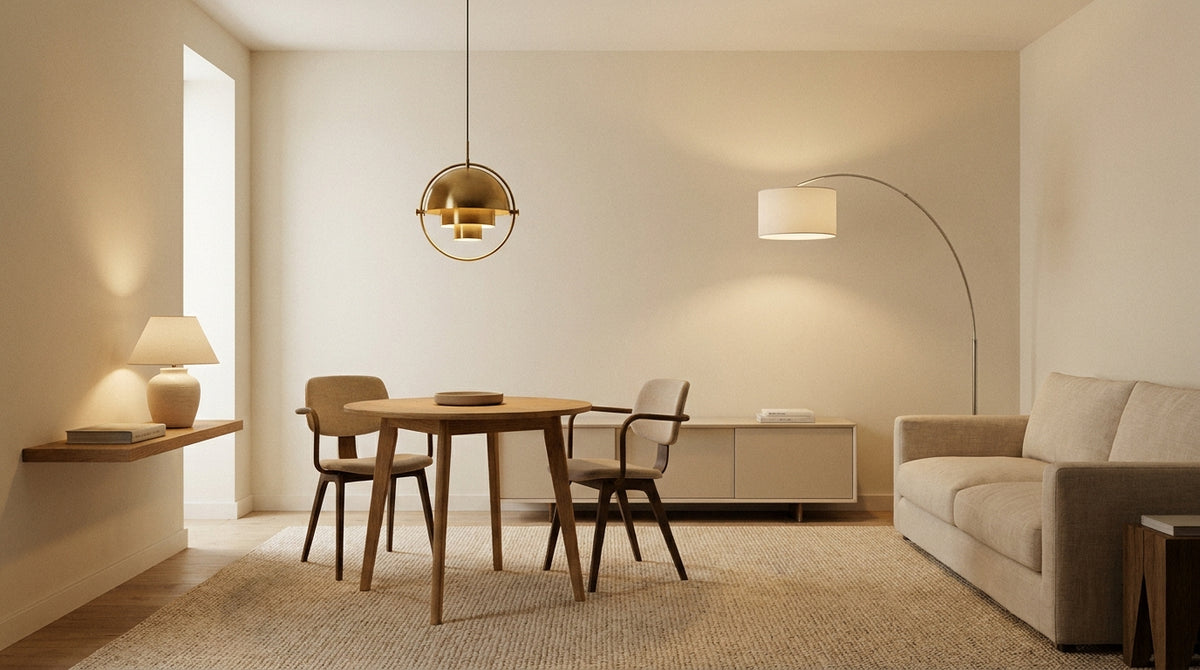
Plan for three sources, not one: general overhead light, an adjustable wall light above the desk or sofa, and a low light for the evening. In a studio of 20 to 30 m², what changes everything is not the number of fixtures but the layering of light, the mounting height and the colour of white.
A studio should be treated as a living room, not a corridor: each zone has its own time and intensity. That is the starting point for a bedroom and office lighting project, where use decides the fixture and never the other way round.
What lighting for a living studio under 30 m²?
Aim for layering rather than power: general light on the ceiling or in a high wall light, an adjustable task light, a low lamp for the evening. A 25 m² studio works with three well-placed sources, provided you can dim the intensity when night falls.
A ceiling light is not compulsory, but it sets the volume. Chosen low and diffused, it avoids the spotlight effect that crushes a single room. The diameter and height guidelines for a ceiling light for a small living room apply as they are under 30 m².
How much light for 20 to 30 m²?
The right benchmark is not watts but total lumens across the room. A studio can take a generous general light and two softer points, provided everything can be dimmed in the evening. The surface calculation is detailed in how many lumens for a living room.
- 2700 K: in the evening, a light that turns neither the screen nor a face blue
- 3000 K: the safest value for a single room used for everything
- 4000 K: above the worktop, never in line with the sofa
- Dimmer: the equipment that changes a room in the evening without redecorating
Which sources when there is no ceiling light?
An older studio with no ceiling point is not condemned to a desk lamp. A high wall light, an arc floor lamp or a pendant on an existing hook work around the constraint. The possible setups are detailed in how to light a room without a ceiling light.
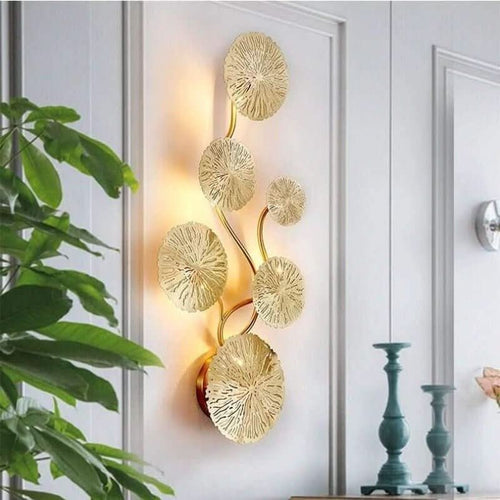
A living room wall light fixed at 1.80 m replaces a ceiling light without taking up floor space, and it lights the wall rather than the void. The collection has 13,539 references as of 18 November 2026, from wired models to connected wall lights.
What lighting for a photo studio or a home video call?
A main source at three-quarters facing you, plus a fill light that opens up the shadow on the opposite side. That is all. Colour temperature matters more than power, because a camera handles a face lit too cool or too frontally poorly.
Fixtures to layer light in a studio
 Wall light | Heor
 Wall light | Zenena
 Wall light | Flovena
 Wall light | Sveva
 Wall light | Bastia
 Wall light | Tubara
See the full selection: Wall lights, Wall Lamps and Designer Wall Lighting
Which bulb for a photo studio?
A 3000 K bulb behind a wide shade gives more accurate skin than a 6500 K one that turns blue. The source should be large and never bare in line with the face: it is the lit surface that softens the shadow, not the power.
| Temperature | Rendering | Where to use it |
|---|---|---|
| 2700 K | warm, flattering | fill lamp, late evening |
| 3000 K | warm neutral | main source of a photo corner |
| 4000 K | white, drier | worktop, retouching |
| 6500 K | cool | avoid on a face |
A stock of 3000 K E27 bulbs is enough for three fixtures and moves from one room to another. Across a sample of 247 listings in our catalogue as of 18 November 2026, 67% carry the LED label and 100% the CE certification: the technology is no longer a selection criterion, the tint is.
Between warm white and cool white, the trap is not the tint but mixing them in the same room. The full comparison is in white or yellow light, how to choose.
What lighting for video conferencing?
Place the source in front of you, never behind: a window at your back turns your silhouette into a shadow puppet. An adjustable desk lamp diffused through a shade is enough for an hour-long meeting.
- Facing the window, never with your back to it, even for a morning call
- At eye level, not above the brow where it hollows the eye sockets
- One dominant source, the rest as weak fill to open up shadows
The height of the source matters more than its power. A task light directed at the face, placed at screen height, fixes half the complexion problems in a video call.
How to diffuse light without buying photo equipment?
A linen, paper or rattan shade does exactly the job of a diffuser: it enlarges the source and breaks the hard point. The larger the lit surface, the softer the shadow and the closer the result looks to a window.
A linen shade on a lamp already in place changes the look of a photo corner without adding a single device.
Photo studio pricing and rental: what really drives the bill
It is not the lamps. It is the floor area and ceiling height, the backdrops and paper, equipment insurance, electricity, and then retouching time. When renting, a tall empty room costs more than an equipped one, because it allows more framing options.
Which studio case is yours?
What budget for a photo studio?
A budget is built in three lines, and the order matters more than the total:
- What you rent: floor area, backdrops, flashes, by the hour or by the day
- What you buy once: the room's fixtures, bulbs, shades
- What you consume: paper, gels, electricity
- What you forget: retouching time and storing the equipment
How to reduce the cost of a photo studio?
Less equipment, better placed, always costs less than more equipment badly distributed. A room equipped for both living and photographing pays for itself twice, and evening light becomes a use in its own right. That is where ambient lighting stops being a detail.
Unsure which colour temperature to choose? Write to the team from the contact page stating the floor area and the use of the room: the answer is worth more than another table.
How to light a studio without drilling or rewiring
Three families of solutions: rechargeable fixtures that sit far from any outlet, pendants on an existing hook, battery bulbs that transform a lamp already in place. None requires chasing walls, and all can be moved when the room changes use.
How to fix a wall light without drilling?
The wall decides for you: plaster, brick, concrete or drywall do not take the same fixing. The methods are detailed in fixing a wall light without drilling.
- Weight: a light wall light holds with adhesive fixing, beyond that you drill
- Support: a hollow drywall needs a toggle anchor
- Cable: a wireless model removes the wiring problem
If drilling into a rented wall stops you, installation feedback on the Designix Google listing often settles the doubt better than a tutorial.
Which no-work solutions for movable light?
A battery wall light comes off on moving day, a rechargeable floor lamp follows from sofa to table, a portable bulb transforms a lamp already in place.
| Solution | What it requires | Where it works best |
|---|---|---|
| Wireless wall light | a flat wall, a recharge | headboard, above the desk |
| Rechargeable floor lamp | no connection, 2 to 3 kg on the floor | reading corner, coffee table in the evening |
| Pendant on a hook | an existing hanging point | centre of the room, above a table |
A wireless wall light suits a wall that carries nothing, and recharges like a phone. Across a sample of 247 listings as of 18 November 2026, 90% are IP20, which is enough in dry interiors.
The rechargeable floor lamp, meanwhile, solves the desk corner blind spot without running a cable. For the low evening light, a battery bedside lamp avoids the cable crossing the room and moves from bedside to sofa.
In stock · shipping costs shown at checkout · up to 30% off in your cart
Ready to turn inspiration into reality?
Tell us about your room, your style and your budget, and we will show you the pieces that truly suit your project.
Get guidance in 30 seconds →