Bathroom lighting standards: the right IP rating, zone by zone
This article is also available in French: Norme éclairage salle de bain
In zone 1, shower and bathtub, no 230 V: a sealed 12 V spotlight, IP65. Within 60 cm around it, an IP44 wall light is enough. Everywhere else, a ceiling light or a standard illuminated mirror, and one spotlight per 1 to 1.5 m², so 4 to 5 for 5 m².
What lighting for a bathroom?
Three sources, not one: a ceiling light or spotlights for general light, a wall light or illuminated mirror for the face, a low point for the night. The NF C 15-100 standard only sets the zones where 230 V is forbidden. The rest is about visual comfort.
When the circuit has to change, the light fixture comes too early in the conversation. A bathroom renovation project handles the electrics before the finishes: you set the volumes, run the cables, fit the boxes, and the model is chosen afterwards.
- General light: several points spread out, never a single one in the centre of the ceiling
- Face light: wall light or illuminated mirror, at eye height
- Accent light: low wall light or strip, to avoid switching on the whole room at night
- Zone 1: 12 V only, transformer placed outside the zone
How to position your bathroom spotlights?
Align them on the circulation axes and above the vanity top, not at random across the surface. Two parallel rows in a wide room, a single line in a narrow room. Keep 1 to 1.5 m between two spotlights and at least 20 cm from the wall, otherwise the halo gets cut off.
Recessed fitting is decided before painting: a spotlight goes into a false ceiling or a hollow slab, never into a solid partition without a reserved opening.
Direct lighting: definition, and what it changes above the mirror
Direct lighting sends the flux towards the surface to be lit, without bouncing off the wall or ceiling. Above the mirror, that gives a sharp, contrasted face, with shadows under the cheekbones. Backlighting does the opposite: it softens everything, including tired features.
| Direct | Indirect | |
|---|---|---|
| Rendering | Sharp, contrasted | Soft, shadow-free |
| Where | Wall light above the mirror, spotlights | Backlit mirror, strip, cornice |
| Use | Shaving, make-up | Ambience, bathing |
The rest comes down to low sources and a dimmer: that is what sets a spa-style bathroom apart from a room that is merely well lit.
What IP rating for a bathroom?
IP44 in zone 2, meaning the 60 cm around the shower or bathtub, and IP65 in zone 1. Outside these zones, IP20 is enough, but IP44 handles the humidity of a room without a window better. The first digit protects against solids, the second against water.
What is the IP44 standard?
IP44 means: protected against solid bodies larger than 1 mm and against water splashes from all directions. That is the level the bathroom lighting standard requires in zone 2. It withstands splashes, not a direct jet.
Out of a sample of 126 wall lights from our catalogue as of 19 November 2026, 74% are IP44, 16% are IP54, 7% are IP65 and 2% are IP45.
The level 4 does not restrict style, it frames it. IP44 wall lights with a spa feel rely on frosted glass and brushed brass, two materials that age well in a damp room.
IP44 or IP65: what to choose in the shower?
IP65 in zone 1, above the shower tray up to 2.25 m high, because the shower head jet comes from the front. IP44 from 60 cm from the edge, where only splashes fall back. The 65 seals the fixture more tightly, which is barely visible and easily forgiven.
- Zone 0: inside the bathtub or shower tray, very low voltage 12 V, IP67
- Zone 1: up to 2.25 m above the shower tray, 12 V and IP65, transformer outside the zone
- Zone 2: 60 cm around zone 1, 230 V allowed with IP44
- Zone 3: the rest of the room, IP20 sufficient, IP44 safer in a damp room
In zone 1, voltage matters as much as the rating: a 230 V fixture is forbidden there even in IP65. The choice therefore comes down to 12 V, with an accessible transformer for maintenance. Everything is detailed in this guide to the IP65 light fixture.
Conversely, zone 2 accepts 230 V, and that is where most of the decorative choice happens. If the partition is close to the shower tray, IP65 bathroom wall lights remain the safe bet.
Two details fail more often than the IP rating itself: the missing seal behind the wall light and the cable hanging out of the box. The lighting mistakes that ruin a bathroom almost all come down to these finishes.
What spotlight for a bathroom?
A recessed spotlight, adjustable above the vanity top, 12 V in zone 1 and 230 V elsewhere. Choose a model with integrated LED or a GU10 base, with a beam narrow enough not to dazzle when leaning towards the mirror. Sealing matters more than power.
How many spotlights for a 5 m² bathroom?
Four to five spotlights spaced 1 to 1.5 m apart, arranged in a cross around the centre of the room. Two go over the vanity top, the others light the shower and the circulation. A single central point leaves the corners in shadow and hollows out the face.
How many spotlights per m² in a bathroom?
One spotlight per 1 to 1.5 m², so 4 to 5 for 5 m² and 7 to 8 for 10 m². The calculation is done in lumens rather than watts: aiming for 200 to 300 lumens per m² gives a clear level without dazzling. Then allow 2700 K to 3000 K to keep a warm light.
- Spacing: 1 to 1.5 m between two spotlights
- Partition edge: 20 cm minimum to avoid a cut halo
- Temperature: 2700 K to 3000 K, never 6500 K in front of a mirror
- Zone 1: 12 V and IP65, without exception
A corridor-shaped room needs one more line, not more powerful spotlights. The number of spotlights per m² is calculated on the usable surface, removing low furniture.
Size matters too: a recessed bathroom spotlight is chosen in a diameter that suits the ceiling and the available depth, not the fashion of the moment.
If the circuit has to change before choosing the fixture, start by telling us about your bathroom project: we define the volumes before talking about models.
Where is your bathroom lighting problem?
What light fixture for a bathroom?
Three families are enough: the wall light near the mirror, the ceiling light or pendant for general light, the illuminated mirror when no wall is suitable for mounting. The wall light remains the most versatile, provided you respect the IP rating of the zone it falls in.
How to light a bathroom mirror?
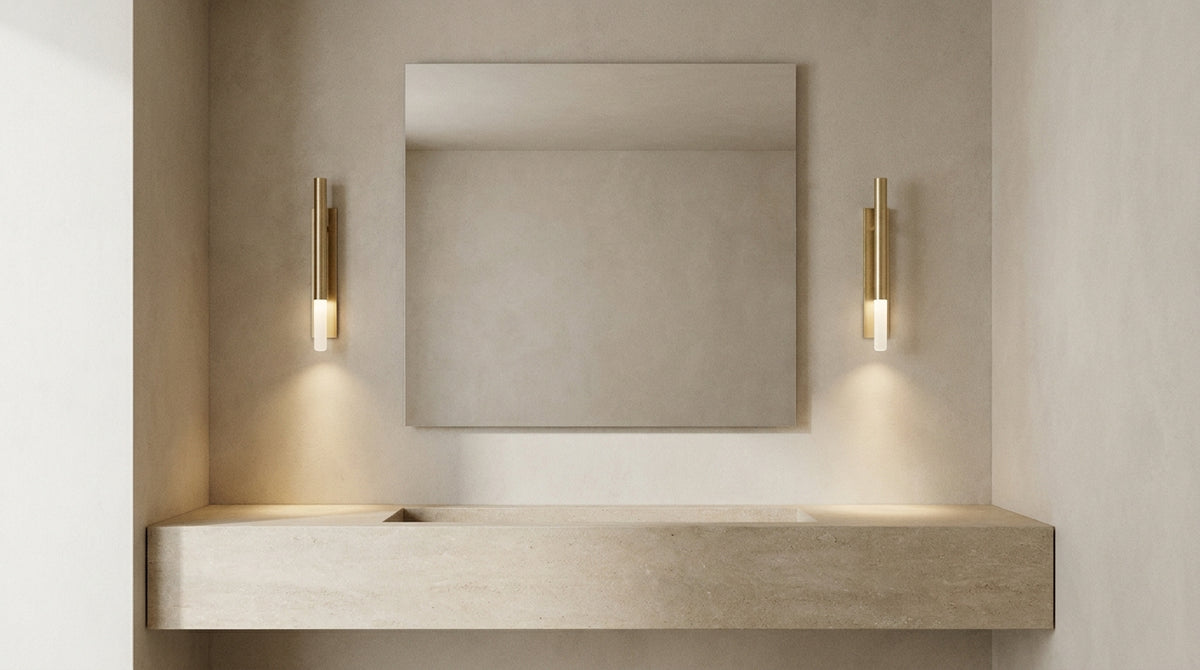
Two wall lights on either side are better than a single one above: the face is lit from both sides, with no shadow under the nose. Place them at eye height, around 1.60 m, and centre the mirror on the same line. The height of a wall light is set by the user, not the room.
If the partition is less than 60 cm from the shower tray, switch to IP65. Otherwise, IP44 wall lights are enough, and the choice opens up to round or tube shapes.
Wall light, ceiling light or illuminated mirror: the right choice by zone
| Zone | Fixture | What it brings |
|---|---|---|
| Vanity top | Wall light or illuminated mirror | Sharp face, no shadow |
| Centre of the room | Ceiling light or spotlights | General level |
| Zone 1 | 12 V IP65 spotlight | Shower lit safely |
| WC and sleeping corner | Low wall light | Night light, without dazzling |
In the centre, an LED ceiling light covers a compact room without taking up height. Its diameter is chosen in proportion to the surface, not the style of the house.
Under a high ceiling or above a freestanding bathtub, a bathroom pendant brings the light down to a useful level. The line must then be brought up to the ceiling, which is decided before the work.
Near the mirror, LED bathroom wall lights avoid changing a bulb in an area where you have to stand on a stool. The LED base also clearly dominates the product listings.
The Bathroom Wall Light collection has 545 references as of 19 November 2026. Out of a sample of 126 of these listings on the same date, 73% show a two-year warranty, 58% are LED and 19% are G9.
Product listings are reviewed by buyers; the workshop reviews can be checked with one click on the Designix Google listing.
Bathroom light fixtures that meet the standard
 Outdoor light fixture | Luminance
 Gallery LED wall light in metal, chrome, height 5 cm, IP44
 Marylin LED wall light in aluminium, matte gold, height 4.2 cm, IP44, 3000 K, 24 W
 Opaline LED wall light in steel, black and white, height 50 cm, IP44
 Baleva LED wall light IP44, white, height 6 cm, IP44, 15 W
 Baleva LED wall light IP44, white, height 6 cm, IP44, 10 W
In stock · shipping costs shown at checkout · up to 30% off in your cart
Ready to turn inspiration into reality?
Tell us about your room, your style and your budget, and we will show you the pieces that truly suit your project.
Get guidance in 30 seconds →