Bookshelf lighting: the right light, shelf by shelf
This article is also available in French: Éclairage bibliothèque
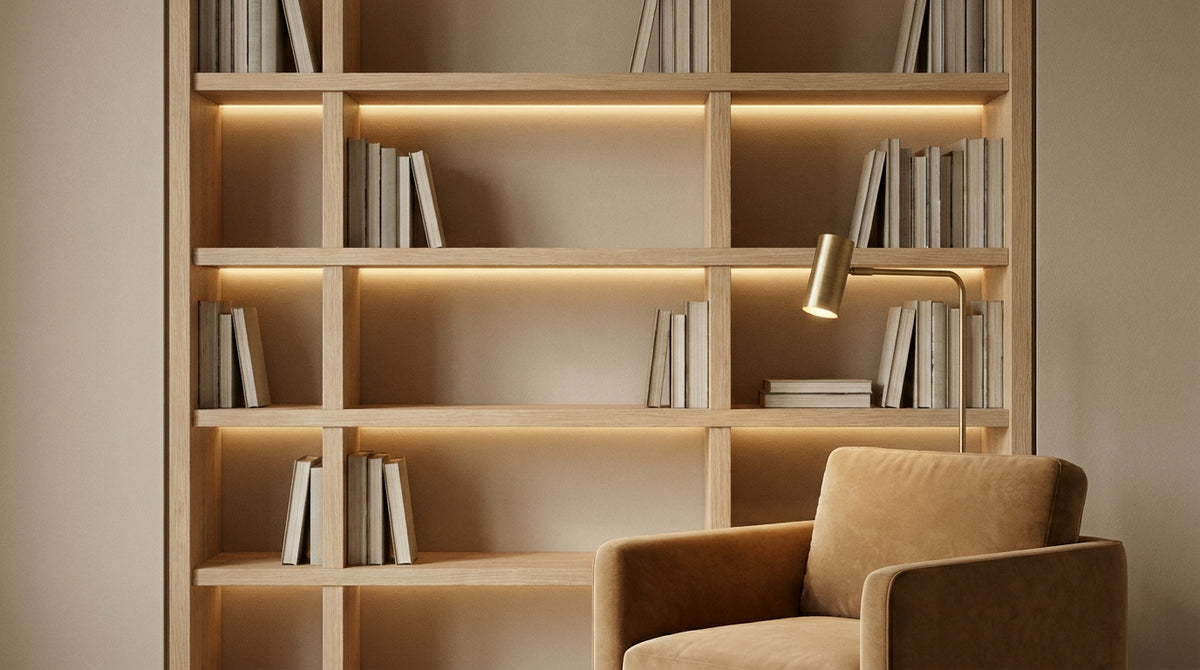
Plan for three layers: a 3000 K LED strip stuck under each shelf, set back 2 to 3 cm from the front edge, a reading wall light at shoulder height above the armchair, and a discreet halo above the unit. The strip lights the spines, the wall light lights the pages, the halo keeps the bookcase from becoming a dark mass.
How do you light a bookcase?
Three sources are enough, each with a role. An under-shelf LED strip lights the spines without heating them, a reading wall light sits at shoulder height for reading, and a soft halo above the unit lifts the bookcase out of the shadows. Stacking sources without hierarchy tires the eye and blurs the titles.
When the unit is part of a study or a bedroom, plan the bedroom and study lighting project before drilling the first hole. Power points and heights are decided on the plan, not once the shelves are full.
| Solution | Where to place it | What it solves |
|---|---|---|
| 3000 K LED strip | Under each shelf, 2 or 3 cm from the front edge | Lights the spines without glare on the pages |
| Reading wall light | At shoulder height, on the armchair side | Focuses the light on the open page |
| Adjustable spotlight | At the top of the unit, angled forward | Makes objects and pale bindings stand out |
What lighting for reading?
A directed beam of 300 to 500 lumens, at shoulder height and adjustable, rather than a distant ceiling light. The light should fall on the page, never into the eyes. An articulated arm or an adjustable wall light sets the angle with one turn, without leaving the armchair.
The principle is the same as for task lighting: a nearby source, a narrow cone, a moderate output. Nothing to do with the room's general lighting.
- Height: 1.10 to 1.30 m from the floor, at the shoulder of a seated person
- Direction: towards the page, never towards the face
- Dimmer: useful, evening reading does not call for maximum output
- Reach: an articulated arm covers two neighbouring shelves
Reading wall lights are fixed to the upright of the unit and adjusted once and for all. On a freestanding shelf, a floor reading lamp does the same job without drilling.
From a survey of 247 wall lights in our catalogue on 17 November 2026, 90% are rated IP20, 67% are described as LED and 91% carry a 2-year warranty. The wall light collection contains 13,539 references on the same date, articulated reading lights included.
How do you light the inside of a bookcase?
A self-adhesive LED strip under each shelf, powered at 24 V, set back 2 to 3 cm from the front edge. That setback prevents glare from the front and stops the strip from heating against the pages. The rest is a matter of profile and colour quality.
- Aluminium profile rather than a bare strip, to stiffen the line and diffuse the light points
- 3000 K to stay on a warm white consistent with the rest of the room
- 24 V once the length exceeds a few metres, voltage drop is less visible
- Hidden power supply behind the upright or under the unit, never on the bottom shelf
The third layer stays discreet: a source that grazes the top of the unit and lets the room breathe. That is the logic of a living room and family room lighting project, where each light point has a function and none takes over the whole space.
Which colour temperature, and which type of lighting should you avoid?
3000 K for a bookcase: a warm white that keeps paper believable and wood warm. Below 2700 K, bindings turn orange. Above 4000 K, paper looks clinical and gold tooling turns blue.
Which colour temperature should you choose?
One temperature for the whole unit, and the same as the room when the bookcase opens onto the living room. Mixing temperatures turns a wall of books into a chequerboard.
- 2700 K: very warm, best kept for an already amber-toned room
- 3000 K: the right benchmark, warm without turning yellow
- 4000 K: neutral, to avoid on ivory paper and leather
The subject of colour tones is covered in detail in our article on white or yellow light. Once the tone is set, the base remains to be chosen. On the same survey of 247 wall lights on 17 November 2026, E27 accounts for 31% of listings, E14 for 15% and G9 for 13%, with the characteristic declared on 222 of the 247 listings.
3000 K bulbs cover all three formats. Our guide to bulb types and bases helps you decide when the product listing is silent.
Which type of lighting should you avoid?
Halogen and strips without a diffuser. The first heats the books and dries the glue in the bindings, the second shows every light point like a bead on the wood. A single ceiling light, far from the unit, misses its target for the same reason.
- Halogen: direct heat against pages and spines
- Bare strip: each LED is visible, the continuous line effect disappears
- Cool white beyond 4000 K: paper whitened, leathers greyed
- Single source on the ceiling: the unit stays in the armchair's shadow
Wireless or rechargeable bookcase lighting: what really holds up?
A rechargeable wall light suits a rented shelf or a unit with no power supply. It lasts a few hours in continuous use, much less if the sensor triggers on every pass. For two hours of daily reading, a wired fitting remains more reliable and a 24 V strip more consistent.
How do you install an LED in a bookcase?
The strip is stuck under the shelf, set back from the edge, on an aluminium profile, and the power supply is hidden behind the upright. Allow one socket per bay or a shared transformer, plus a switch within reach from the bottom of the unit.
- Locate the cable route in the upright, on the wall side, so it disappears behind the books.
- Stick the strip under the shelf, 2 or 3 cm from the front edge, on its profile.
- Group the transformer behind the unit and bring the switch down to the bottom.
- Switch on, step back three paces, correct the direction before filling the shelves.
The method for an LED strip fitted under a kitchen unit applies as it stands, with one big difference: pages are more fragile than tiles and dislike both heat and contact.
Unsure about the height of the wall light or the place for the transformer? Ask the team: we answer on your plan, before you buy.
What lighting for a closed unit or a cupboard?
A wall light or a strip with a motion sensor, which switches on when the door opens and off by itself. In a closed volume, the light should stay short and lateral, otherwise it bounces off the door and tires the eye within seconds.
- Sensor: on when opened, automatic switch-off
- Switch at the bottom of the upright if the sensor becomes annoying
- Rechargeable when no socket can be brought in
- IP20 is enough indoors, humidity is not the issue
Rechargeable LED wall lights are fitted without an electrician and charged by USB, which solves the case of old units moved from home to home.
Your bookcase: where do you start?
Why are library lamps green?
Because green-tinted glass, long held to rest the eyes, equipped the first desk lamps in reading rooms. The habit outlived the reason: green signals studious reading faster than any white shade. The nod costs less than a whole library.
Where does this green come from, and how do you use it without the cliche?
Green works in small touches: a shade, a base, a wall light. Across a whole unit, one real drawback has to be considered. Opaque green glass filters out reds, and a burgundy binding turns dark brown under its halo.
A green shade on a table lamp, beside the armchair, is enough to give the signal. The rest of the unit stays in brass, black or off-white.
Lamps and wall lights to light a bookcase
 Wall light | Heor
 Wall light | Zenena
 Wall light | Flovena
 Wall light | Sveva
 Wall light | Bastia
 Wall light | Tubara
See the whole selection: Wall lights, Wall Lamps and Designer Wall Lighting
Before ordering, three checks are worth more than a fourth hesitation: the length of strip, the height of the wall light and the bulb base. Our guide to choosing your lighting wisely, room by room covers these points, source by source.
In stock · shipping costs shown at checkout · up to 30% off in your cart


Ready to turn inspiration into reality?
Tell us about your room, your style and your budget, and we will show you the pieces that truly suit your project.
Get guidance in 30 seconds →