Recessed lighting: choosing and installing it without mistakes
This article is also available in French: Luminaire encastrable
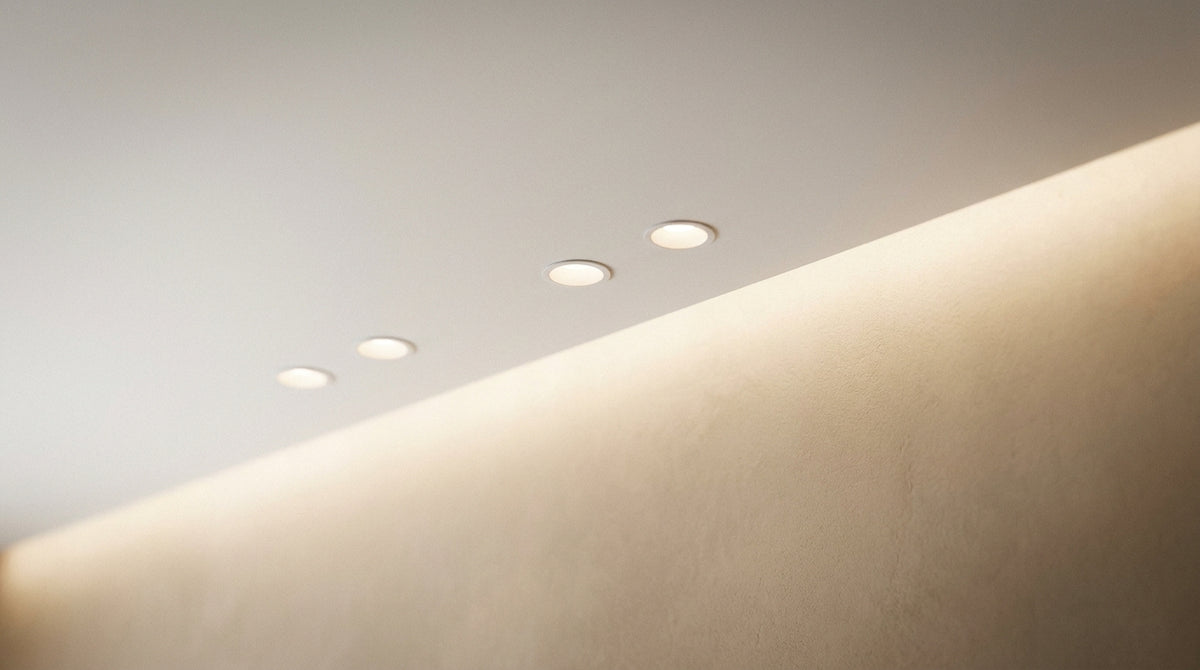
Allow one recessed light per 1 to 1.5 m² of ceiling, without scattering them at random: a fixed one for an even grid in a hallway, an adjustable one above a worktop or a picture. Before settling on the model, decide the room and the IP rating, because that is what limits the choice.
How do I choose my indoor recessed spotlight?
One criterion decides it, and it is not aesthetic: the clear height between the finished ceiling and the structure above. Under 4 cm, only an ultra-slim model fits. Above that, the whole catalogue opens up.
Ultra-slim spotlight when clear height is short
Renovation suspended ceilings often leave 3 to 5 cm. An ultra-slim model fits there without cutting the slab, and that is what saves a project when the service duct runs just behind.
- Clear height under 4 cm: go for ultra-slim, with a reduced recess depth
- New suspended ceiling: 8 to 10 cm of space opens up every format
- Solid concrete slab: no recessed light, use a surface-mounted fixture
Design, what you see when it is switched off
Switched off, a recessed light is still a disc on the ceiling. A thin, flush trim, white or black, stands out as much as a spotlight with a thick chrome ring from the 2000s.
- Flush: the trim disappears into the paint, the most understated look
- Matte white: blends into a standard white ceiling
- Black or gold: makes a statement, best kept for coloured ceilings or open-plan spaces
Style matters over time: in a survey of 250 references in our catalogue on 27 October 2026, 81 % carry the Modern label and 79 % Contemporary. Design lighting therefore comes down to the slimness of the ring, not to piling on details.
Fixed, adjustable or replaceable bulb
| Type | Use | What you need to know |
|---|---|---|
| Fixed | Hallway, kitchen, circulation | Even grid, the light falls straight down |
| Adjustable | Picture, worktop, furniture | 30 to 45° tilt, corrects after installation |
| GU10 bulb | Everyday use | Can be replaced without removing the fixture |
| Integrated LED | Looking for slimness | Whole unit to replace at end of life |
A replaceable socket remains the most flexible choice: in the same survey, 11 % of listings state a GU10 socket and 26 % an E27. If you are torn between the two standards, our comparison of GU10 or GU5.3 spotlights settles it based on your power supply. Before comparing shapes, our article on the LED downlight explains when this family replaces the classic spotlight.
How should recessed spotlights be laid out in a living room?
Map the room into zones before drilling: a perimeter line 60 cm from the walls for ambient light, one or two targeted points over the coffee table and the furniture. The centre of the ceiling does not need a spotlight.
How many recessed spotlights per m²?
One point per 1 to 1.5 m² is enough for ambience, one every 0.8 m² for a work room. For a 20 m² living room, allow 12 to 16 points depending on the power chosen.
- Ambience only: 1 point per 1.5 m², 2700 K
- Reading and working: 1 point per 0.8 to 1 m²
- Ceiling height above 2.80 m: tighten the grid
The number of points does not replace the quantity of light: our guide on how many lumens for a living room gives the total to aim for. Our article on the number of spotlights per m² details the calculations room by room.
What distance between recessed ceiling lights?
Space the points about 80 cm to 1.20 m apart for a continuous grid, and double that gap if you only want accent lighting. The distance to the wall stays between 40 and 60 cm.
- 40 to 60 cm from the wall: wall washing, no shadow under the furniture
- 80 cm to 1.20 m between points: even grid with no gaps
- Less than 40 cm from the wall: the cast shadow becomes pronounced
The full calculation is in our article on the distance between ceiling spotlights. To plan the layout without mistakes, our method for installing spotlights in a living room covers every step, from marking out to drilling.
Outdoor and bathroom recessed lighting: which IP rating?
The IP rating is the only criterion that matters under the shower or outside: IP44 minimum in a damp room outside the bath zones, IP65 for a terrace exposed to rain. An IP20 outdoors fills with moisture within a season.
IP44 in a damp room
In a bathroom, a recessed light above the mirror or the bath needs at least IP44. That explains the active search for these models: in our survey of 250 references on 27 October 2026, 94 % carry an IP20, 3 % an IP65 and 2 % an IP44.
- IP20: dry rooms only, living room, bedroom, hallway
- IP44: water splashes, bathroom outside zones 0 and 1
- IP65: water jets, terrace, poolside
A bathroom lighting project is built with these ratings from the start, not after the tiles are laid: see our bathroom lighting project. Our page on the waterproof spotlight details the uses of each level.
How do I install a recessed outdoor light under a roof overhang?
A spotlight under a roof overhang experiences moisture without receiving rain directly: an IP44 is often enough, an IP65 secures an overhang exposed to wind. Always allow a slight slope so condensation drains away, and never use silicone sealant around the trim.
Our guide to the IP rating of an outdoor light helps you decide based on actual exposure.
How do I install a recessed light on a concrete terrace?
On a solid slab there is no cavity to house the body of the fixture: use a model designed to be cast into the slab (a housing set before pouring) or a surface-mounted version. Drilling 5 cm into concrete to slot in an 8 cm spotlight does not work.
- Cast slab: recess housing installed before the concrete
- Existing slab: outdoor ground light or surface-mounted wall light
- Wooden terrace: ground recessed light with a flush trim
An on-site survey avoids this kind of dead end, and that is exactly the work we do in Vaulx-en-Velin: our contact details are on the page have your room surveyed.
How do I install recessed spotlights without a transformer?
Choose 230 V wired directly to the mains: no more transformer to house, no more fault to hunt for behind the slab. 12 V remains valid in a wet room, but requires an accessible transformer.
How do I wire recessed spotlights without a transformer?
Each 230 V spotlight is wired in parallel on the mains supply, via a terminal block or a quick connector housed in the box. Add up the total power on the circuit before multiplying the points: a lighting circuit breaker handles a defined combined load.
- 230 V: direct connection, no transformer needed
- 12 V: transformer required, and it must be accessible
- Dedicated circuit: check the combined power before adding points
Our method for changing the bulb without clips completes the maintenance side.
What drill diameter for a recessed spotlight?
The cut-out follows the diameter of the body, not the trim: a spotlight listed with a 90 mm trim is often drilled at 75 mm. Measure the fixture once removed before reaching for the hole saw.
| Common format | Indicative cut-out | Where it fits |
|---|---|---|
| Mini recessed | 50 to 60 mm | Cupboard, niche, small hallway |
| Standard | 70 to 85 mm | Living room, kitchen, bathroom |
| Large format | 90 to 120 mm | Large room, high slab |
The details of the matches are in our article on the diameter of a recessed spotlight.
What makes up the installation bill
No amounts here: the bill is read as line items. The number of points, the nature of the surface (plasterboard, concrete, timber slab), reworking the existing electrical circuit and access to the loft each weigh on the quote.
- Number of points: the first line item, multiplied by the difficulty of each hole
- Nature of the surface: single or double plasterboard, concrete, panelling
- Existing circuit: reworking, adding a breaker, earthing
- Access: lost loft or closed rafter space change the picture
If the number of points is still unclear, have the room surveyed: the team sends back a layout plan with the itemised quote. The selection to browse alongside is in our recessed LED downlights.
Where can I find recessed lighting that lasts?
The right reflex is to look at the technical sheet before the photo: IP rating, recess depth, socket and warranty. Three minutes of reading save three years of badly distributed light.
- IP suited to the room, without unnecessary over-rating
- Depth compatible with the clear height measured
- Common socket, to replace the bulb without removing the unit
- Warranty: in the survey of 250 listings, 89 % state 2 years
The selection is also reviewed publicly: the Designix Google listing remains available, with up-to-date reviews.
For rooms where decor matters most, a statement fixture complements the grid of recessed lights: a pendant light above the table, a dining room chandelier for a dining room, a living room ceiling light when the ceiling is solid. Our lighting is always chosen as a second layer, after the general light.
[[WIDGET]]In stock · shipping costs shown at checkout · up to 30% off in your cart


Ready to turn inspiration into reality?
Tell us about your room, your style and your budget, and we will show you the pieces that truly suit your project.
Get guidance in 30 seconds →