
Round wall light: the right light on the right wall
This article is also available in French: Applique murale ronde
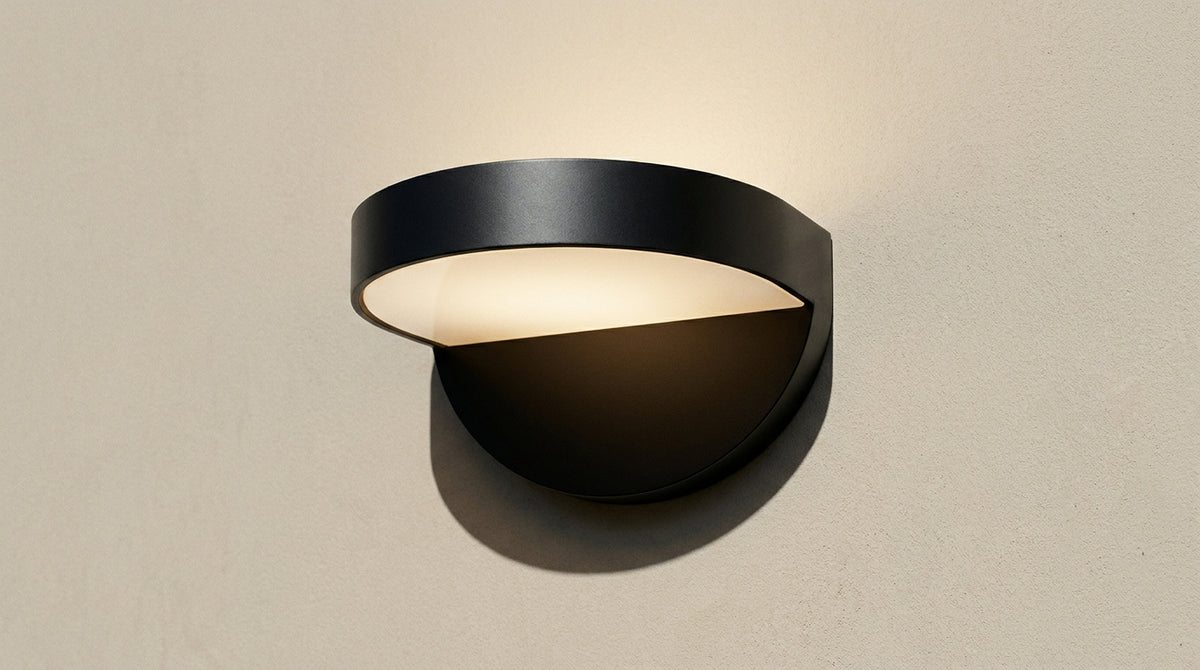
Round wall light: choosing the diameter, the socket and the height
Measure the wall, choose the diameter (20 to 30 cm for a bedroom, 35 cm and up for a living room), settle the socket according to the effect you want, then set the position between 1.50 m and 1.80 m from the floor. A well-placed round light illuminates the wall as much as the room.
A round wall light is not chosen from a photo. It is chosen by a diameter, a socket, a light colour. The rest, the look of the glass, the shade of the metal, comes afterwards, and it is often what decides the mood of a hallway in the evening. Designix supports lighting renovation projects for living rooms in Vaulx-en-Velin and nearby, and the catalogue speaks for itself once you know what to look for.
What is a wall light, and what does the round shape bring?
A wall light is a fixture attached to the wall, wired to the mains or battery-powered, that lights upwards, downwards or in a halo. The round shape projects a pool of light without hard angles: the wall is tinted gradually instead of carrying a sharp rectangle.
Round, globe, oval: what the shape changes on the wall
The round gives a soft, concentric shadow, very readable on a textured wall. The globe, on the other hand, is visible in profile and becomes an object in the room, not just a source. On a survey of 93 listings in our collection as of 26 October 2026, 100% declare the round shape, 9% the globe and 5% the oval: several shapes can coexist on the same reference. If the globe speaks to you, the globe shape and its variants is detailed further on.
- Flat round: 4 to 8 cm projection, discreet in a hallway or against a door.
- Deep round: 12 to 18 cm, it projects a wider halo and can be seen from afar.
- Globe: readable from every angle, perfect as a pair on either side of a bed.
- Oval: stretches the light vertically, useful on a tall, narrow wall.
Which styles stand the test of time?
On the same survey, 76% of the listings declare a modern style and 73% contemporary, against 17% nordic and 12% minimalist. In other words, the market leans very strongly towards clean lines. It is no accident: a sober round ages better than a busy decoration.
- Modern: matte black metal, opal glass, no ornament. The safest choice.
- Contemporary: brass or gold, fine lines, a statement in an entrance.
- Minimalist: a single round, as little material as possible, the light alone counts.
- Industrial: protective grille, raw metal, for a kitchen or a staircase.
Our reading of the minimalist wall light details what distinguishes a successful clean line from a bare wall. And once the style is settled, the simplest thing is to browse a selection of round wall lights filtered by shade and by room.
What height for wall lights?
Indoors, allow 1.50 m to 1.80 m from the floor to the centre of the fixture: that is the range that places the light at eye level, without glare. In a hallway, align all the wall lights on the same level, otherwise the eye spots the discrepancy immediately.
What height in a bedroom, a hallway, a staircase?
In a bedroom, the level is set by the mattress, not the floor: 60 to 70 cm above the top of the mattress for reading lying down. Our guide to the ideal height for a wall light gives the reference points room by room, and the bedroom and office lighting project helps place two points of light rather than a central ceiling light.
- Bedroom: a pair 60-70 cm above the mattress, or a bedside wall light at pillow height.
- Hallway: 1.70 m generally, spaced 2 to 3 m apart for a regular rhythm.
- Staircase: follow the slope, 1.80 m from the stair nosing, never in line with the handrail.
- High ceilings: go up to 1.90 m rather than leaving a gap under the fixture.
The fixing matters as much as the level: our method for installing a wall light covers marking out, drilling and connection.
What height for an outdoor wall light?
Outside, you no longer reason from the floor but from the area to be lit: a terrace is set at 1.80 m to 2.10 m, an entrance at handle height plus 30 cm. Of our 93 listings, 95% are IP20, so strictly indoor: only 1% are IP44 and 3% IP65.
- IP44: protected against splashes, sufficient under a sheltered awning.
- IP65: resists water jets, essential by the sea or in driving rain.
- Entrance: 30 cm above the handle, to light the lock and the face.
- Terrace: aim downwards to avoid dazzling your guests.
Waterproof models can be found in our selection of IP44 wall lights, and the rest of the outdoor catalogue in wall lights for terraces.
Which wall should receive your round wall light?
What wattage and what socket for a round wall light?
The socket decides everything: the available wattage, the light colour and how easy it is to replace. Of our 93 listings as of 26 October 2026, 45% are E27, 18% integrated LED, 14% G9 and 6% E14. E27 remains the standard, and that is good news: the bulb can be changed.
E27, G9, E14 or integrated LED: which to choose?
E27 accepts the most powerful and most common bulbs, up to 60 W LED equivalent. G9 fits in a compact glass but heats up and costs more. E14 suits small volumes. Integrated LED cannot be replaced: the whole fixture is changed at the end of its life.
| Socket | Share of survey | What it allows |
|---|---|---|
| E27 | 45% | Standard bulb, up to 60 W, replaceable anywhere |
| Integrated LED | 18% | Fixed output, no replacement, long life |
| G9 | 14% | Compact glass, moderate output, heats up |
| E14 | 6% | Small volumes, limited output |
A simple rule: to light a room, aim for 5 W of LED per square metre; to create a mood, 2 to 3 W is enough. Our guide to the different types of bulbs explains which socket accepts which dimmer.
What light colour for a wall light?
Aim for 2700 K to 3000 K in a living space: that is the warm white that makes wood and fabric look flattering. Above 4000 K, the wall becomes clinical white, which suits a staircase or a garage, not a bedroom. An E27 socket lets you change your mind without changing the fixture.
- 2700 K: bedroom, living room, reading corner. The most versatile value.
- 3000 K: hallway and entrance, a slightly crisper warm white.
- 4000 K and above: staircase, garage, conservatory. Avoid near a bed.
On the same survey, the dominant colour is black at 59%, ahead of white at 33% and gold at 28%. Matte black disappears on a dark wall and stands out on a light one: it is a choice of contrast, not of fashion.
Round wall lights: the selection


Have you settled the room and the socket? The round wall light collection brings together 1,434 references to filter by room, colour and style: enough to decide in a few minutes. If any doubt remains about the result, take the time to describe your wall to us: colour, height, surroundings, and we will point you to the right references.
How to hide a wall bulb?
Three solutions: an opal diffuser that veils the source, a socket set lower down that takes the bulb out of the field of vision, or a bulb cover added behind the shade. The first is the most effective and the easiest to find in shops.
Diffuser, opal glass or offset socket?
Opal glass diffuses and softens, but loses a little output. Clear glass lets the filament show, which becomes a deliberate aesthetic choice with a filament bulb. The offset socket is found mainly on reading wall lights: the bulb drops into an arm and leaves the line of sight.
- Opal glass: hides the bulb, soft light, ideal in a bedroom.
- Clear glass: embraces the source, to be reserved for decorative bulbs.
- Offset socket: the bulb leaves the wall axis, no visual nuisance.
- Bulb cover: the cheapest solution when the fixture is already fitted.
Our method for hiding a wall light bulb without drilling covers the cases where the fixture is already in place. And of the 93 listings surveyed, 87% are metal against 24% glass: glass remains a minority, so look for it specifically.
One last thing, often overlooked: the wall light does not replace a ceiling light, it complements it. Two or three low points change a room more than a more powerful central chandelier. Wall lights and the subtle lighting that transforms a wall are worth more than a third ceiling spot.
In stock · shipping costs shown at checkout · up to 30% off in your cart


Ready to turn inspiration into reality?
Tell us about your room, your style and your budget, and we will show you the pieces that truly suit your project.
Get guidance in 30 seconds →




