How many LED spots per m²: the room-by-room method
This article is also available in French: Combien de spot par m2
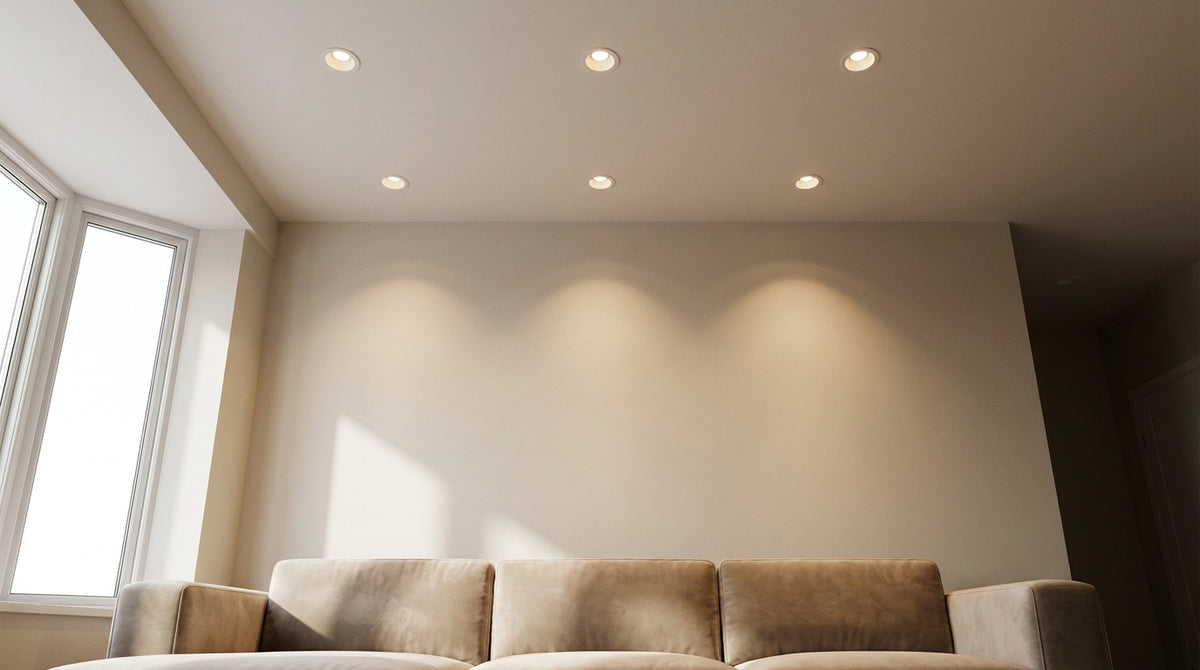
Allow one LED spot for every 3 to 4 m², then adjust this figure according to three parameters: ceiling height, beam angle and distance to the work surface. In kitchens and offices, divide the area by 1.5 to 2 m². Under a 2.40 m ceiling, space the spots further apart.
How many LED spots should be installed per m²?
Plan for one spot for every 3 to 4 m² in a living room or bedroom, one for every 1.5 to 2 m² in a kitchen or office, one for every 2 m² in a bathroom. These densities assume a standard ceiling, around 2.50 m, and a beam of 36° to 60°.
This ratio remains a starting point. In a living room with irregular walls or crossed by a beam, the layout is decided room by room, as part of a living room lighting project designed for the actual shape of the room and not just its surface area.
How many spots per m² in a living room?
One spot for every 3 to 4 m² is enough for everyday living. Move to 2.5 m² per spot if the sofa also serves as a reading corner, otherwise the shadow returns exactly where you sit.
- 100 to 200 lux at floor level for watching television or entertaining
- 250 lux and above on the sofa if you read
- 36° beam for soft light, 24° for an accent on a painting
- 2700 K for a warm living room, 3000 K if it opens onto the kitchen
A 6 m long wall often requires two rows rather than a single line of five spots. Complement the ceiling density with low-level sources: an adjustable wall lamp near the sofa or a floor lamp for the corner, and the room gains depth without adding a single spot. The recessed models available range from the recessed LED downlight to the adjustable spotlight, which leaves control over the angle without changing the ceiling.
How many spots per m² in a kitchen?
Allow one spot for every 1.5 to 2 m², and treat the work surface as a separate zone: that is where the light matters, not in the centre of the room.
The pitfall is well known. A single ceiling light casts your shadow on the chopping board as soon as you lean over. Two closely spaced spots above the work surface, as part of a kitchen lighting project, settle the matter before decoration even comes into it.
- 300 to 400 lux on the work surface, 150 lux is enough at floor level
- Adjustable GU10 to aim at the surface without lighting empty space
- 3000 K to 4000 K to distinguish the colours of food
- One spot every 60 to 80 cm along the surface, never a single one in the centre
A kitchen pendant above the island, mounted 75 cm from the top, provides the ambient light that spots cannot produce. For an accent on the surface, an adjustable GU10 LED bulb places the light exactly where you chop.
How many spots for a 12 m² bedroom?
Three to four spots are enough in 12 m², provided they are not aligned in the centre. Aim for 150 lux at floor level, no more: a bedroom too brightly lit at the ceiling is tiring.
- 3 spots of 5 to 6 W arranged in a triangle for a 12 m² bedroom
- 150 lux at floor level, compared with 300 in an office
- No spot in line with the bed, that is the rule that saves your sleep
Complement with low-level, adjustable sources. Two bedroom wall lights framing the bed replace the ceiling light when reading, and the atmosphere changes without touching the layout. If you want to check your calculation room by room, our guide on the number of spots per m² repeats the same ranges case by case.
How do you arrange spots in a room?
Start from the centre and work in parallel bands: one spot every 80 cm to 1.20 m in a living room under a 2.50 m ceiling, up to 1.50 m if the ceiling is higher. Then set the first spot at about one third of the ceiling height, measured from the wall.
Which room do you want to light with spots?
What distance between two ceiling spots?
The distance depends on height, not on taste. The higher the ceiling, the further apart the spots, because the light cones widen as they descend.
- 80 to 100 cm apart under a 2.40 m ceiling
- 1 m to 1.20 m between 2.40 m and 2.80 m
- 1.20 m to 1.50 m beyond 2.80 m
The right reference remains visual: two neighbouring cones should touch at floor level, never clearly overlap. Our article on the distance between ceiling spots details the calculation according to each configuration.
At what distance from the wall should the first spot be placed?
Allow one third of the ceiling height. Under 2.50 m, this places the first spot about 80 cm from the wall, which smooths the wall without pressing the light against it.
- 1/3 of the height: the basic rule, valid everywhere
- 60 to 80 cm to light a bookcase or a painting
- 1 m and more if you want to leave the wall in shadow
A spot too close to the wall creates an unsightly patch of light and leaves the rest blurred. Too far away, it serves no purpose. A regular spacing of spots is planned on paper before drilling, never by eye.
You have the density on paper but are unsure about your actual room? Use our page to describe your room before drilling, and we will tell you where to place each spot.
How do you choose the number of spots when the ceiling height changes?
The higher the ceiling, the more spots you need, not fewer. Under 2.40 m, space them out and widen the beam. Beyond 3 m, double the density or switch to directional models, otherwise the light stops before reaching the floor.
| Ceiling height | Floor density | Recommended beam |
|---|---|---|
| Less than 2.40 m | 1 spot for 4 to 5 m² | 60°, diffuse light |
| 2.40 m to 2.80 m | 1 spot for 3 to 4 m² | 36° to 45° |
| More than 3 m | 1 spot for 1.5 to 2 m² | 24° to 36°, adjustable |
Low ceiling: fewer spots or a wider beam?
The wider beam. Under 2.40 m, multiplying spots creates patches and consumes power for nothing.
- 60° covers a table without leaving a grey zone
- One spot fewer is better than a spot that dazzles
- A low-level source compensates for what the ceiling cannot provide
Great height: why double the density?
Because light loses intensity with distance. A 36° spot placed at 3.50 m only lights a narrow disc on the floor, and the rest of the room falls back into darkness.
In a living room with great height, double the number of points and choose adjustable models. A LED ceiling light can replace two rows of spots when the room is wide and low in use, and a dining room chandelier brings the light down to table height, which no ceiling spot will do. Our article on how many spots on the ceiling repeats the calculation height by height.
Do 1000 lumens light well?
Yes, 1000 lumens comfortably light 4 to 6 m² depending on the mounting height, which is 150 to 200 lux at floor level in a living room. On a work surface, the same power covers only 2 to 3 m², because you need to aim for 300 to 400 lux.
Lumens, lux and m²: the calculation in one line
Divide the lumens by the area: you get lux. That is all, and it is enough to settle a number of spots.
- Living room: 150 to 200 lux, i.e. about 12 lumens per m² per lux targeted
- Kitchen and office: 300 to 400 lux
- Hallway: 50 to 100 lux is enough
A flux of 1000 lumens therefore covers 5 m² in a living room and 2.5 m² above a work surface. The difference between lux and lumens explains why the two figures are not read the same way on a box.
Why a 5 W spot and a 7 W spot are not counted the same way
Because the watt measures consumption, not the light produced. A very efficient 5 W spot can output as many lumens as an old 7 W one, and you will then install fewer on the ceiling.
- Read the lumens, not the watts, to count your spots
- High efficiency reduces the number of points needed
- A more powerful bulb never replaces a badly placed spot
Always compare at the same white temperature: 2700 K and 3000 K do not give the same impression at identical flux. The apparent efficiency can vary by a third between two references of the same power.
Which density mistakes cost dearly?
Two mistakes recur: counting spots by surface area rather than by volume, and mixing two white temperatures in the same room. The first leaves dark zones, the second makes a room look messy, even with the right number of spots.
- Forgetting the height: the same 3 m² per spot does not hold under a 3.50 m ceiling
- Mixing 2700 K and 4000 K in the same room, the difference is immediately visible
- Neglecting the protection rating: IP44 is essential near a water point, IP20 is enough elsewhere
- Drilling before checking the position of the joists, a failed hole is visible for life
The method to follow to install ceiling spots without marking errors comes down to a pencil layout validated before the first drill bit. Our catalogue holds the three density solutions, recessed downlights, GU10 bulbs and ceiling lights, and the selection is commented on by buyers: our Google listing can be checked in one click if you want to read the feedback before choosing.
Spots, downlights and GU10 bulbs for recessing
 Wall light | Livissa
 Wall light | Seressa
 Pendant light | Anir
 Wall light | Sylvestra
 Pendant light | Jory
 Living room floor lamp | Vertia
See the whole selection: Limited Edition: Last pieces in stock not to be missed!
Related reading
In stock · shipping costs shown at checkout · up to 30% off in your cart


Ready to turn inspiration into reality?
Tell us about your room, your style and your budget, and we will show you the pieces that truly suit your project.
Get guidance in 30 seconds →