Vintage glass pendant light: how to choose it, hang it and light it
This article is also available in French: Suspension verre vintage
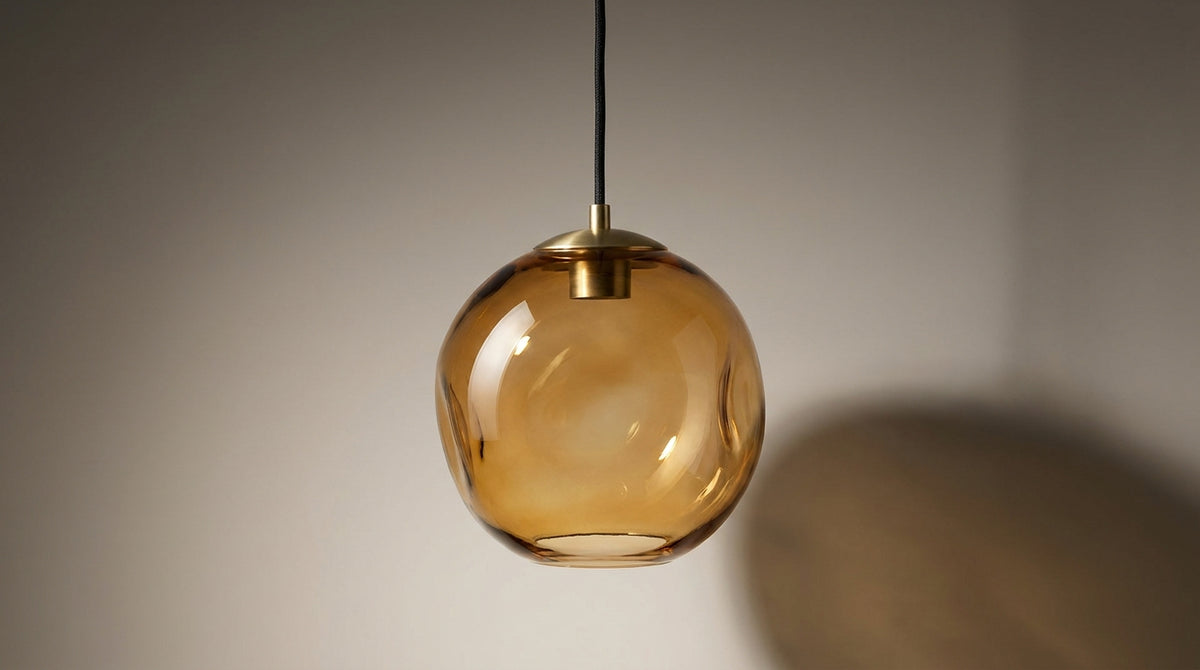
Choose the bulb before the pendant: 2700 K for amber or smoked glass, not 4000 K, whose cold white turns amber green. Then set the drop, 75 to 85 cm above a tabletop. These two decisions are made before purchase, not after installation.
Which glass for which light?
Frosted or opal glass diffuses an even light and hides the bulb. Ribbed glass casts bright lines across the walls. Smoked and amber glass filter the light and tint it. In all three cases, the colour of the glass dictates the bulb temperature, never the other way round.
Glass light fittings are hard to compare in a photo: an amber piece shot in daylight looks like a clear one. Sorting by colour settles the question before you even click.
Frosted, ribbed or opal glass: which to choose?
Three glasses, three kinds of light. Frosted and opal look alike in a photo but not in person: opal keeps a milky haze at the edges, frosted stays more neutral.
| Glass | What it does to the light | Bulb that suits it |
|---|---|---|
| Frosted | Diffused, even, bulb invisible | Opal LED E27, 2700 K |
| Ribbed | Casts crisp lines on the walls | Filament E14, 2700 K |
| Opal | Milky haze, very soft light | Opal LED E14 or G9 |
| Clear | Shows the bulb and the socket | Filament on display, 2700 K |
Clear glass forgives nothing: it shows the socket, the filament and the dust. It does, however, suit a well-designed filament bulb, which becomes part of the decor. In ribbed glass, the same bulb loses all interest, the ribs swallow the filament.
Vintage pendant in smoked or amber glass?
Smoked glass kills the white of the bulb and gives a grey, almost hushed light. Amber warms everything it passes through and takes over in the evening. A smoked glass pendant needs a slightly more generous bulb than clear glass, since the glass absorbs part of the output.
Amber glass and warm light are a less flexible pairing than they appear: a bulb that is too cold turns the whole thing grey, one that is too powerful turns it orange.
The vintage glass family is no small matter here: our vintage glass wall light collection alone has 137 products as of 27 October 2026, from clear to smoked. At that density, you choose the colour from comparison photos, not from memory.
Coloured glass: which bulb temperature?
Tinted glass does not light the same way as clear glass. The more saturated the colour, the more the bulb should stay warm and moderate in power.
- 2700 K: the temperature that will not turn amber green, try it first
- 3000 K: acceptable on clear or white glass, risky on green
- 4000 K: the cold white that pulls amber towards grey-green, avoid
- E14, E27, G9 socket: check it on the product page, it is never obvious
Amber bulbs extend the glass without betraying it, provided you keep the power moderate. An LED that is too strong bleaches the colour and erases the work of the glass.
Then there is the socket, which is never obvious. The guide to E14, E27 and G9 sockets avoids the classic mistake: a pendant delivered without a bulb, and a socket nowhere to be found in the kitchen drawer.
At what height should you hang a vintage glass pendant?
Allow 75 to 85 cm between the bottom of the glass and a tabletop, and 2.10 m of clear passage above the floor in a hallway. The drop is decided before you drill: a heavy glass cannot be raised again without redoing the fixing point.
What drop above a dining table?
The bottom of the glass sits between 75 and 85 cm from the tabletop. The larger the room, the lower in that range you go, so the light stays over the plates and not in people's eyes. A large dining room chandelier is raised a few centimetres, otherwise it fills the guests' field of view.
How do you adjust the height of a pendant light?
Three measurements are enough: floor to tabletop, height of the glass, height of the fixing point. The difference gives the cable length to leave. Adjusting the height of a pendant on an adjustable cable is then a two-person job, a tape measure in one hand and the glass in the other.
A sloping ceiling, an offset opening or a beam in the wrong place change the calculation, and only become apparent when you drill. Asking the workshop your measurement question before ordering avoids an unnecessary hole in a new ceiling.
Once the drop is calculated, all that is left is choosing the room: the selection of glass light fittings reads colour by colour, from clear to smoked.
Pendants and glass light fittings in the selection


Glass and brass, or glass and black metal?
Brass warms amber glass and ages well. Black metal draws a crisp silhouette and brings out clear glass. The choice comes down to the room: brass for a hushed light, black for graphic contrast.
| Frame | Effect on the glass | Room it suits |
|---|---|---|
| Brass | Warms the colour, matte patina | Living room, dining room |
| Black metal | Frames without colouring, crisp contrast | Hallway, open kitchen |
Brass, for a light that warms
A patinated brass frame adds its own tint to that of the glass. On amber, the whole thing leans towards honey. On clear glass, it recalls last century's workshop pendants, without falling into flea-market imitation.
Black metal, to draw the silhouette
Black does not colour the light, it frames it. A slim frame holds the glass at a distance and lets the bulb show. It is the choice for light-coloured rooms, where you want a line and not a golden patch.
The two frames do not need the same care: brass patinates and is polished, glass is washed in warm water without abrasive products. Caring for a pendant without dulling it comes down to two steps, but you still have to do them in the right order.
Which glass pendant for each room?
A living room calls for a wide glass, in proportion to the tabletop. A bedroom prefers a compact opal so it does not dazzle you when lying down. A hallway wants a narrow model that leaves 2.10 m of passage. The room decides the format before the colour.
Which pendant for a living room?
Above a table, the diameter of the glass follows the tabletop: about a third of its width, never more than the space between two chairs. A large pendant above a table for eight stays within that logic, never above a small side table.
Which pendant for a bedroom?
In a bedroom, the pendant is mostly seen lit from the bed: low opal glass, E14 socket, soft bulb. The glass lamps in the selection replace a pendant when the ceiling cannot be drilled, in rented accommodation for example.
Which pendant in a hallway?
A narrow hallway requires 2.10 m of clear passage under the glass and a model that is taller than it is wide. Clear glass quickly dirties the light, frosted holds up better. All these models are IP20: perfect indoors, to be avoided in a damp bathroom.
Where will your vintage glass pendant live?
Two checks before you click. The weight of the glass and the nature of the surface decide the fixing: installing a pendant light on the ceiling on hollow plasterboard is not the same as on a concrete block. Every product page in the catalogue carries the 5-year warranty and CE certification.
For the rest, the verifiable customer reviews say more than a rating copied here. The company's Google listing keeps them up to date, which no article can do over time.
In stock · shipping costs shown at checkout · up to 30% off in your cart


Ready to turn inspiration into reality?
Tell us about your room, your style and your budget, and we will show you the pieces that truly suit your project.
Get guidance in 30 seconds →