Who invented the light bulb, and what it changes in your home
This article is also available in French: Qui a inventé l'ampoule électrique et en quelle année
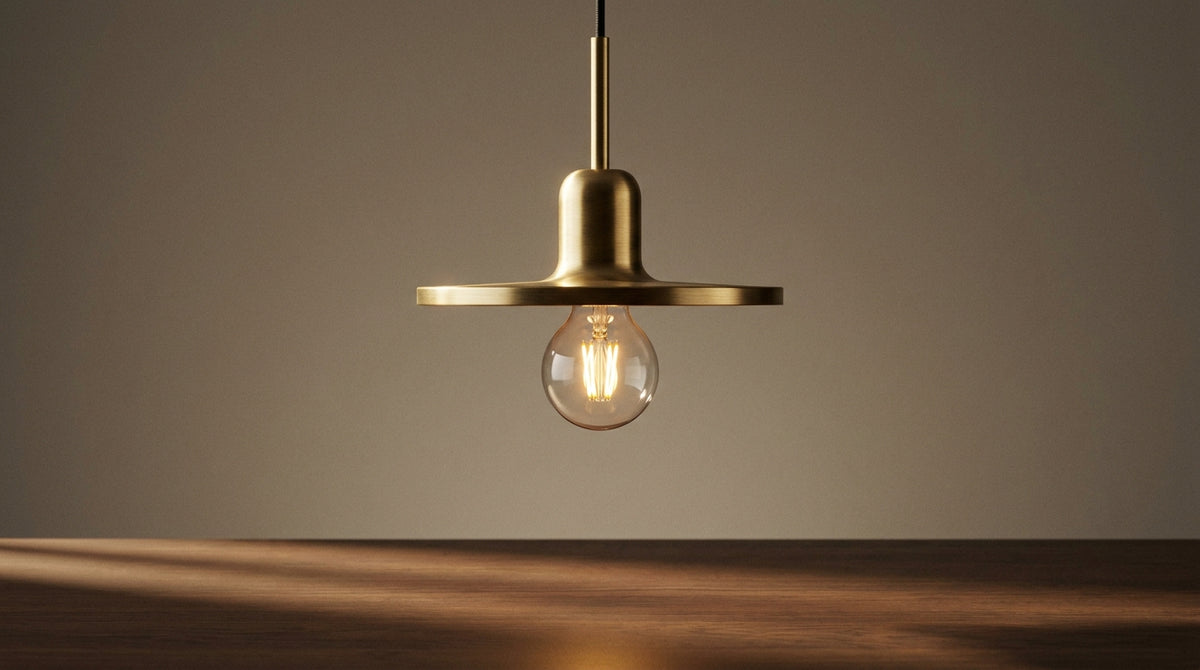
The light bulb has no single inventor: Joseph Wilson Swan patented a carbon filament in 1878, Thomas Edison filed on 22 October 1879 a durable version that could be manufactured in series. Two things from that story stayed in your home: the filament and the screw base.
Who invented the light bulb, and in what year?
Two dates are enough: 1878 for Joseph Wilson Swan's carbon filament patent, 22 October 1879 for Edison's filing. The second won posterity because he made the bulb sellable. That same lifespan constraint can still be read in the design lighting you install today.
The incandescent bulb, an invention with several hands
Nobody starts from zero. The principle, making a material glow inside an enclosure emptied of air, was already circulating among several engineers. What was missing was lifespan.
- The vacuum: less air inside the bulb, a filament that lasts longer.
- The carbon filament: the heart of Swan's 1878 patent.
- The screw base: the part that has never moved since.
- Series manufacturing: Edison's real contribution.
Who invented the light bulb in 1879?
Thomas Edison, with a filing on 22 October 1879, in his Menlo Park laboratory. His bulb combined a very fine carbon filament, a strong vacuum and reproducible manufacturing. The patent was originally English, the industrialisation American. Swan and Edison would eventually exploit their invention together.
E27, E14, GU10 bases: the table that settles it
The base controls everything: a perfect bulb in the wrong socket never lights up. E27 for 27 mm sockets, E14 for 14 mm, GU10 for two-pin spots. The bulb base size is read on the socket, not on the bulb.
- E27: the standard for pendants and floor lamps, found in E27 base bulbs.
- E14: small diameter, for bedside lamps and compact wall lights.
- GU10: two pins, directional bulb, designed for spots.
- G9 and G4: fine pins, on fixtures where the bulb stays visible.
Which lamp was invented by Thomas Edison?
A carbon filament bulb under strong vacuum, filed on 22 October 1879, able to last long enough to be sold. It is not the first electric light, it is the first that became a product. The rest, socket, shape, wattage, was built around it.
Filament bulbs, E27 bases and design LED sources
 Star Wall Light | Celestial Light
 Art Deco Monkey Wall Light | Oryn
 Gold Design Wall Light | Ceno
 Staircase globe wall light | Pael
 Design LED Wall Light | Gair
 Stag Wall Light | Silo
See the whole selection: Art Deco Wall Light: 1920s-1930s Collection
From carbon filament to LED
The principle has changed sides. In an LED, no more metal heated white hot: a semiconductor converts the current into light. The detail is explained simply in how an LED works.
- The principle: a semiconductor replaces the incandescent filament.
- The shape: the glass and the thread remain, the source slips inside.
- The heat: far less loss, the globe stays warm to the touch.
What has not moved is the envelope. A LED filament bulb keeps the shape of the glass, the warm light and the original thread, which makes it credible in an old fixture as well as in an Art Deco wall light.
Why the E27 base is still screwed into your living room
Because a century and a half old standard is not replaced by decree. In a survey of 48 references from the Art Deco Wall Light collection on 29 September 2026, 46 % carry an LED source and 13 % an E27 base. That collection has 463 references in total. Edison's invention is a minority there, but it has not disappeared.
Who invented the light bulb: Edison or Tesla?
Edison, for the marketable bulb filed on 22 October 1879. Tesla did not invent the light bulb: he worked on transmitting electricity as alternating current, which made it possible to power entire cities. Without a grid, the most accomplished bulb remains a laboratory object.
What Tesla brought, and what he did not invent
Alternating current, long-distance distribution, the induction motor. It is this work that makes domestic lighting possible on a large scale.
- Alternating current: carrying electricity far from where it is produced.
- The induction motor: converting current into movement.
- The grid: what turns a laboratory invention into a daily service.
Electricity has no single inventor, and neither does artificial light. They are chains of work, of which we remember the name of the one who made the object usable.
Three misconceptions that cost you dear when buying
They come back with every purchase and make you return a bulb for nothing. An overview of the different types of bulbs lets you set them aside in three minutes.
| Misconception | What really happens |
|---|---|
| An LED is not bright enough | At comparable power, the perceived difference comes mainly from colour temperature, not from the technology. |
| An E27 base means a big bulb | E27 describes the socket, not the volume of the globe: a large globe screws onto a small lamp. |
| The filament belongs to the past | It exists in an LED version, with the look of glass and a much lower consumption. |
For the visual aspect, it is precisely the modern version you should look at: LED filament bulbs take up the original aesthetic without the original flaw.
One last point before the basket: not all LEDs dim. If you keep a dimmer on the wall, read switching to all-LED to avoid flickering.
Which bulb to choose today, room by room?
Answer by room before looking at the bulb: warm white for the living room and the bedroom, a more neutral white for the kitchen and the bathroom, a model suited to humidity outside. A single badly chosen fixture is enough to kill the atmosphere of a whole room.
- Living room: 2700 K, several sources at different heights rather than one central point.
- Bedroom: warm white, low intensity in the evening, a dimmer is welcome on the bedside lamp.
- Kitchen: 4000 K above the worktop, to light without casting a shadow on your hands.
- Bathroom: protection rating suited to the zone, neutral white in front of the mirror.
Colour temperature: 2700 K or 4000 K?
2700 K for the living room, the bedroom and relaxation areas: the light leans towards amber and wood looks warm. 4000 K for the kitchen, the worktop and the bathroom: whites stay white and details read clearly. The doubt between the two is settled by a simple test, detailed in white or yellow light.
A concrete example: above a worktop, a directional GU10 bulb lights the useful area without dazzling, provided you aim for the right temperature.
The checks before buying
Three minutes are enough. Read the socket, the colour temperature, then the compatibility with your dimmer, in that order.
For a bulb that stays visible under a shade, the shape matters as much as the light: XXL decorative bulbs embrace the large globe, where a standard model disappears into the shadow.
Then comes the dimmer: an ordinary bulb placed on a dimmer flickers. The subject is covered in detail in dimmable or variable bulb.
If you are still hesitating, buyer reviews are public on the Designix Google listing.
Before ordering, if you are hesitating between two colour temperatures for the same room, there is still a simple solution: ask the Designix team. The answer depends mainly on the height of your sources and the colour of your walls.
You are starting from a fixture you already own: which source should you order?
In stock · shipping costs shown at checkout · up to 30% off in your cart


Ready to turn inspiration into reality?
Tell us about your room, your style and your budget, and we will show you the pieces that truly suit your project.
Get guidance in 30 seconds →