Windowless hallway: which light fixture will illuminate it
This article is also available in French: Luminaire Couloir sans fenêtre
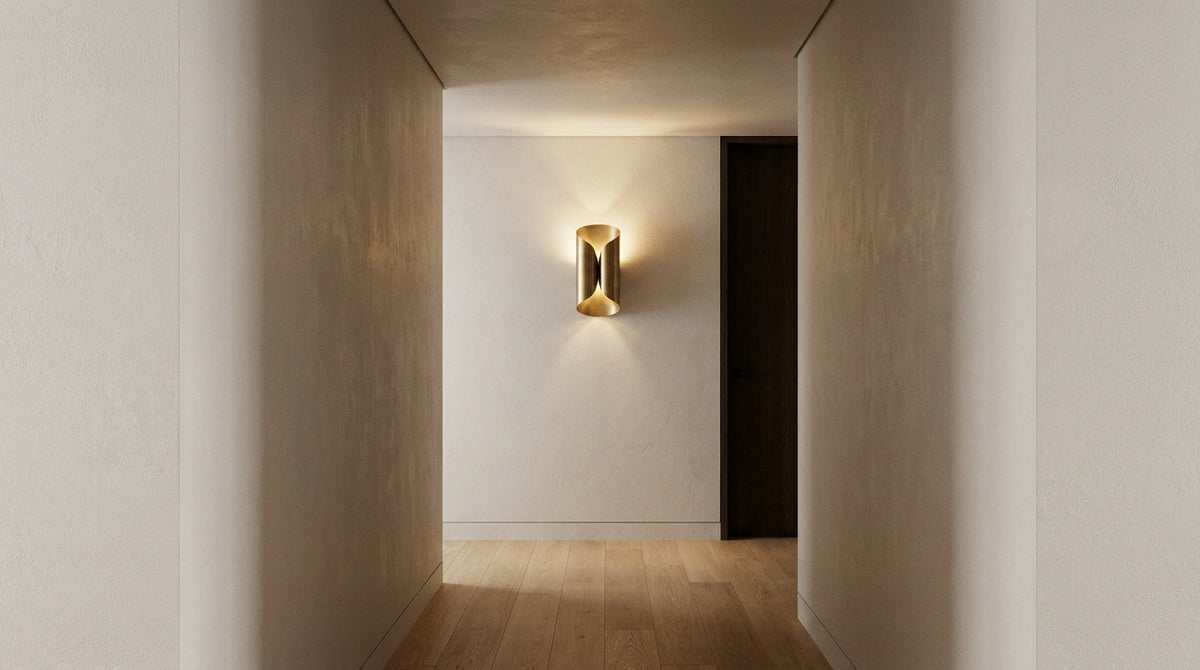
Light from above and from the sides: a flat ceiling light or spotlights aligned along the axis, then a wall light angled towards the ceiling halfway along. In a survey of 250 references from our catalogue on 7 November 2026, 57 % declare the room "hallway": the models exist, all that remains is choosing the right temperature, 2700 to 3000 K.
How do you bring light into a dark hallway?
Allow for at least two sources, never a single point in the middle of the passage: a base at the ceiling that provides the general level, and indirect wall lighting that bounces the light upwards. A windowless hallway is treated as a route, with lit zones and breathing spaces, not as a room to be lit in one go.
Habitable windowless room: what the light must compensate for
A habitable windowless room loses three reference points at once: the time, the depth and the vanishing point. The light must restore them, otherwise the passage remains a tunnel.
- The general level: a steady flow that avoids isolated bright patches
- The bounce: a flow directed towards the ceiling, which lights without dazzling
- The low reference: a source at shoulder height to read the volumes
- In the evening: a lower intensity, otherwise the passage wakes you instead of guiding you
In our selection, the wall lights for hallways with indirect diffusion change a feeling of confinement fastest, for a single mounting point.
Fake illuminated window or luminous ceiling: what really works
A fake illuminated window works when it is seen from a distance: at the end of a hallway, it creates a credible vanishing point. Seen up close, a flat LED panel is spotted immediately and the illusion collapses.
| Solution | What it gives | What it requires |
|---|---|---|
| Fake illuminated window | A vanishing point at the end of the hallway | A free wall and hidden wiring |
| Luminous ceiling | A homogeneous flow, with no cast shadow | Sufficient ceiling height |
| Light well | Real daylight | Major works, beyond a simple renovation |
The light well remains the only solution that brings back genuine daylight; the other two simulate it. For a through hallway already lit at both ends, the question is often settled with less: a light boost in the centre is enough, as explained in our guide to lighting a dark room.
What light fixture ideas do you have for a hallway?
Three families cover almost every case: the flat ceiling light, the indirect wall light and the pair of aligned spotlights. The choice is made on the available height and on the width of the passage, not on style first.
Flat ceiling light and aligned spotlights
A flat LED ceiling light fits under 2.40 m of height without eating into the passage. It provides the lighting base and is visually forgotten, which matters in a narrow hallway.
Aligned spotlights, for their part, create a rhythm. One point every 2 to 3 metres, offset from the door axis to avoid stepping into a beam when opening. Our article on the hallway ceiling light details the mounting heights according to width.
Beware the detail that spoils everything: a spotlight placed right on the axis of a door casts the shadow of the jamb at every passage. Offset it by 20 to 30 cm and the result changes completely. The principle also applies to hallway lighting with spotlights, where the layout matters more than the wattage.
Narrow hallway: format before wattage
Under 90 cm wide, a light fixture that protrudes more than 15 cm from the wall visually narrows the passage. Favour flat formats or slim wall lights, even if it means multiplying the points. The solutions for narrow hallway lighting almost all rely on this principle.
Hallway wall lights: the indirect light that widens the wall
A wall light angled upwards projects the light onto the ceiling, which then bounces it back into the room. The wall looks taller and the hallway wider, without adding a single lumen in the centre.
The mounting height decides everything: too high, the wall light lights the ceiling and leaves the wall in the dark; too low, it dazzles. Our guide to the height of a wall light gives the measurements to remember. Before deciding, the Google listing of our shop shows our projects and the feedback left by buyers, kept up to date at all times: see the Designix Google listing.
The light fixtures that solve a windowless hallway
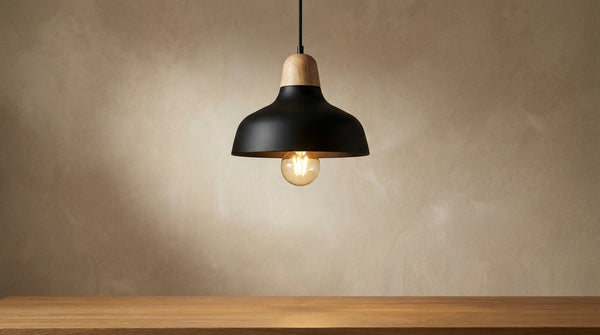
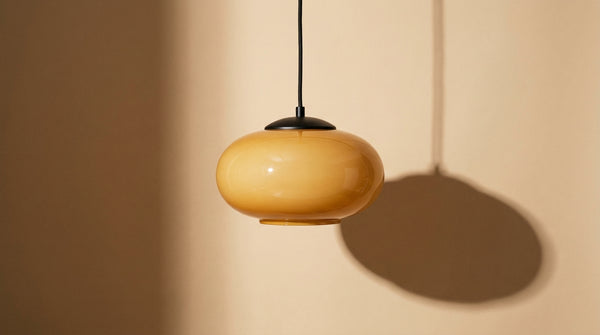
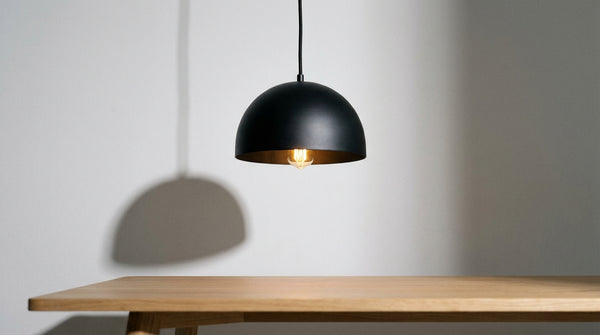
 Pendant light | Interlacia
 Pendant light | Nivara
 Pendant light | Ysandre
 Ceiling light fixture | Bruna
 Living room floor lamp | Hyra
 Wall light | Sveva
See the whole selection: Alternative to Luminaire.fr: designer lighting shop | Designix
Which gives more light, cool white or warm white?
Cool white appears brighter, but it lights a passage poorly: the sensation of clarity comes from contrast, not from the flow. In a windowless hallway, a clear warm white (2700 to 3000 K) gives a more readable light at equal wattage. Our guide to white or yellow light details the cases where cool white remains useful.
2700 K and 3000 K: the temperature for a passage
- 2700 K: classic bulb light, warm, ideal in the evening
- 3000 K: neutral warm white, the best compromise for a hallway
- 4000 K: neutral white, best kept for service corridors
- Consistency: a single temperature along the whole route, otherwise the eye stumbles
A windowless hallway has no daylight to match: that is precisely why it can allow a warmer temperature than a living room. If you need to change the sources, 2700 K bulbs allow you to harmonise without changing the fixtures.
Why 6500 K is tiring in a hallway
6500 K leans towards blue and gives the impression of a waiting room. Walked through several times a day, sometimes at night, a passage lit this way forces the eye to readjust at every entry and exit. Keep 6500 K for occasional technical use, not for a daily route.
How do you light a windowless room without getting the wattage wrong?
Start from the linear length, not the surface area: a 6 m hallway is not calculated like a square room of the same surface area. Allow for one point every 2 to 2.5 metres for a steady flow, and a little more if the hallway is less than a metre wide.
How many light points for a long hallway?
In a 6 m hallway, three or four points are enough if wall lights complete the wall. Beyond that, you stack sources without gaining comfort. For the calculation method per square metre and per lumen, our guide to calculating the amount of lighting gives the reference points room by room.
Dimming: what the product sheets state
In our survey of 250 references on 7 November 2026, 24 % state "dimming: yes" and 16 % explicitly rule it out. The characteristic is only given on 101 sheets: the absence of a mention therefore does not mean the absence of a dimmer, it must be checked case by case.
In a hallway, the dimmer is mainly useful in the evening: a trickle of light rather than full power. If no light point can be installed on the ceiling (concrete, slab, duct), our method for lighting a room without a ceiling light opens other avenues, from the track to the floor lamp. The rest is decided in the lighting catalogue, where wall and surface-mounted fittings complement the ceiling lights.
Unsure about the mounting height or the number of points to allow for in your hallway? Describe the room to us in two lines via our contact page: we reply with your measurements in front of us, without selling you one model too many. Contact us
What is your windowless hallway like?
What can I do to furnish and enhance a windowless room?
Three levers, in this order: bounce the light towards the back, light the walls rather than the floor, and clear the passage. A dark hallway stays dark because it absorbs, not only because it lacks sources.
Mirror at the end of the hallway: bouncing the light back
A mirror at the back of a hallway doubles the perspective and bounces part of the flow back towards the entrance. Placed facing a wall light, it does the work of an extra source. Our article on how to widen the visual space details this play of reflections.
Light walls and ingress protection rating
In our survey of 250 references on 7 November 2026, 94 % state IP20: there is no point paying for IP44 or IP65 for a hallway, that protection is only useful in a wet zone. A light, matt wall bounces light better than a dark satin tone.
- Light matt wall: the best light output for no budget at all
- Wall light: a hallway wall light replaces a missing ceiling point
- Wide hallway: a hallway floor lamp provides a low reference without drilling
- Warranty: 2 years on 85 % of the survey, a criterion to read before comparing
In stock · shipping costs shown at checkout · up to 30% off in your cart


Ready to turn inspiration into reality?
Tell us about your room, your style and your budget, and we will show you the pieces that truly suit your project.
Get guidance in 30 seconds →