Scandinavian lighting: the right light, room by room
This article is also available in French: Luminaire scandinave
In a review of 250 references from our catalogue as of 7 November 2026, only 20% are in a minimalist style, against 79% in a modern style. Scandinavian design is therefore a matter of choice, not volume. Look for pale wood, opal glass, light at 2700 K and an E27 socket, then adapt the drop to the room.
A successful Nordic living room depends on three sources placed at different heights, not on one statement piece. That is the method we apply in our collection of designer light fixtures: each product page states the socket, protection rating and recommended temperature.
What exactly is a Scandinavian light fixture?
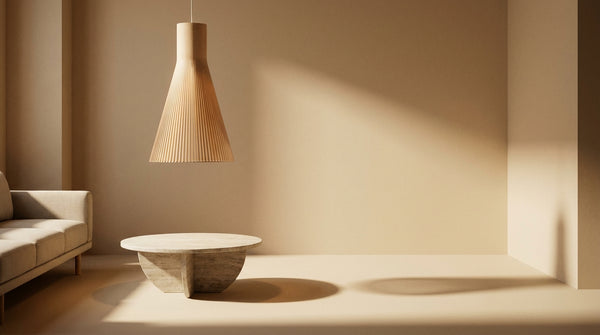
Three materials, warm light, shapes with no added decoration: pale wood, lacquered metal, opal glass, bulbs around 2700 K. A Scandinavian light fixture illuminates without weighing on the room. Its signature is not colour, it is the way the shade diffuses light and the way the stem fades away.
Which materials define the Scandinavian style?
In the same review of 250 product pages, metal is listed on 82% of references and glass on 38%. Genuinely Nordic pieces, however, almost always pair pale wood with a diffuser.
- Pale wood: oak or beech, natural tone, never glossy varnish.
- Opal glass: diffuses without glare, ideal in a low pendant.
- Lacquered metal: off-white or matte black, slim frame.
- Rattan or paper: filtered light, warmer.
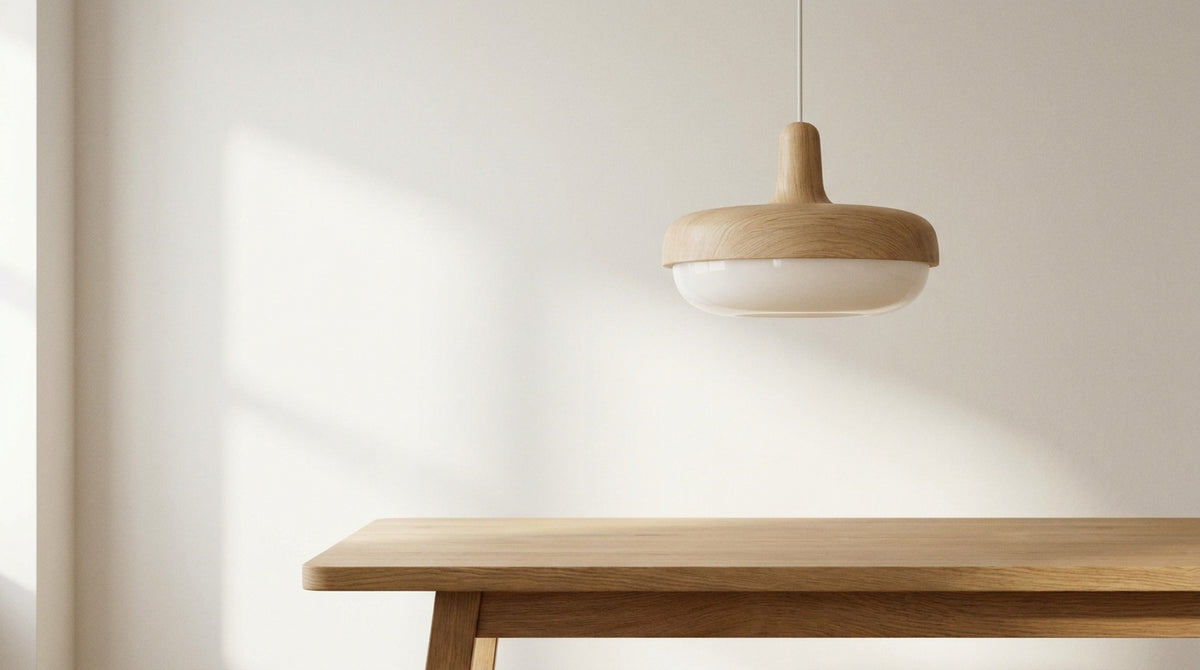
Opal glass remains the best ally for a dining table: it softens the bulb and avoids the spotlight effect. Scandinavian lamps with a round diffuser are the most direct illustration.
Which colour temperature should you choose?
Aim for 2700 K, the value that leans towards warm white without turning orange. Above 3000 K, pale wood loses its softness and white becomes clinical.
The socket matters just as much: in the review, 26% of product pages are E27 and 22% are integrated LED. E27 lets you change the bulb, integrated LED imposes the original module. Our guide to white or yellow light details the differences in rendering.
Scandinavian or minimalist, what is the difference?
Scandinavian keeps a warmth of material, minimalist removes even the texture. A minimalist light fixture in brushed steel suits a desk, rarely a sofa corner.
Unsure about the drop or the temperature? The Designix team answers before you buy, via the contact page.
Which Scandinavian light fixture for a living room?
Three sources, three heights: a ceiling light or pendant in the centre, a floor lamp beside the sofa, a table lamp on a piece of furniture. This layering creates zones rather than uniform lighting, and it is what makes the room readable in the evening.
The floor lamp, the corner piece par excellence
A slim stem, a tall shade, light falling at shoulder height: the Scandinavian floor lamp fills the void without adding furniture. An arc lamp needs more space and a clear seating area.
- Under 20 m²: one pendant, one floor lamp.
- 20 to 30 m²: add a table lamp.
- Over 30 m²: two floor lamps, never just one.
Our article on the Scandinavian arc floor lamp gives the distances to respect depending on the room.
Pendant or ceiling light in the centre?
Above a coffee table, a pendant hangs around 1.60 m from the floor. Without a central table, choose a Scandinavian ceiling light in opal glass: it diffuses widely and does not block the view.
In the review, 94% of product pages are IP20. That is enough in a dry living room; IP44 is only justified in a damp room.
At what height should a Scandinavian pendant hang above a table?
Allow 70 to 80 cm between the bottom of the shade and the surface. Lower, the light flattens faces; higher, it lights the room instead of the table. The rule is checked seated: the edge of the shade passes above the line of sight, not in front of it.
How to adjust the drop without drilling twice
Measure from the surface, not from the ceiling. A cable with a cord grip lets you adjust afterwards, without tools. Our tutorial to install a pendant light on the ceiling covers fixing and safety height.
- Table clearance: 70 to 80 cm, never less than 60.
- Seating: the edge of the shade above the eyes.
- Cord grip: adjusts the drop without rewiring.
Which shade so you do not see the bulb?
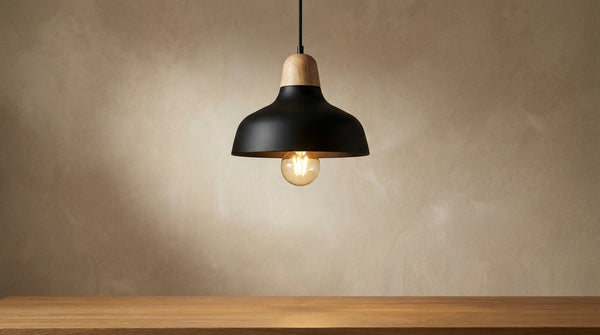
A deep shade hides the bulb as soon as you sit down, provided the socket is centred. This is the weak point of models that are too wide. Scandinavian shades with a closed skirt correct this flaw without reducing power.
A Scandinavian wooden pendant works on the same principle: light comes out at the bottom, the wood filters the rest.
The Scandinavian selection: pendants, floor lamps and table lamps
 Pendant light | Interlacia
 Pendant light | Nivara
 Pendant light | Ysandre
 Ceiling light | Bruna
 Living room floor lamp | Hyra
 Wall light | Sveva
See the whole selection: Alternative to Luminaire.fr: designer lighting shop | Designix
How to keep soft light in a bedroom with a Scandinavian light fixture?
Two sources are enough, both under 2700 K and dimmable if possible. A wall light at shoulder height near the bed, a table lamp on the chest of drawers. Avoid a ceiling light on its own: it flattens the room and casts shadows downwards.
Wall light or bedside lamp?
The wall light frees up the bedside table and sits around 1.20 m from the floor. The bedside lamp, on the other hand, moves around and follows your reading habits.
- 2700 K: the only temperature to keep in the evening.
- Dimmer: 24% of the review offers one, check before buying.
- Opaque shade: prevents glare when lying down.
For an adult bedroom, an adult bedroom wall light with a switch saves you searching for the button in the dark.
How to mix Scandinavian with existing furniture
Pale wood accepts dark furniture, provided the shapes stay simple. The mix works with one Nordic piece per zone, not three. Our advice on mixing lighting styles starts from the furniture already in place.
Before buying remotely, the Designix Google listing lets you read public reviews, with no rating copied here.
Vintage Scandinavian lighting: how to recognise it?
Three clues: patinated brass rather than gilded, a slightly yellowed opal shade, a tapered solid wood stem. The reissue is more regular, often heavier, and its metal shines. Patina is the only sign that cannot be copied.
What distinguishes a period piece from a reissue
- Brass: irregular patina on the original, uniform on the copy.
- Screws: old-style slotted on period models.
- Cable: original fabric, to be checked.
- Weight: period pieces are lighter, the metal thinner.
A retro lamp fits well into a bright room, provided you do not stack up references.
What to pair it with without overloading
One vintage piece per view is enough: it becomes the focal point. To balance the whole, our article on lighting decor starts from the light already in place in the room.
In which room should the light fixture make the difference?
In stock · shipping costs shown at checkout · up to 30% off in your cart


Ready to turn inspiration into reality?
Tell us about your room, your style and your budget, and we will show you the pieces that truly suit your project.
Get guidance in 30 seconds →