What resistor for a 12 V LED: the practical guide
This article is also available in French: Quelle résistance pour led 12v
What resistor for a 12 V LED?
Subtract the LED forward voltage from the supply voltage, then divide by the target current. For a 12 V LED rated at 2 V and 20 mA: (12 - 2) / 0.02 = 500 Ω. A 470 Ω or 560 Ω resistor will do. A strip or a fixture that is already regulated does without one entirely.
What resistor to power a 12V LED?
Allow 470 to 680 Ω for a red or yellow LED powered at 12 V under 20 mA. Two parameters decide the exact value: the diode forward voltage and the current you are aiming for. A white or blue LED, which needs close to 3 V, calls for a lower resistor.
How do you calculate the resistor for an LED?
The formula fits on one line: supply voltage minus forward voltage, divided by the current in amps. On a fixture sold complete, this calculation is done at the factory and the power supply is included.
Take a 2 V, 20 mA LED wired to 12 V: (12 - 2) / 0.02 = 500 Ω. All that remains is to pick the nearest standard value.
- Forward voltage: 1.8 to 2.2 V for a red one, 3 to 3.4 V for a white one
- Current: 20 mA for an indicator LED, 350 mA for a power LED
- Standard value: take the standard resistor just above, 470 Ω, 560 Ω or 680 Ω
- Wiring: the resistor goes in series, before or after the LED, the result is the same
To grasp why a resistor limits current without touching voltage, you need to look closely at the diode: how an LED works explains this behaviour in a few lines.
What resistor for a 5 V or 3 V LED?
Redo the same calculation with the available voltage. At 5 V, the margin above the threshold drops to 3 V, or 150 Ω for 20 mA. At 3 V, only one volt is left, so 50 Ω: the slightest supply variation shifts the current.
- 3 V: the margin is too narrow, a constant-current driver is preferable
- 5 V: USB output or bench supply, 150 Ω for 20 mA
- 12 V: the margin is comfortable, it is the easiest voltage to regulate
- 220 V: never a resistor alone, use a driver or a dedicated power supply
Once the wiring is settled, the choice moves to the fixture itself: the LED lighting collection gathers the models that already include their power supply.
How do you run a 12 volt LED?
Use a 12 V DC power supply, then a series resistor or a driver that sets the current for you. Respect the polarity: the long leg goes to positive. For several LEDs, series wiring sends the same current through each one.
What resistor for an LED that stays on?
In continuous use, the resistor converts the voltage difference into heat, and the LED heats up on its side. Stay at 20 mA for a 5 mm LED and let air circulate around the assembly.
- Dissipation: at 12 V and 20 mA, the resistor sheds close to 0.2 W, a 1/4 W part works at its limit
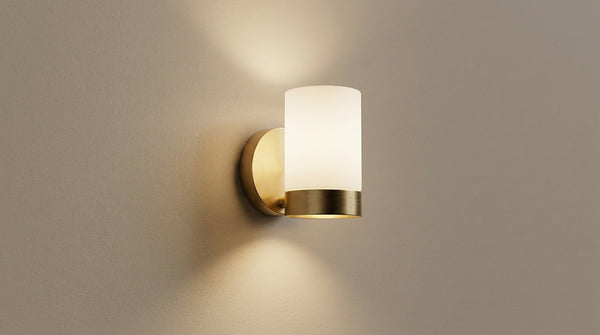
- Ventilation: an enclosed module heats up quickly, like behind a closed wall light
- Drift: an unstable supply changes the current, a driver holds it steady
The step is simple, but polarity and wiring direction are easy to get wrong: wiring an LED walks through the diagram step by step.
Resistor calculation for LEDs in parallel
Each LED placed in parallel needs its own resistor. A single shared resistor across several diodes lets more current through the greediest one, which burns out and takes the others with it.
- Parallel: one resistor per LED, calculated with the same formula
- Series: a single resistor for the chain, the current stays the same throughout
- Limit: beyond a few diodes in series, the available voltage is no longer enough
If your setup remains unclear, bare component, strip or complete fixture, a Designix adviser reviews your wiring plan with you from Vaulx-en-Velin.
What happens if you use an LED bulb that is too powerful?
It heats up, wears out faster and can mark its socket. The problem is not the voltage but the heat concentrated at the base. In a closed fixture, that heat cannot escape and service life melts away with it.
What is the maximum current an LED can handle?
A 5 mm LED handles around 20 mA. A power LED commonly goes up to 350 mA, sometimes 700 mA, provided it sits on a heatsink.
- 20 mA: classic through-hole LED, passive cooling is enough
- 350 mA: power LED, heatsink required
- Beyond that: efficiency drops and the tint drifts towards blue
When a lamp flickers or dims, the cause almost always comes from the power supply, and wiring a 12 V LED to 220 V shows where the limit lies.
On a closed model, the fixture sets the ceiling: an LED ceiling light states the permitted wattage on its datasheet.
Doubt often concerns the power supply rather than the diode. wiring an LED transformer covers the case of 12 V DC obtained from the mains.
Where the question no longer arises: strips and LED fixtures ready to install
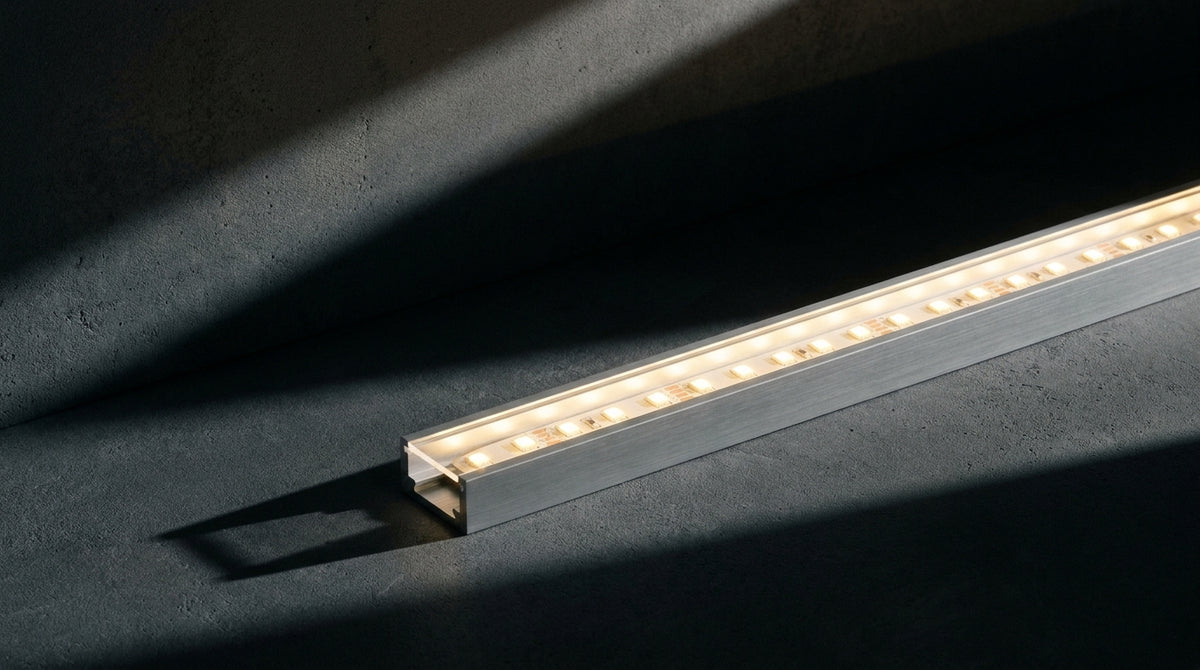
On a 12 V strip, resistors are soldered roughly every 5 cm. You cut at the mark and there is nothing left to calculate. On a complete fixture, the driver is included and the question disappears. All that remains is choosing the length and the base.
Our survey of 250 catalogue references, closed on 29 September 2026, gives the measure of indoor lighting: IP20 on 94% of the survey, LED technology declared on 249 of these 250 datasheets, LED or E27 base on 26% of the survey each. 2-year warranty and CE certification on 100% of the survey.
The Luminaire Led collection counts 18,850 references on the same date. Mounting there is pendant for 42% of the survey and wall-mounted for 36%, with a room declared living room on 82% and bedroom on 68%.
- Strip: no calculation if you connect an LED strip with the right connector
- Length: knowing how to cut an LED strip at the right mark avoids voltage drop at the end of the run
- Base: the bulb base size decides compatibility with your existing fixture
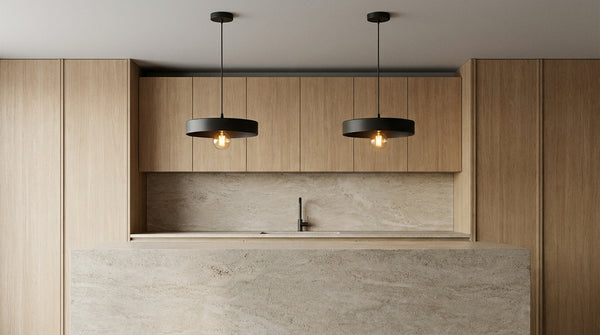
The rest comes down to style and mounting height. A kitchen pendant above the worktop lights the task without casting shadows.
For the table, a dining room chandelier brings the luminous volume a living room calls for, without a single solder joint. The selection is reviewed by buyers, and the Designix Google listing shows their up-to-date feedback.
LED fixtures ready to install, no resistor calculation


Which LED fixture do you actually need?
In stock · shipping costs shown at checkout · up to 30% off in your cart


Ready to turn inspiration into reality?
Tell us about your room, your style and your budget, and we will show you the pieces that truly suit your project.
Get guidance in 30 seconds →