
Light bulb types: LEDs, bases, and Kelvin explained
This article is also available in French: Les différents Types d'ampoules guide complet

Identify three elements in order: technology (LED, the only one still relevant), the base that must fit into your socket (E27, E14, G9, G4, GU10), and the color temperature in Kelvin. This trio settles almost all choices; shape, glass, and power are now merely decorative.
What are the 4 types of bulbs?
Four types of bulbs coexist: LED, compact fluorescent, halogen, and incandescent. Only the LED remains on the market and truly relevant: it lights up instantly, heats up very little, and consumes about 90% less than an incandescent bulb. Halogen and incandescent bulbs have been withdrawn from the European market due to their poor efficiency.
The compact fluorescent, known as low-consumption, retains a residual place: it takes a few seconds to reach full brightness and contains mercury. The LED has solved both of these flaws at once.
To light an entire house, LEDs cover every room, from ceiling lights to the smallest spotlight: this is the foundation of every lighting department today.
The switch to all-LED is done as bulbs burn out, without replacing everything on the same day, as long as you keep the same base.
Our LED bulb collection includes 266 references as of September 23, 2026, enough to find the exact equivalent of any old bulb.
What are the disadvantages of LED bulbs?
Three caveats often come up: uneven light quality depending on the model, a rendering that is sometimes too cold, and entry-level references that are incompatible with a dimmer switch. Check for the mention "dimmable" before buying if you are using a dimmer.
This point matters for a living room or bedroom, where the mood is often adjusted. Our guide on dimmable bulbs details compatibility.
What are the different types of bulb bases?
Two main families: screw bases (E27, the large one; E14, the small one) and pin bases (G9, G4, GU10, GX53). The letter indicates the fixing method, the number the diameter or spacing in millimeters. An E14 is 14 mm wide, a G4 has 4 mm between its two pins.
In a survey of 33 bulbs from our catalog on September 23, 2026, the E27 base accounted for 42% of references, ahead of the G9 (27%) and the G4 (24%). The E27 therefore remains the format to prioritize knowing.
Our LED bulbs to find by base


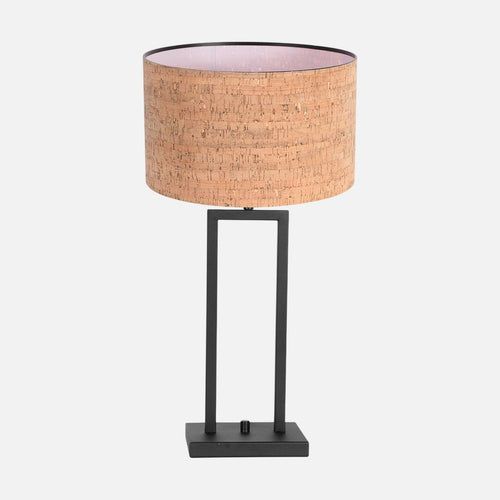
Once the base is identified, replacement is limited to power and color. Our E27 base bulbs cover the majority of pendant lights and table lamps.
How to identify a bulb base?
Look at the base of the used bulb: a wide thread is an E27, a narrow thread is an E14, two small pins are a G4 or a G9. When in doubt, compare the old bulb and the socket before buying.
The complete reference is often on the base or packaging: base type, power in watts, voltage. Our article on bulb size and base shows how to read these markings.
What is the standard bulb base?
The E27 is the standard base in France: the large 27 mm screw base that most ceiling lights, pendant lights, and lamps receive. The E14, its narrow version, is mainly used for small lamps and some wall sconces.
How do you know what type of bulb to use depending on the room?
Match the color temperature to the room's use. Warm white (2200 to 2700 Kelvin) for a living room or bedroom where you relax, neutral white (3000 to 4000 K) for a kitchen or bathroom where you need to see clearly. The base, however, depends on the fixture.
The lower the Kelvin number, the more the light leans toward a warm yellow; the higher it goes, the whiter it becomes. The choice between white or yellow light is decided room by room.
Our catalog data confirms this residential use: in the same survey of 33 bulbs on September 23, 2026, 61% are associated with the living room and 58% with the bedroom. These are the two rooms where design LEDs are used most often.
Having trouble choosing between an E27 and a G9 base, or about the right light temperature? You can chat with our decor advisors to decide before ordering.
With LED, power is thought of in lumens rather than watts: a single base covers a wide range of intensity; it is up to you to aim for the desired ambiance.
To help choose between two atmospheres before buying, the selection is commented on by buyers, and the Designix Google profile gathers their public reviews.
What base are you looking for for your bulb?
Which bulb shapes to choose depending on the fixture?
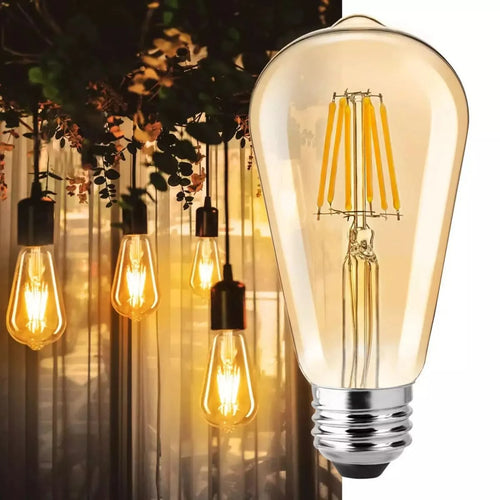
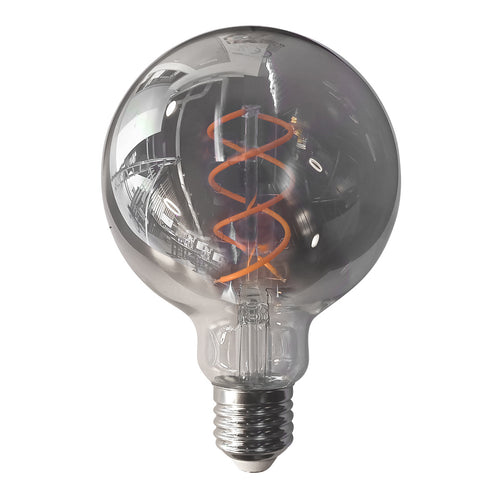
The shape is chosen after the base, depending on whether the bulb remains visible or not. A visible bulb in a pendant light without a lampshade calls for a beautiful globe or a decorative filament; hidden behind glass, a standard shape is enough. Globe, tube, flame, and sphere are common silhouettes.
The LED filament reproduces the warm look of old Edison bulbs, without their consumption. To pair shape and temperature according to the location, see our markers on decorative bulbs and temperature by room.
Regarding materials, this survey of 33 bulbs on September 23, 2026, leans toward glass (61%) and metal (42%), finishes that are noticeable when the bulb is exposed.
One single habit avoids mistakes: technology, base, temperature, then shape. Our guide to choosing your bulbs correctly covers the method from start to finish.
In stock · shipping costs shown at checkout · up to 30% off in your cart
Ready to turn inspiration into reality?
Tell us about your room, your style and your budget, and we will show you the pieces that truly suit your project.
Get guidance in 30 seconds →


