Large pendant lights: getting the proportions right
This article is also available in French: Suspension luminaire grand diamètre
What pendant diameter for your room?
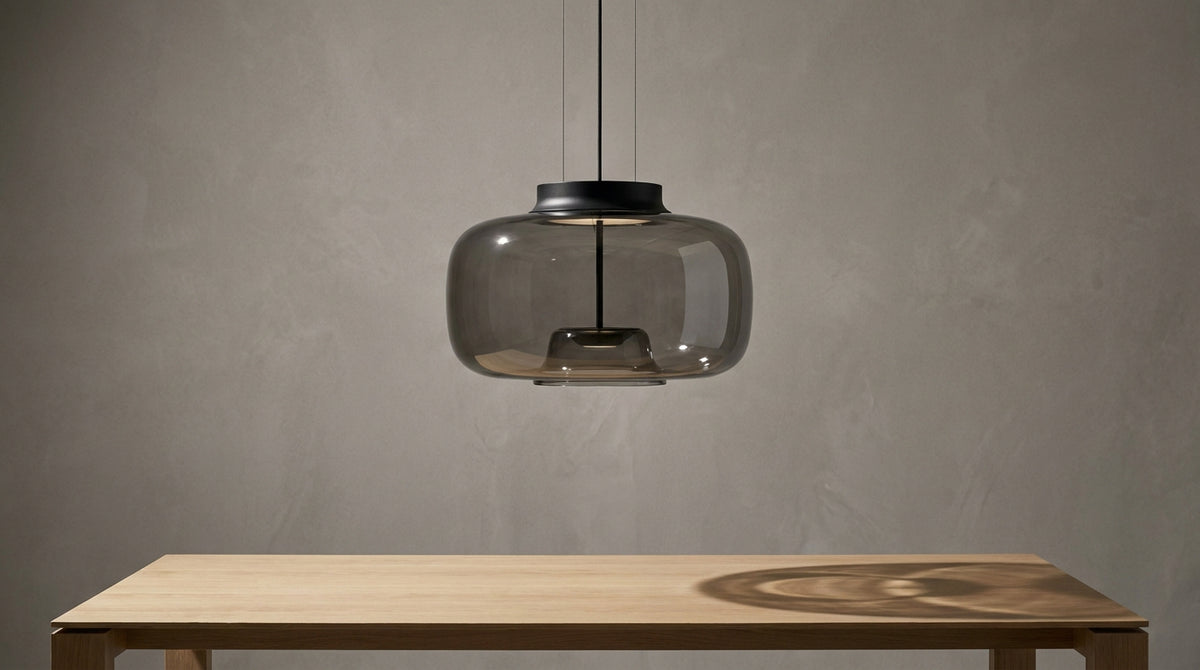
Allow for half the width of the piece of furniture to be lit, never half the width of the room. A 140 cm table calls for a 70 cm diameter, a 180 cm table needs 90. Beyond 100 cm in diameter, two light points are better than a single block placed in the centre.
The half tabletop rule
This rule works in almost every room, because a large format aligns with the furniture it lights and not with the walls. The light should overhang by a few centimetres on each side: this overhang gives the visual base and lights the plates as much as the tabletop. Our XXL large pendant light is chosen on exactly this measurement, and the collection has 7 references as of 30 September 2026.
- Half the tabletop: the basic calculation, to be done before any purchase.
- 60 to 80 cm: the comfortable large format above a 120 to 160 cm table.
- 80 to 100 cm: the XXL format, reserved for large tables and open volumes.
- Two lights: the right answer beyond a 200 cm table, and for a kitchen island.
| Tabletop width | Recommended diameter | The result |
|---|---|---|
| 80 to 100 cm | 40 to 50 cm | A simple, centred pendant |
| 120 to 160 cm | 60 to 80 cm | The most common large format |
| 180 to 200 cm | 90 to 100 cm | The XXL format, centrepiece of the living room |
| Over 200 cm | Two pendants of 50 to 60 cm | Better light distribution |
These measurements remain a working base, to be confirmed on the model's product page. A pendant light always states its diameter and its cable length: these two values decide the final result, not the photo.
What a large diameter changes in the light
The wider the shade, the lower and wider the light falls. The tabletop is lit as one, faces are lit from below, and hard shadows disappear. This is what distinguishes a large format from a small pendant hung high: the lit surface, not the power. We cover this point in detail in measuring by room.
A closed shade concentrates the flow towards the table, an open shade diffuses it throughout the room. In a through living room, a large format light placed alone is not always enough: a wall light or a floor lamp completes it without competing.
Large pendants and large format from our selection


Which chandelier or pendant for a large room?
The chandelier dresses high volumes and rooms to be staged, the pendant keeps the light close to use. Above 3 m in height, the equation changes: the light must come down into the field of vision, otherwise it becomes a lost point on the ceiling and the room stays dark below.
Large living room, dining room and open kitchen
In a dining room, the centrepiece is aligned with the table, never with the geometric centre of the floor. A dining room pendant of 70 cm above a 140 cm table structures the space without crushing it.
In a living room, the large format works above a sofa or a coffee table, often as a second light point. A living room pendant of 60 cm sits very well with accent lighting, provided it does not aim at the same wall.
When the kitchen opens onto the dining room, the island needs its own light point. A lower and finer island pendant marks the boundary between the two zones without separating them.
Stairwell and ceilings over 3 m
A stairwell crushes anything left stuck to the ceiling. A high ceiling chandelier lowered to mid-height fills the void and lights the steps, instead of leaving a black hole above the stairwell opening.
On a pendant under a high ceiling, three parameters decide the result.
- Cable length: to be planned from the order so the light reaches the field of vision.
- Weight: a large diameter in glass or metal requires a reinforced anchor point.
- Number of points: two smaller lights are often better than a single block.
At what height should a large pendant be hung?
Aim for 70 to 80 cm between the bottom of the light and the tabletop, and never less than 2.10 m above the floor in a walkway area. A large diameter is hung a little higher than a small one: it already occupies a lot of visual field, and lowering it too much makes it invasive.
Above a table: the measurement that avoids banging your head
- 70 to 80 cm between the bottom of the light and the tabletop of a dining table.
- 85 cm above a worktop or an island, to clear the view.
- 2.10 m minimum above the floor wherever people walk.
The measurement is adjusted on installation, once the table is in place. A light installed before the furniture is delivered almost always ends up too low.
Long pendant: when to shorten the cable
You shorten in two cases: when the light drops below the line of sight, and when the bottom goes below 70 cm from the tabletop. The cable is cut cleanly with pliers, then fed back into the housing. Keep the offcuts, they are useful if the room changes configuration.
Hesitating between two diameters for the same room? Give us the width of your table and the ceiling height: you can ask us your question and we will decide with you.
Where should your large pendant serve first?
How do you fix a large diameter pendant to the ceiling?
The mounting is suspended, so everything rests on the anchor point. Fix into concrete, into a solid slab or onto a sealed hook, never into plasterboard without a suitable plug. A large diameter weighs more than a small one, and the fixings are chosen accordingly.
On the ceiling or without drilling
Most installations go through a ceiling connection box, with a hook or a canopy that hides the incoming wires. If you are starting from an existing light point, which chandelier with a canopy explains what can be mounted without touching the electrical network.
Without drilling, two solutions exist: a hook already in place, or a fixing on an exposed beam when the volume allows it. Installers following a project will find the spacing, weights and cable lengths in our trade area.
Weight, socket and light: reading the technical sheet
The sheet says everything, provided you know what to look for. A large diameter in glass is not installed like a fabric shade, and the socket decides the light you will get in the evening.
- E27 or GU10 socket: replaceable bulb, you keep control over the colour temperature.
- Integrated LED: fixed source, to be chosen in kelvins from the order.
- IP20: dry room only, never in a bathroom.
- 2-year warranty and CE marking: the two mentions to check before confirming.
The suspended mounting, the style and the material matter as much as the diameter: an oval in metal does not fill the same volume as a glass globe. To adjust the power to the surface, refer to calculating the amount of lighting needed, and for style, choosing a chandelier according to its dimensions avoids proportion mistakes. Our customers' reviews remain available on the house's Google listing.
On the same subject
In stock · shipping costs shown at checkout · up to 30% off in your cart


Ready to turn inspiration into reality?
Tell us about your room, your style and your budget, and we will show you the pieces that truly suit your project.
Get guidance in 30 seconds →