Choosing a chandelier: the right dimensions and styles that last
This article is also available in French: Choisir un lustre : le guide des dimensions et des styles

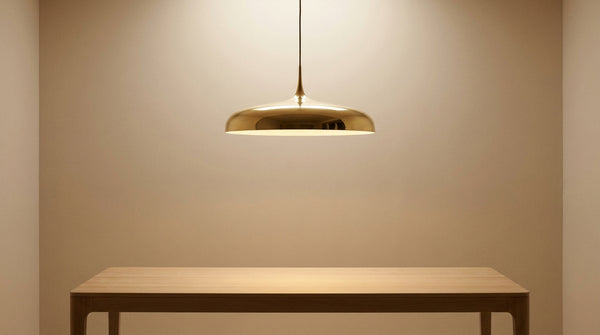
Measure the width of the table and the ceiling height at the fixing point, then work out: the diameter of the chandelier is around a third of the table width, and the pendant hangs between 75 and 85 cm above the tabletop. These two benchmarks frame most choices.
How do you choose the size of a chandelier?
Add the length and width of the room in metres: the total gives a starting diameter in centimetres. A 5 m by 4 m living room therefore calls for a chandelier of around 90 cm. This base is then adjusted according to the furniture, the ceiling height and what the chandelier needs to light. For a living room lighting project carried out room by room, these benchmarks are set before any order.
Which chandelier diameter for which floor area?
| Room area | Chandelier diameter | Typical room |
|---|---|---|
| Less than 10 m² | 40 to 50 cm | Hallway, small study |
| 10 to 20 m² | 50 to 65 cm | Bedroom, dining room |
| 20 to 30 m² | 65 to 80 cm | Living room |
| More than 30 m² | 80 cm and more | Open-plan living room |
Four checks before confirming the size:
- Ceiling height: below 2.50 m, a model no more than 40 cm high
- Clearance: 60 cm free between the edge of the chandelier and each wall
- Weight: check before hanging, the fixing is not always provided
- Number of light points: a chandelier with several branches lights a wider area than a single volume
What width of chandelier above a table?
Allow at least 30 cm less than the width of the tabletop: a 100 cm table calls for a chandelier of 70 cm maximum. If it is narrower, the pendant needs to be raised slightly to clear the line of sight. Our article on the perfect chandelier for a dining room covers round and extended tables.
Of the 126 references in the Grand Lustre collection counted on 4 October 2026, suspended mounting dominates everything else: in a survey of 72 listings, 93 % declare a pendant and 6 % a surface-mounted fitting. A large chandelier is therefore chosen first on cable length.
If you would rather have the measurements taken and the installation confirmed than buy blind, you can ask Designix for advice in a few lines.
Large spaces and statement chandeliers


What are the different styles of chandelier?
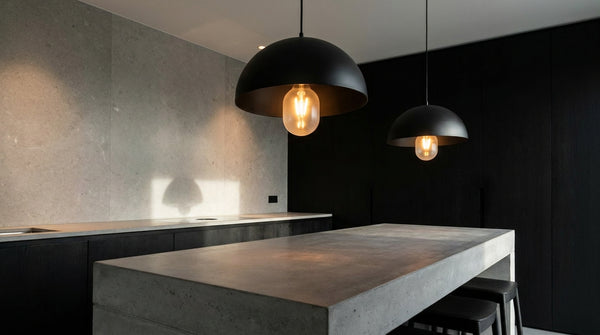
Three families keep coming back: the modern with geometric lines, the industrial in metal with a visible structure, and crystal or glass which diffuses refracted light. Style is chosen after dimensions, once the size is settled.
The modern and contemporary style
In the survey of 72 references carried out on 4 October 2026, 88 % declare a modern style and 56 % a contemporary style, and a listing can carry several. Metal dominates the materials at 61 %, glass follows at 29 %. In an interior that is already busy, a metal pendant light with clean volumes lets the room breathe.
The industrial style and black metal
Exposed wire, visible sockets, raw metal: 26 % of the survey takes this register. The E27 base, present on 46 % of the survey, leaves the choice of filament bulb, the one that gives the expected warm result. The vocabulary is confusing, and our guide to telling a chandelier apart from a pendant light helps you phrase the right request when ordering.
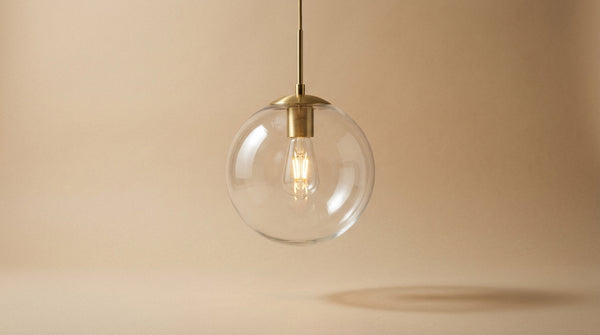
Crystal and glass
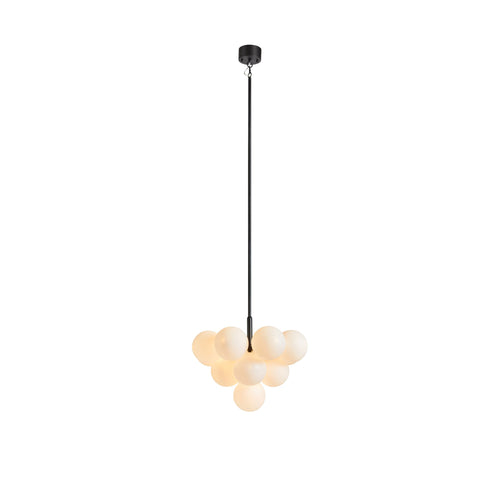
Glass accounts for 29 % of the materials declared in the survey. It refracts light instead of concentrating it, which suits tall rooms and tables where you entertain. A selection of glass lighting lets you compare thicknesses and tints before deciding. When doubt remains about how a finish will hold up over time, the reviews published on Designix's Google listing remain available to read.
Which room will your chandelier live in?
Which chandelier makes a room look bigger?
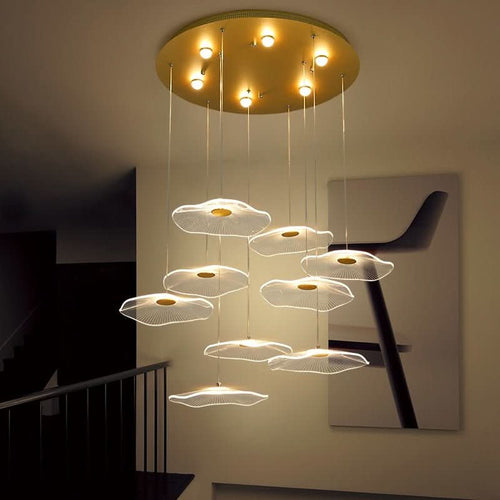
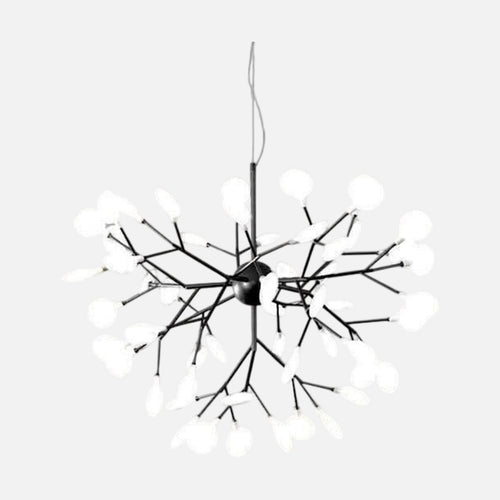
Light the walls rather than the centre: light bounced back towards the walls visually pushes back the limits of the room. A large, slim, openwork diameter makes the space look taller than a solid model, provided you let the surrounding area breathe.
How do you make a room look bigger?
- Indirect light: a halo on the ceiling enlarges, a beam aimed at the floor shrinks
- Light materials: clear and white glass reflect light
- Openwork structure: you see the wall through it, the room feels deeper
- Consistent colour temperatures: mixing two whites breaks the continuity of the space
A bedroom or study lighting project is handled the same way, by spreading the sources rather than concentrating them.
A large diameter, at what distance from the wall?
Allow a minimum of 60 cm between the edge of the chandelier and each wall. Below that, the fitting hides the wall and the room looks narrower, whatever its diameter. A bedroom chandelier stays within this margin, even above a bed.
Which light suits a living room best, warm or white?
Warm white at 2700 K for living rooms: the light leans towards amber and rests the eye in the evening. 3000 K, more neutral, suits worktops and hallways. For a living room, 2700 K remains the benchmark.
2700 K or 3000 K: which to choose?
| Criterion | 2700 K | 3000 K |
|---|---|---|
| Rendering | Warm white, amber | Neutral white |
| Rooms | Living room, bedroom, dining room | Kitchen, hallway, study |
| Effect in the evening | Restful | Crisper, cooler |
Our comparison of warm and cool light explains why cool white tires the eye more at the end of the day.
Can you change the bulb without changing the chandelier?
Yes, as long as the base matches. Watch out for dimming: in the survey of 72 references from 4 October 2026, only 11 % declare a dimmable bulb, 26 % declare the opposite and the rest give no information. If you want to lower the light in the evening, check the wording before buying rather than assuming it. In that case, steer your choice towards a living room chandelier compatible with a dimmer.
At what height should a chandelier hang above a table?
Allow 75 to 85 cm between the bottom of the chandelier and the tabletop. Under a 2.50 m ceiling, this range leaves little margin: a model whose total height does not exceed 40 cm is better. Above a 3 m ceiling, the pendant gets longer and the chandelier drops accordingly.
Why 75 to 85 cm above the tabletop?
Below 75 cm, the chandelier enters the field of vision of seated guests and dazzles them. Above 85 cm, it still lights the tablecloth but loses its role as a focal point. A dining room chandelier is therefore set within this range, then checked while seated, not standing.
Cases with a very high ceiling require a different calculation, which we detail in our article on chandeliers and ceiling height.
A 2.50 m ceiling or a great height?
Once the height is set, three points remain to check before drilling:
- The weight: to check against the strength of the support
- The fixing point: measure at the ceiling, not at the floor
- The ceiling rose: it dresses the start of the cable and hides the holes
The step-by-step method for hanging a chandelier without drilling three times can be read in this guide.
In stock · shipping costs shown at checkout · up to 30% off in your cart
Ready to turn inspiration into reality?
Tell us about your room, your style and your budget, and we will show you the pieces that truly suit your project.
Get guidance in 30 seconds →