80 cm diameter pendant light: how to choose and install it
This article is also available in French: Suspension 80 cm de diamètre
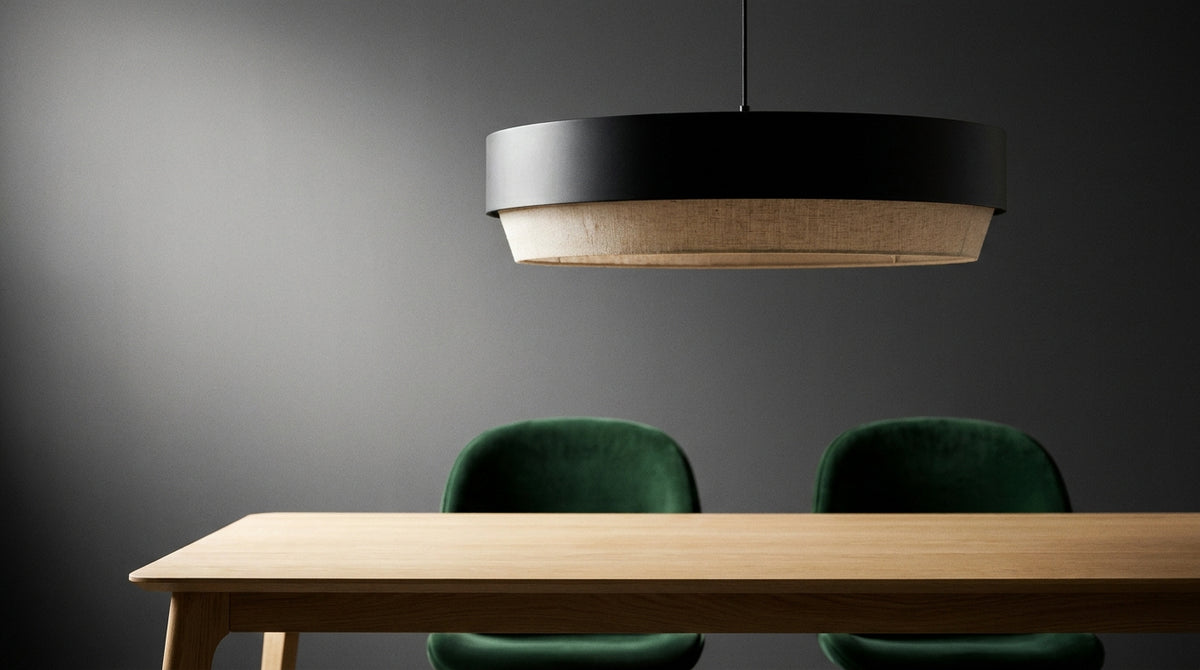
Aim for a diameter equal to half the table's width: 80 cm suits a 160 cm top. Place the bottom of the shade 75 cm above the tabletop, and check two things before buying: the weight your ceiling can take, and an E27 socket for the bulb.
Which room for an 80 cm diameter pendant light?
An 80 cm diameter fits a dining room, a living room with a high ceiling, an open kitchen with an island or a generous entrance hall. It is too bulky for a tight six-seat table, a 2.40 m ceiling and a bedroom where the bed leaves little clearance.
The reference proportion stays simple: the shade covers about half the tabletop's width. On 160 cm, an 80 cm diameter takes up just the right amount of space. Smaller, and it crushes the table; larger, and it floats.
- Dining room of 160 to 180 cm: it covers the tabletop without reaching past the chairs.
- Living room with a high ceiling: it fills the void, provided you raise the whole fixture.
- Open kitchen with an island: it marks the boundary between preparation and meals.
- Bedroom and hallway: rarely suitable, the volume gets in the way of movement.
Large diameter pendant lights are therefore chosen on these measurements; the finish comes afterwards.
A 2.80 m living room is not handled like a 2.50 m dining room: the guidelines for getting the proportions of a large diameter pendant right change with the volume.
80 cm diameter chandelier: the same rule applies
An 80 cm diameter chandelier follows the same proportions: half the table's width, bottom of the shade 75 cm above the tabletop. Only the silhouette changes.
Arm models take up more visual volume than a taut shade of the same diameter. To compare two formats, a chandelier's dimensions should be read as diameter and total height, never one without the other.
Open kitchen or living room: what the diameter changes on the floor
Above an island, an 80 cm diameter lights the prep area in one go. In a living room, the same diameter lights a coffee table, not a whole sofa.
- Island up to 180 cm: one centred pendant is enough.
- Island of 240 cm and more: two smaller formats are better than one.
- Living room: above the coffee table or the reading nook.
- Walkway: 2 m of clearance under the shade.
A kitchen pendant often hangs lower than you would think, because you are lighting the worktop rather than the ceiling.
In a living room, it is placed over a specific area: a living room pendant is chosen for what it lights, not to fill the ceiling.
At what height should an 80 cm diameter pendant light be hung?
The bottom of the shade goes 75 cm above a dining tabletop, about 1.60 m from the floor. Allow 80 to 90 cm above an island and 2.10 m of clear space in a walkway.
Too small a gap dazzles the guests. Too high, the bulb becomes visible and the light is lost to the sides.
| Use | Height of the bottom of the shade |
|---|---|
| Dining table | 75 cm above the tabletop |
| Kitchen island | 80 to 90 cm above the worktop |
| Living room coffee table | 100 to 120 cm |
| Walkway | 2.10 m from the floor minimum |
Above a dining table: the measurement that keeps your guests' gaze free
Before drilling, hold the mounting plate up to the ceiling and check the nature of the support: solid slab, plasterboard with a rail, or a box already in place. This check decides the fixing, not the weight stated on the spec sheet.
Around a 160 cm table, an 80 cm diameter lets the eye move between guests. A dining room light of this diameter is placed centred over the tabletop, never offset towards one end.
Living room and large volume: the adjustable height changes everything
In a living room with a high ceiling, the hanging height is set by what you want to light, not by a fixed measurement. An adjustable cable lets you lower the fixture for a dinner, then raise it again.
Multiplying the sources avoids the spotlight effect on the ceiling: the guidelines for lighting a living room in several layers come down to a few principles.
The gesture is the same everywhere: adjusting your pendant's height before locking the cable for good, never after.
Brass, linen, metal or glass: which material for an 80 cm diameter shade?
Linen softens the light, metal directs it, glass lets it through. At a large diameter, the material is as visible as it is illuminating: it is what decides the tone the room takes on in the evening.
In a survey of 31 lampshade references from our catalogue as of 1 October 2026, linen accounts for 52 %, metal 26 %, fabric 23 % and glass 13 %. A single listing can declare several materials, so these shares do not add up.
80 cm diameter lampshade: what linen changes about the light
A linen shade filters the light towards warm tones and blurs the sharp edge of the light cone. At 80 cm in diameter, the taut surface matters as much as the colour: natural linen gives a matt light, with no reflection on the table.
Metal and glass, when they do better than fabric
Metal sends the light down onto the tabletop instead of spreading it, which suits large tables. Glass lets it circulate in every direction and lets the bulb show: a filament bulb becomes a decorative feature.
Glass pendants stand out most above a pale surface, where transparency lights the space without casting shadows.
Large diameter pendant lights to discover
 pleated white fabric pendant light, oval shade Ø 60 cm | Velina
 K1068RS grey linen lampshade
 Black arc wall reading light, fabric shade Ø60 | Noctis
 Black Scandinavian floor lamp, cork shade, living room reading light | Stang
 Light rattan design chandelier | Calya
 Black Zig-Zag 4253ZW floor lamp with white linen shade – a unique design and functional use
See the whole selection: Lampshades: Pendants, Table Lamps and Floor Lamps
Which diameter: 80, 100 or 120 cm?
The diameter follows the table's width: 80 cm for a 160 cm top, 100 cm for 200 cm, 120 cm for 240 cm and more. In a living room, ceiling height weighs as much as the table in the decision.
100 cm diameter pendant light: from which table upwards
100 cm becomes relevant from a 200 cm table upwards, or in a living room whose ceiling exceeds 2.80 m. Below that, it hangs too close to the plates and hides faces.
To move up to a 100 cm diameter, first check the room's width: a fixture wider than the table unbalances the whole.
44 cm lampshade: the small format, and why it does not replace an 80
A 44 cm shade suits a table of 80 to 90 cm, a reading nook or an entrance. It does not replace an 80 cm: above a large tabletop, it lights the centre and leaves the ends in the dark.
In between, a 120 cm diameter pendant light is only justified in an open volume with plenty of clearance.
If you are still hesitating between two finishes or two diameters, send us your room's dimensions from our contact page: we will reply on what actually holds the scene.
How to install and equip an 80 cm diameter pendant light?
The fixing point decides everything: an 80 cm diameter presents a wider surface than a small format and pulls harder on the ceiling. Identify the nature of the support before drilling, then fit a DCL box or a hook anchored into the structure.
The fixing point and the fixture's real weight
A plate screwed into plaster alone will not hold a large shade. The right move: drill a pilot hole, feel the resistance of the support, and move the fixing point if the drill goes through without effort.
Of 30 listings in our survey that declare a protection rating, 97 % show IP20, meaning dry indoor use. The manufacturer's warranty is 2 years on 97 % of those same listings, and CE certification likewise.
A fitting already present in the ceiling simplifies the connection: the steps to install a pendant on a DCL box come down to a few stages.
E27 socket: the bulb fitted to almost all our pendants
Of 30 of the 31 surveyed listings that declare a socket, 97 % are E27. It is the most common format, and the one that leaves the widest choice among E27 bulbs.
The selection is reviewed by buyers; the reviews published after delivery can be read on the Designix Google listing.
Warm white or neutral white, depending on the room
Warm white, around 2700 K, suits a dining room and a bedroom. Neutral white, around 4000 K, lights a worktop better. A large fabric shade already softens the light: no need to add an overly yellow bulb.
To adjust the intensity, the guidelines on bulb wattage for a dining room avoid the classic mistake of an overly powerful fixture.
Where will your 80 cm pendant light hang?
On the same subject
In stock · shipping costs shown at checkout · up to 30% off in your cart


Ready to turn inspiration into reality?
Tell us about your room, your style and your budget, and we will show you the pieces that truly suit your project.
Get guidance in 30 seconds →