
Boule lights: choosing shape, material and placement
This article is also available in French: Luminaire boule
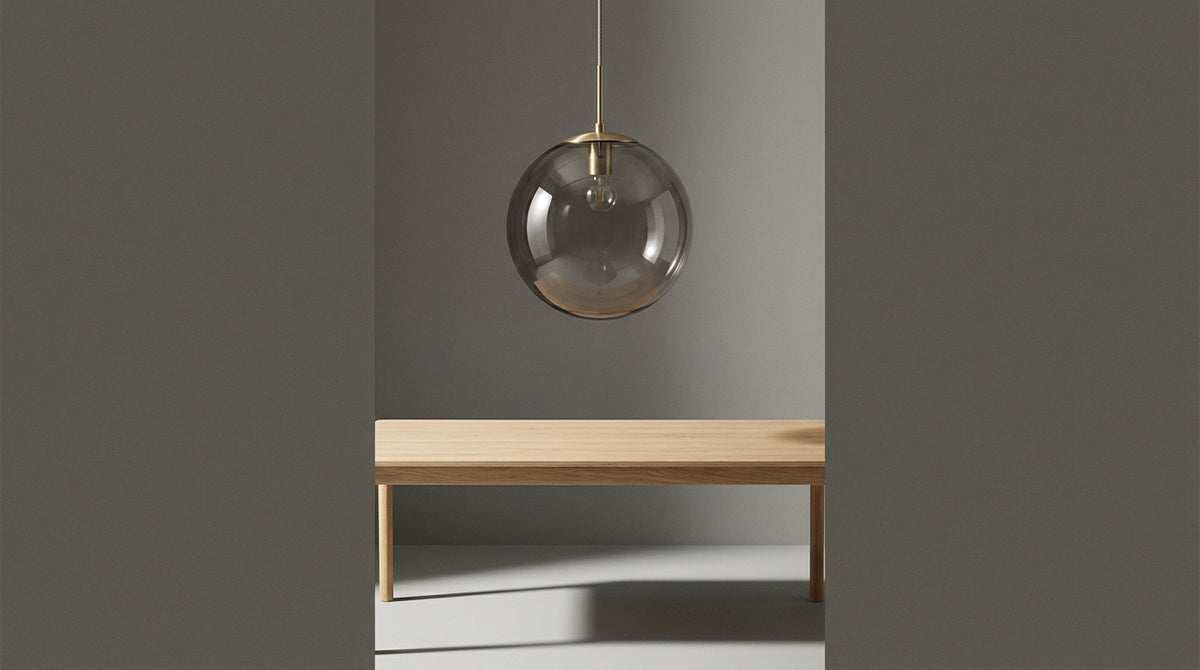
Aim for 30 to 40 cm in diameter for a pendant globe above a table seating six, 20 to 25 cm for a globe on a bedside table, 15 cm for a wall light. In a survey of 250 references from our catalogue as of 12 October 2026, 30% have a spherical shape. Material comes next.
What is a globe light, and what does it change in a room?
A globe light is a sphere that contains the source: glass, metal, paper, rattan. The light is not directed; it goes in all directions and fills the room instead of piercing it. The result is even lighting, without hard shadows, which is most noticeable in the evening.
A globe fits anywhere. It imposes neither angle nor pattern, which explains why it appears above a table, at the bedside or in a hallway. You will find them in every size in the Designix lighting collection.
Glass globe, paper globe, faceted globe: three different lights
The material determines the effect, more than the diameter. Three families to know:
- Glass globe: light passes through, the bulb is visible, the halo is wide and lights the whole room.
- Paper or rattan globe: the light is softened, without glare, ideal in a reading corner or a hallway.
- Faceted globe: each facet throws back a point of light, a strong decorative effect, with less useful illumination.
- Metal globe: opaque, it sends light upwards or downwards depending on the cut.
A glass globe is not a chandelier: the first lights, the second stages. To tell a chandelier from a pendant, count the light points rather than the silhouette.
Why the globe shape appears everywhere
In the survey of 250 references from our catalogue on 12 October 2026, the globe shape is declared on 30% of the listings, tube on 28%, round on 18%. One listing in three in the shop is therefore a globe, often a pendant: pendant mounting appears on 45% of the same survey.
Its neutrality explains this presence: a sphere does not age like a fashionable lampshade, and its light blends with any wall colour. It is the simplest starting point for rethinking a whole room.
How to choose a globe light well
Start with the material, not the size. Glass diffuses far and lights the room, metal concentrates, paper softens. Only then choose the diameter according to the room and the distance between the globe and your eyes. The drop is adjusted to the centimetre.
Which globe size for which room?
The diameter follows the lit area and the available height.
| Diameter | Where | Placement guide |
|---|---|---|
| 15 to 20 cm | Hallway, corridor, wall light | Above the walkway, never in your line of sight |
| 20 to 25 cm | Bedside, side table | Below eye level when you are seated |
| 30 to 40 cm | Dining room for six | Bottom of the globe 75 to 85 cm above the tabletop |
| 45 to 60 cm | Living room, double height | One third of the ceiling height |
Beyond 45 cm, the weight changes category and the fixing point must follow. A large pendant light is planned before drilling, not after.
If you would rather have the drop and diameter checked before ordering, simply describe your room to us: we will reply on the measurements.
Glass globe or metal globe?
| Material | Effect | Where it works | Good to know |
|---|---|---|---|
| Glass | Wide halo, visible source | Living room, dining room | Easy to clean, shows little |
| Metal | Directed light | Tabletop, hallway | Does not diffuse to the sides |
| Paper, rattan, rope | Softened light | Bedroom, corridor | Needs regular dusting |
| Brass, copper | Warm reflections | Dressed interior | Develops a patina over time |
Glass remains the most luminous material: again on the same survey of 250 listings, it is declared on 40% of references, metal on 85%. Glass lamps offer this transparency in smoked, frosted or ribbed versions.
For a full, luminous globe without weighing down the room, glass lights are the safest starting point, whether as a pendant or a table lamp.
Where to place a globe light, room by room?
Three positions are enough: pendant above a table, placed at the bedside or in a hallway, fixed outside when the room becomes a terrace. Diameter and height change each time, the shape does not. Here are the guides that prevent glare.
The pendant globe above the table
Place the bottom of the globe 75 to 85 cm above the tabletop. Higher, it no longer lights the table; lower, it gets in the way of the eye. One globe is enough up to six place settings, two beyond that.
A globe is not only for seeing: it sets the tone of the meal, and that is the whole point of successful ambient lighting. Lowering the intensity in the evening is enough to change the room.
In a large living room, it is better to spread several points rather than increase the diameter. Pendant lights combine well in twos or threes along the same line.
The table globe at the bedside
A globe of 20 to 25 cm on a bedside table gives enough light to read without disturbing the other person. The socket matters less than the position: the sphere must stay below eye level once seated.
A round base accepts almost any shade shape, and the globe is one of them. A well-proportioned bedside lamp does more for sleep than a ceiling light you forget to switch off.
The globe outside, when the room becomes a terrace
Outside, the globe changes requirements: the protection rating comes before aesthetics. IP65 for a spot truly exposed to rain, IP44 under a covered terrace. In the survey of 250 listings on 12 October 2026, IP20 remains the majority at 94%: aiming for IP65 is a deliberate choice.
IP65 outdoor wall lights extend the wall of the house without covering the facade in string lights.
A 25 m² living room under a 2.50 m ceiling is not treated like a 6 m² hallway. Before settling on a size, it can help to have your lighting project assessed, especially if the room serves several purposes.
Our selection is reviewed by buyers, and the Designix Google listing shows it without filters. The workshop is at 12 chemin Maurice Ferréol, in Vaulx-en-Velin: you can come with a plan and a photo.
Globe lights from our selection
 Pendant light | Bravara
 Pendant light | Harmonie Florale
 Pendant light | Mirdanissa
 Ceiling light | Dorica
 Ceiling light | Cylira
 Living room floor lamp | Foglia
See the whole selection: Alternative to Luminaire.fr: designer lighting shop | Designix
Where should the globe go in your home?
Which bulb and which light in a globe?
A standard-sized globe takes an E27 socket, the most common: 26% of the survey of 250 references from our catalogue on 12 October 2026. Small globes take an E14 or a G9. For colour, aim for 2700 K in the evening and 3000 K for working.
E27, E14 or G9: which socket in a globe?
- E27: the large screw socket, the one used on globes of 25 cm and more. The widest choice of bulbs.
- E14: small screw socket, for compact globes and wall lights.
- G9: pins, common on small-diameter globes.
- Integrated LED: nothing to change, but the source cannot be replaced.
A socket is checked on the product listing before ordering. The guide to types of bulbs details the power equivalences from one technology to another.
Warm white or cool white in a globe?
In a globe, the colour temperature shows more than elsewhere: the sphere diffuses the tint throughout the room.
- 2700 K: warm white, close to the old incandescent, for the living room and bedroom.
- 3000 K: warm white slightly more neutral, for the kitchen and bathroom.
- 4000 K and above: cool white, best kept for workrooms.
- Dimming: declared on 25% of the survey of 250 listings, practical for moving from dinner to evening.
The choice between white or yellow light is decided room by room, not for the whole home. If in doubt, 2700 K bulbs remain the safe choice for a globe.
In stock · shipping costs shown at checkout · up to 30% off in your cart


Ready to turn inspiration into reality?
Tell us about your room, your style and your budget, and we will show you the pieces that truly suit your project.
Get guidance in 30 seconds →




