Chandelier or pendant light: how to tell them apart
This article is also available in French: Comment bien faire la distinction entre un lustre et une suspension lumineuse

Count the light points on the product sheet: four bulbs or more spread over a frame with arms, that is a chandelier. A single point at the end of a cable or rod, with or without a shade, is a pendant. Two markers settle doubtful cases: the drop below the ceiling and the socket.
What is the difference between a chandelier and a pendant?
Count the sources, then look at the frame: several light points on arms give a chandelier, a single line coming down gives a pendant. The third criterion is the drop below the ceiling, often short on a chandelier and adjustable on a pendant.
The frame and its arms
A central column, side arms, sometimes two tiers: the frame carries light in several directions at once. It is what fills the volume and stands out from a distance, whether lit or off.
A single-point model can still have a frame, pendants or a cup fixed on a short rod. It then stays close to the ceiling, and the word chandelier suits it better than pendant. A large living room chandelier is chosen over the table, never on the wall.
The single light point
A pendant comes down in a single line, cable or rod, and is adjustable in height. The socket is often visible: in our survey of 96 pendants as of September 30, 2026, 92 listings declare a socket, including LED 33%, E27 31%, E14 13% and G9 8%. This detail determines the bulb you will buy next.
| Criterion | Chandelier | Pendant |
|---|---|---|
| Light points | 2 to 12 and more | 1 most often, up to 3 on a bar |
| Drop below ceiling | short, the light stays high | adjustable, often from 60 to 150 cm |
| Light distribution | wide, upwards and downwards | concentrated on a surface |
| Typical use | living room, hallway, staircase | table, island, worktop |
Redoing a living room often means moving the light point at the same time as the walls. It is the right moment to frame the renovation project for your living space, where ceiling height and table position decide the format.
What is a pendant light?
A pendant light comes down from the ceiling by a cable, a rod or a chain and ends in one or more light points. Its height is adjustable, which makes it useful above a table or a worktop. It lights a precise area, not the whole room.
One light point, an adjustable drop
Adjustment is made during assembly by shortening the cable. That is what allows the same pendant light to be placed above a coffee table or a kitchen counter.
Shade or no shade: what it changes
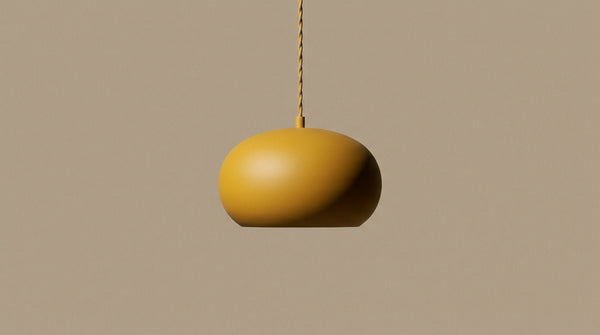
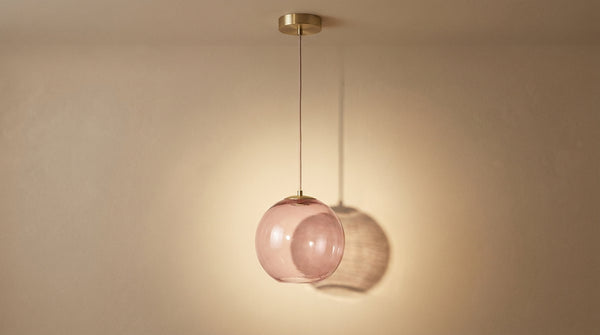
A closed shade concentrates light downwards, an open piece diffuses it around. In the same survey of 96 listings, 43% show a ball shape, 32% a tube shape and 20% an oval shape.
- Ball: enveloping light, made for a round table
- Tube: comes down low, perfect above an island
- Oval: covers a rectangular table without overhanging it
Choosing a pendant shade therefore depends on the shape of the table as much as on the style of the room.
What is the difference between a ceiling light and a chandelier?
A ceiling light touches the ceiling or stands a few centimetres away from it, a chandelier comes down. A ceiling light lights widely without taking up volume, a chandelier becomes a visible element of the room. Under a low ceiling, the ceiling light often remains the most comfortable solution.
The ceiling light stays in contact with the ceiling
Surface-mounted, it frees up the view and lights a circulation area as a whole. A LED ceiling light is chosen on three data points: lumens, colour temperature and diameter, never on style alone.
The chandelier comes down, the ceiling light does not
- Ceiling light: contact with the ceiling, wide lighting, little relief
- Chandelier: short drop, several sources, strong presence
- Pendant: adjustable drop, one source, targeted lighting
A chandelier with short arms, placed almost flush with the ceiling, behaves like a decorative ceiling light. This borderline case leads to a broader question: when no central point is planned, lighting a room without a ceiling light relies on a mix of wall lights and floor lamps.
The fixing deserves a look before drilling: the load is distributed differently between a surface mount and a suspended rod. To settle this point, the simplest is to talk about your project with Designix.
Which light for which room and at what height?
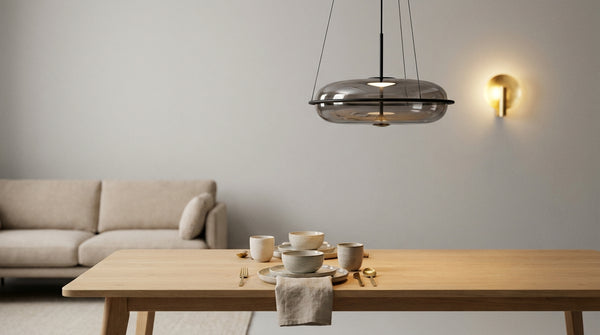
Three measurements decide on their own: the diameter of the light, the height of the table and the ceiling height. The diameter is calculated from the table, not the room, and the bottom of the light sits about 75 cm above the tabletop.
Dining room: the diameter follows the table
Take half the width of the table. On a 90 cm top, aim for 45 cm in diameter; on 120 cm, 60 cm. The rest of the markers are detailed in the guide to choosing a chandelier by dimensions.
On a very long table, two pendants are better than one chandelier that is too wide: guests at the ends are better lit. This is the trade-off detailed in the guide to the dining room chandelier, table by table.
What height between the shade and the tabletop?
Place the bottom of the light 75 cm above the tabletop, and go down to about 60 cm for a more intimate light. Below that, the bulb is visible as soon as you get up from the table.
This height is set during assembly and checked once the table is in place. A dining room chandelier with short arms often needs to be lowered slightly.
Living room, bedroom, kitchen: ceiling height changes everything
- Under 2.40 m: ceiling light or small chandelier, no long pendant
- From 2.40 to 2.80 m: classic pendant above a table
- Over 3 m: long drop or several light points
- Kitchen: two pendants rather than one above an island
In large volumes, a large pendant comes down 1.50 m or more without overwhelming the room.
Pendants and chandeliers to choose for your room
 Pendant Light | Lotus
 White glass pendant | Luminous Sphere
 Baby Room Chandelier | Caro
 Bedroom Wall Light | Glass Ball
 Art Deco Monkey Wall Light | Oryn
 Ball Table Lamp | Orion
See the whole selection: Original Lights: Pendants and Chandeliers with Unique Design
Which light are you really looking for?
How many lumens are needed to light a room?
Count 100 lumens per square metre for the ambience of a living room, 200 to 300 for a table or a worktop. A 20 m² dining room therefore sits around 2,000 lumens in total, spread over several points rather than a single one.
What are the 3 types of lighting?
- Ambient: the general light of the room
- Task: the table, the worktop, reading
- Accent: the wall, the staircase, a highlighted object
A chandelier alone covers ambient lighting, much less task lighting. This breakdown is developed in the guide to choosing the right type of lighting.
Warm white or cool white: which to choose?
Warm white, around 2,700 K, makes a living space more welcoming. Cool white, towards 4,000 K and above, lights whiter and suits a worktop better. The full comparison is in the guide white or yellow light.
How to check a light before ordering it?
Three data points can be read on the product sheet: total height, socket and protection rating. The Original Lights collection has 1,593 references as of September 30, 2026, each listed by room, material and colour. Of the 96 listings recorded the same day, 98% declare an IP20 and 100% a 2-year warranty.
Once the family is decided, the most useful step is to compare actual dimensions: the lighting selection can be filtered by room and colour, socket included.
To get a sense of the shop before ordering, the Designix Google listing shows its current rating and reviews.
On the same subject
In stock · shipping costs shown at checkout · up to 30% off in your cart

Ready to turn inspiration into reality?
Tell us about your room, your style and your budget, and we will show you the pieces that truly suit your project.
Get guidance in 30 seconds →