Designer lighting: light your home with style
This article is also available in French: Les luminaires design qui illumineront votre intérieur
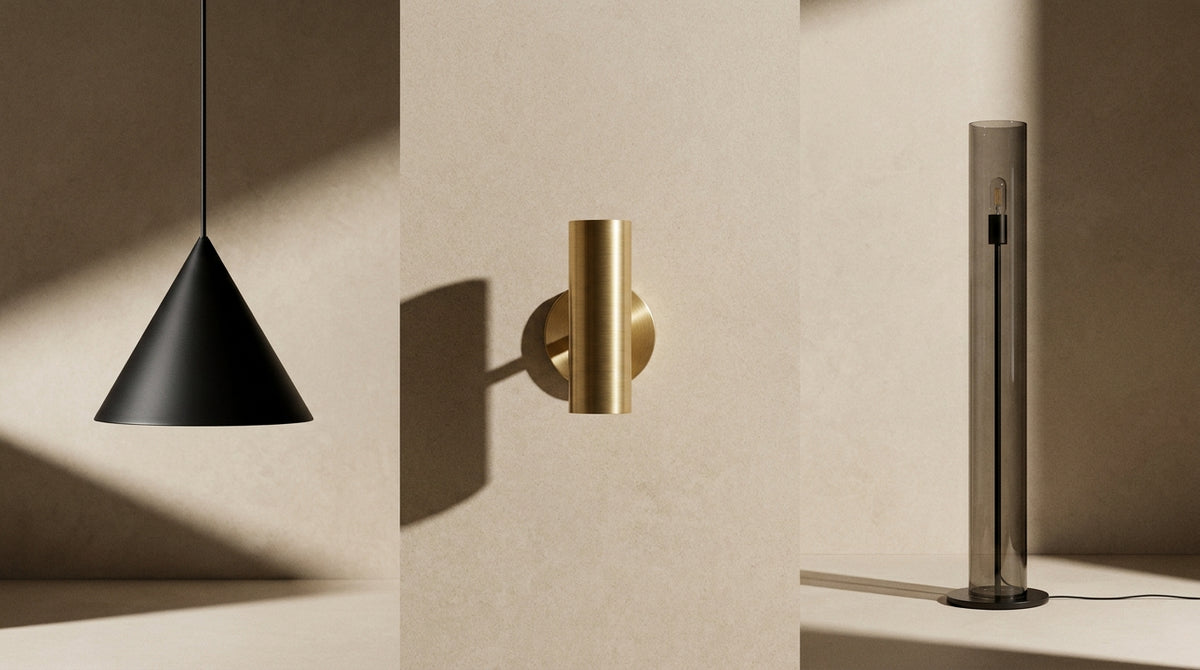
Choose the mounting first, not the style. Across a survey of 250 references from our catalogue as of 30 September 2026, 43% are wall lights, 32% pendants, 15% surface-mounted and 4% table or floor lamps. The mounting determines the height, the room and the quality of light. Style comes after.
Which designer lighting mounting should you choose to light your home?
One main mounting per room, then two secondary sources. A pendant or a ceiling light carries the general light, a wall light works the wall and the circulation areas, a floor lamp creates a corner. The choice depends on the available height and the real use, before any thought of style.
Before ordering, note the clear height under the ceiling, the position of the sockets and the way the room is actually used in the evening. Our decorating advice for lighting your home sets out this survey room by room.
| Mounting | What it lights | Where it excels | Share of the survey |
|---|---|---|---|
| Wall-mounted | a wall, a worktop, a circulation area | bedroom, staircase, hallway | 43% |
| Pendant | the centre of the room, a table surface | dining room, kitchen | 32% |
| Surface-mounted | the whole room from the ceiling | low rooms, corridors | 15% |
| Freestanding | a corner, a bedside table | living room, bedroom | 4% |
This breakdown says the essential: light is designed by use, not by range. In the same survey, the living room mention appears on 82% of the product pages and the bedroom on 71%. Once the mounting is decided, each light can be found by room and by type of installation.
How do you choose designer lighting without getting the mounting wrong?
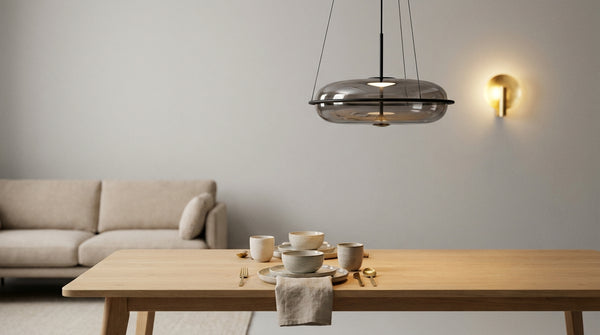
Measure the clear height and the useful reach before looking at a single photo. Above a table, allow 75 to 85 cm between the bottom of the shade and the tabletop. Over a worktop, 70 to 80 cm is enough.
At what height should you hang a pendant above the table?
The right height lets you see faces and lights the plates without glare. At 75 cm, the light falls straight onto the table; at 85 cm, it opens up more, which suits high rooms. Our guide to choosing a designer pendant details these markers according to the size of the tabletop.
If two models still hold you back, a Designix adviser helps you decide between two mountings: simply ask for layout advice, in the Vaulx-en-Velin store or online.
Surface-mounted, wall-mounted or freestanding: what to choose without a ceiling point?
A room without a central power supply is handled differently. Two wall lights facing each other light broadly, an LED ceiling light is fixed to an existing box, a floor lamp takes over at floor level. To go further, our article on lighting a room without a ceiling light reviews each solution.
What should you check before drilling?
- Weight: a pendant light needs a solid support, especially on a high ceiling.
- Socket: E27 on 30% of the survey, GU10 on 11% and G9 on 10%, it determines the bulb.
- Ingress protection: IP20 on 93% of the survey, reserved for dry rooms.
- Dimmability: 29% of the survey indicate it, and it changes the evening in a living room.
One last point settles many hesitations. A dimmable model can be set to 30% after the meal, without changing the mood or switching on a second light. Our designer lighting can also be filtered on this feature.
Which colour temperature for which room?
Aim for 2700 K for a living room, a bedroom or a hallway, 3000 K for a dining room and a kitchen, 4000 K for a worktop or a desk. The temperature is chosen by use, and it changes the room as much as the light fitting.
- 2700 K: the warm light of the evening, which softens woods and textiles.
- 3000 K: a slightly warm white, the compromise between dining and working.
- 4000 K: a neutral white, reserved for worktops and precise reading.
Warm white or neutral white: how do you decide?
The question arises in rooms used at several times of day. A kitchen is lit at 3000 K above the table and at 4000 K over the worktop. Our comparison of white or yellow light helps settle this choice according to the time of use.
LED: what does it really change?
In the survey of 250 references as of 30 September 2026, 78% mention LED. Buying is simpler: no bulb to plan for, and a light that does not fade over the evenings.
Which designer lights for each room, and how many sources do you need?
The living room needs layers of light, the bedroom low light, the dining room a centred point, the kitchen worktop lighting. Allow two to three points per living room, plus one movable point.
Living room: layer rather than light brightly
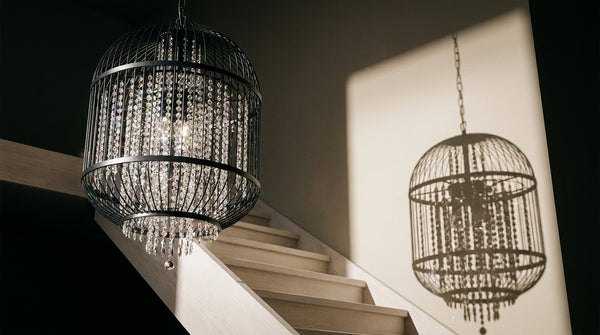
A successful living room keeps the ceiling discreet and multiplies low sources. A large chandelier sets the tone in the centre, with two secondary points around it. In the evening, these low sources create the atmosphere.
Next to an armchair, a floor lamp replaces a second ceiling light and moves with the seasons.
If the room is being fully renovated, lighting is designed at the same time as everything else: our page on living room and family room renovation puts the light fitting back into the whole project.
Bedroom: bring the light down
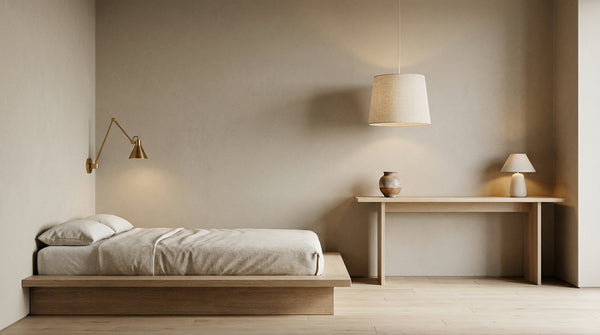
The bedroom copes poorly with light from the ceiling. Two wall lights on either side of the bed, a low lamp, a discreet ceiling light. Our bedroom lighting range brings together the models designed for this use: warm white and dimmable intensity where the product page states it.
Dining room: one point, but well centred
Here, a single point is enough if it hangs low. A large-diameter dining room chandelier above a rectangular table, or two aligned pendants. Glass and metal let the light through, and the table becomes the centre of the room.
Kitchen: light the worktop
In the kitchen, light must fall on your hands, not in your eyes. The right kitchen light is placed near the wall, above the worktop, with a neutral white that keeps colours accurate.
For the number of points, one simple rule holds:
- One main point per room, ceiling light, pendant or chandelier.
- Two secondary points for corners, reading, a low piece of furniture.
- One accent point for what you want to highlight.
Which room do you want to light first?
Style, material, colour: what does our catalogue really say?
Style is read in the materials before it is read in the labels. In the survey of 250 references as of 30 September 2026, contemporary appears on 86% of the product pages, modern on 80%, industrial on 24% and minimalist on 16%.
Which materials and colours dominate?
- Metal 88% of the survey, glass 39%, iron 37%, aluminium 32%.
- Black 60% of the product pages, gold 56%, white 49%, beige 16%.
- Possible overlap: a product page can list several materials and several shades, these shares do not add up.
Should everything match?
No, one common thread is enough. The same metal shade from one room to the next, or the same colour temperature, holds the whole together better than an identical set. Our article on matching lighting styles shows how to pair aged brass and black metal without the house looking like a catalogue.
Then there is trust. Every product page in the survey carries a 2-year guarantee and CE certification, and our Alternative Keria collection brings together 21,640 references as of 30 September 2026. The selection is commented on by our buyers: the Google listing for the store lets you read these reviews and make up your own mind.
Designer lighting: the selection to see according to your mounting
 Applique Murale Aurore Boréale | Rian
 Applique bois et noir | Fusion Élégante
 Lampe Sol Chic Velours Bleu
 Lampe sur Pied Arceau | Iera
 Applique extérieur détecteur de mouvement carrée | Sensoria
 Lampe Extérieure Noire Avec Capteur
See the whole selection: Alternative Keria Luminaires: your new destination | Designix
Related reading
In stock · shipping costs shown at checkout · up to 30% off in your cart
Ready to turn inspiration into reality?
Tell us about your room, your style and your budget, and we will show you the pieces that truly suit your project.
Get guidance in 30 seconds →