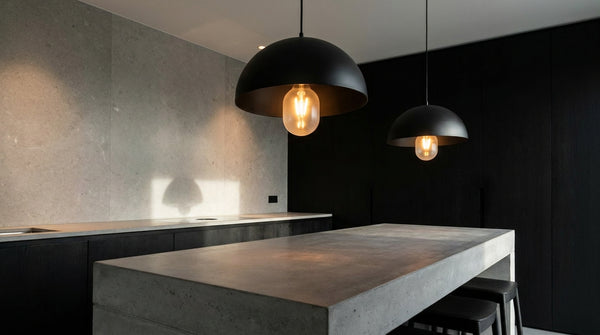
Mixing lighting styles: the thread that holds the room together
This article is also available in French: Associer les styles de luminaires dans une même pièce
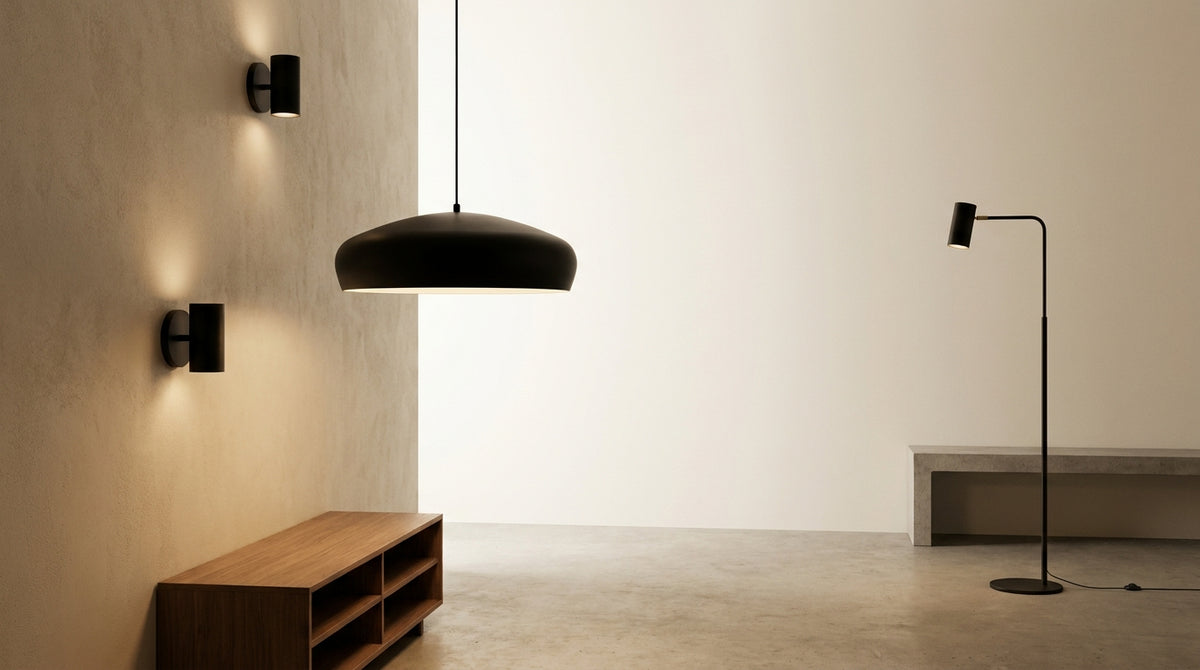
Set a single colour temperature for the whole room, 2700 K or 3000 K, then mix styles without fear. It is two whites lit together that create the false note, never a smoked glass facing a brass one. The rest is just balance to adjust, source by source.
How do you mix lighting styles?
Start from a focal point, then repeat one detail on the other sources: a finish, a metal tone, a shade shape. Three styles can coexist if a single element links them and the whole room shares the same colour temperature. Heights and wattages are then adjusted, zone by zone.
In a living room, this work is thought through by zone before it is thought through object by object. A lighting plan for your living space always starts with the layout: where you read, where you host, where you move. The fixtures come afterwards, chosen for their role.
How many styles can you mix in the same room?
Two, rarely three. One dominant style carries the room, the second adds an accent. Beyond that, the eye looks for a reference point that no longer exists and the room feels cluttered.
The designer light fixtures that mix best keep a simple shape: fewer lines, more freedom around them.
In a survey of 249 references from our catalogue on 5 October 2026, metal is declared on 89% of the sample and glass on 43%.
Two materials that converse effortlessly, and a simply shaped light fixture fits in more easily than a highly drawn piece.
Which detail serves as the common thread?
The finish, almost always. An aged brass repeated on a pendant and a wall light links two eras effortlessly. Matte white also works, more discreetly, and matte black holds up better in a very bright room.
It still needs balancing. To see how to harmonise light with your style, start from a single detail and check that it appears at least twice in the room.
What is the rule of 3 in decoration, applied to light?
It limits a composition to three strong elements. In lighting, that gives three sources per zone: a large source for broad lighting, a secondary source near a task, a low source for atmosphere. Three heights, three roles, a single colour temperature.
How should these three sources be distributed around the room?
By use, never by symmetry. The distribution that works in almost every living room comes down to four markers:
- Pendant or ceiling light: the general light, above the main living point.
- Wall light or floor lamp: the secondary light, near an armchair or a bookcase.
- Table lamp: the atmosphere, at table height.
- Same white: all three sources share the same temperature.
The catalogue follows this installation logic. In the same survey of 249 references on 5 October 2026, wall mounting is declared on 50% of the sample and suspended mounting on 30%. In a dining room, a dining room light fixture hung above the table plays the general source, and the secondary light is placed around it.
Does the 3-5-7 rule replace the rule of 3?
No, it complements it. The 3-5-7 rule counts the objects in a decorative composition, in odd numbers. In lighting, it gives three main sources, five visible points, seven at most. Beyond that, you are switching on groups instead of choosing an atmosphere.
Is it possible to mix decorating styles?
Yes, and a mixed interior often ages better than an interior in a single style. The condition lies in a proportion: around 70% of the room in the dominant style, 30% in the accent style. The link between the two remains the material or the finish, never the colour of light.
Pendants, wall lights and floor lamps to compose the room


How do you make a statement piece and discreet sources coexist?
One strong piece per room, the rest kept in the background.
In a bedroom, a slightly bold bedroom chandelier balances very well with two neutral wall lights.
Discreet sources are chosen for their very discretion.
A wall light above a headboard lights without taking up visual space, and lets the statement piece dominate.
Which style mix works best?
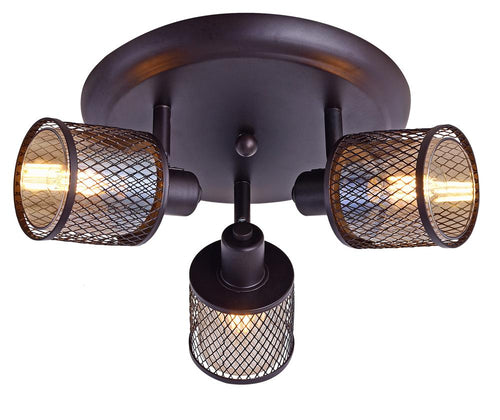
Industrial is the most accommodating style: it brings a material, not an era. Industrial style lamps in black metal fit into a contemporary interior without disturbing it.
The reverse is attempted less often: a very classic fixture in an industrial room looks like it arrived by mistake.
If your room already has its pendant and only the finishes remain to be decided, describe your room to the team: the answer comes with a proposal by zone.
Which colour should you not mix in the same room?
Two colour temperatures lit together. A warm white of 2700 K and a neutral white of 4000 K in the same room give each other away: the first leans yellow, the second bluish. One single white family per room, all sources included, dimmer included.
In your room, what do you start from?
Why is the mixing of whites so visible?
Because the eye compares constantly, even without thinking about it. A pendant at 2700 K above the table and spotlights at 4000 K on the ceiling create two atmospheres in a single volume. Wood looks dull under one, cold under the other.
| Temperature | Rendering | Where to use it |
|---|---|---|
| 2700 K | Warm white, amber | Living room, bedroom, dining room |
| 3000 K | Neutral warm white | Kitchen, hallway, study |
| 4000 K and above | Cool white | Garage, utility room |
Which colour temperature goes with everything?
3000 K works everywhere, from living room to kitchen: neutral enough not to yellow a worktop, warm enough not to cool down a sofa. 2700 K is reserved for relaxation rooms. To choose your bulbs, compare the temperature before the wattage.
For finishes, matte black and matte white remain the two safe choices. If you are looking for blending rather than contrast, see how to create a warm atmosphere without multiplying sources.
What are the lighting trends for the living room in 2026?
Slimmer shapes, mixed materials and light you can adjust. Smoked glass sits alongside brass, pendants stretch into tubes, and dimming becomes the norm rather than the option. One constant: a single colour temperature for the whole room.
Which materials and colours are coming back?
Smoked glass first, which softens the light and pairs with brass as well as matte black. A living room pendant in this material replaces a ceiling light without keeping its heaviness.
In a survey of 249 references from our catalogue on 5 October 2026, black is declared on 57% of the sample, gold on 54% and white on 52%.
The chandelier is also back, in a slim version and often in glass, for tall spaces.
- Smoked glass: it crosses styles without ever clashing.
- Tube and oval shapes: they stretch the light without weighing it down.
- Dimming: essential as soon as a room has three uses.
- A single temperature: the rule that holds everything else together.
Should you change everything at once?
No, and it is rarely the right method. Keep the general source if it lights well, replace the secondary light, then the atmosphere. Lighting trends mostly show material pairings, not isolated objects.
The selection is commented on by buyers, and their feedback can be read in Designix's verified review before deciding on a finish.
In stock · shipping costs shown at checkout · up to 30% off in your cart
Ready to turn inspiration into reality?
Tell us about your room, your style and your budget, and we will show you the pieces that truly suit your project.
Get guidance in 30 seconds →