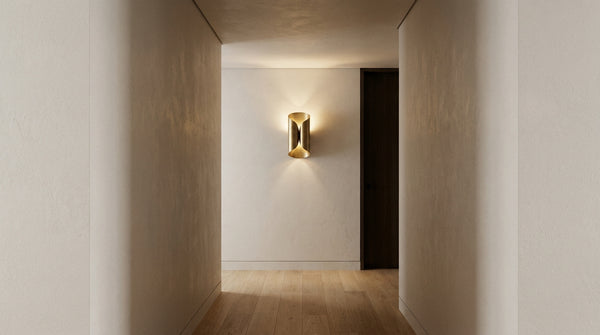
Ceiling light without an electrical supply: 3 solutions
This article is also available in French: Comment installer une lampe au plafond sans arrivée électrique
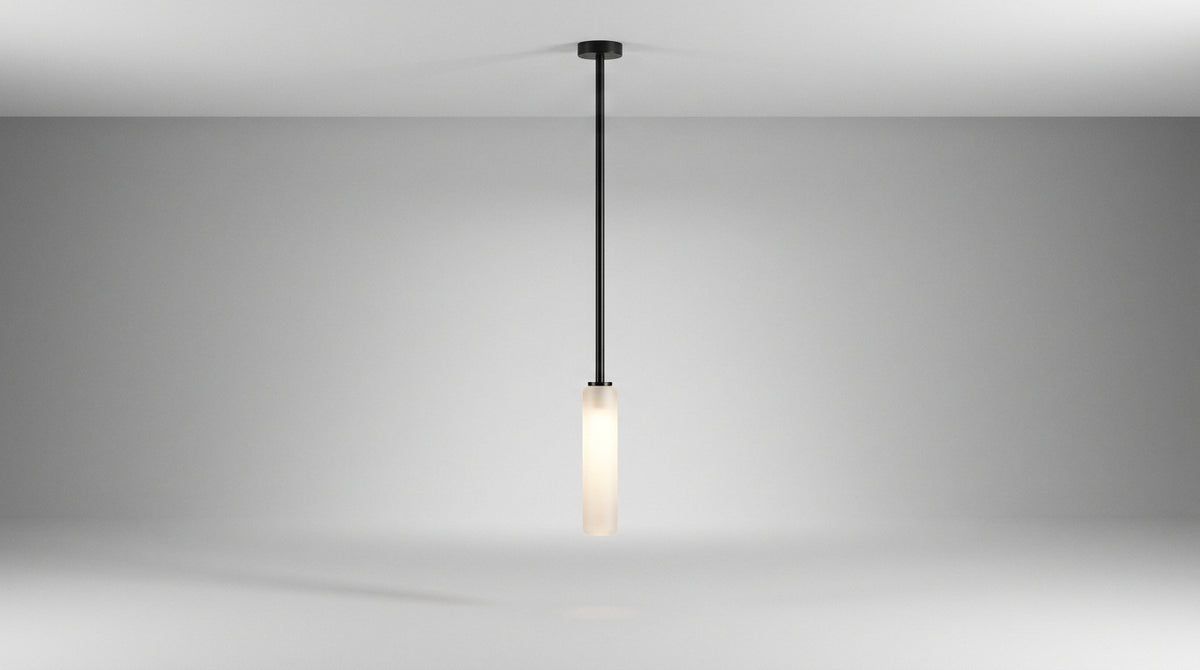
What should I do if there is no electricity at the ceiling?
Three paths are open: a rechargeable LED bulb on a lightweight support, a wall light powered from a nearby socket, or a real ceiling point created from a nearby circuit. The weight of the light fixture decides between them, well before the style you have in mind.
A ceiling light weighing several kilos will not hold on adhesive tape; a model under one kilo manages perfectly well without it. Weigh the item you want to install before comparing finishes, because that figure already rules out two of the three options. It also guides the choice of model, and a selection of designer lighting reads differently depending on whether you can drill or not.
Ceiling light without an electrical connection: the three possible paths
Only one path can be done without tools; the other two require technical work. Everything depends on the nature of the ceiling and on what you are willing to change in the room.
- Rechargeable LED bulb: no power supply at the ceiling, recharged by USB cable, often controlled remotely
- Adhesive support: reserved for lightweight fixtures, on a smooth, dust-free ceiling
- Wall light on a socket: an exposed cable to an existing socket, no structural drilling
- Point derived from a nearby circuit: the only solution that powers a ceiling lamp continuously, without thinking about it
Lightweight ceiling lights and pendants to install
 Barn 3-light ceiling light in black and gold, Premium
 Barn 3-light ceiling light in black, Premium
 Square bathroom ceiling light | Quadris
 Barn 3-light ceiling light in black
 Gearwood Grey Industrial Ceiling Light
 Barn ceiling light in black
See the whole selection: Ceiling Light, Ceiling Lamp and Ceiling Lighting
Light without electricity indoors: what it really means
Lighting without power means accepting a local light instead of general lighting. A battery runs down, the intensity is adjusted by hand, and the result depends entirely on the colour temperature chosen.
- 2700 K: warm white, the closest to a classic bulb in a living room or bedroom
- 4000 K: neutral white, easier to read by in a hallway or kitchen
- Battery life: a few hours of continuous use, far less if you stay at high intensity
- Recharging: by USB cable, which means an accessible socket in the room
In a living room, a lightweight living room ceiling light is fine with a correctly applied adhesive support.
If the room has no light point at all, the answer often comes from the wall rather than the ceiling: lighting a room without a ceiling light relies on several low sources placed at different heights.
How can I connect a lamp without an electrical socket?
You do not connect anything: you replace the lamp with a self-contained model, or you bring the current to it from a nearby socket or switch. A battery-powered LED bulb fits any light fixture with a socket and works without a wire or plug.
Which ceiling, which use: which selection is yours?
The question comes up again and again: how to connect a lamp to the ceiling when there is neither wire nor box. The honest answer is that you do not; you choose a fixture that does without, or you bring the current another way.
The rechargeable LED bulb and its weight limits
A rechargeable bulb weighs more than a classic bulb, and that mass rests entirely on the support. This is the constraint to know before choosing a large lampshade.
- E27 socket: the most common, it accepts most decorative sockets
- E14 socket: for small volumes and table lamps
- Weight: the battery adds volume and mass at the hanging point
- Intensity: adjustable on many models, sometimes in several shades
Pendant light without an electrical connection: adhesive hook or mechanical fixing
An adhesive hook holds a lightweight fixture on a smooth ceiling, nothing more. Beyond that, mechanical fixing remains the only reliable long-term hold.
| Criterion | Adhesive hook | Wall plug and mechanical fixing |
|---|---|---|
| Weight supported | Low | The whole range, glass pendants included |
| Type of surface | Smooth paint, no relief | Concrete, plasterboard, wood |
| Reversibility | Removal without a trace in principle | A hole to fill |
| Long-term hold | To be monitored, heat loosens it | Durable |
The details of fixings are covered in our guide to fixing a ceiling light without drilling.
A pendant light in rattan, fibre or textile stays within the range an adhesive accepts, which is not the case for glass.
How can I create an electrical supply at the ceiling?
You do not start from the consumer unit: you derive a point from a socket or switch on the same circuit, then run it up to the ceiling. The route is made by chasing or trunking and ends in a connection box.
Tapping a nearby socket or switch
The principle is simple: a lighting circuit already exists in the room or behind the partition. You derive a point from it, provided you do not exceed what the circuit can take.
- Locating: identify the relevant circuit breaker and switch it off before any work
- Cross-section: the derived conductor stays consistent with that of the original circuit
- Three conductors: live, neutral and earth for a connected ceiling light
- Two-way switching: possible from an existing switch, reusing its travellers
Creating a DCL box in the ceiling
The DCL box is the connection point intended for a ceiling light. Installing it involves a hole, a box and a clean connection, so a cable run to it.
The method is described step by step in our guide to installing a light on a DCL box. Once the point is created, the constraint disappears and you choose freely, including a large-diameter LED ceiling light.
If your ceiling is plasterboard or the consumer unit is at the other end of the home, it is better to decide beforehand: writing to us lets you confirm the starting point before buying anything.
What are the drawbacks of wireless switches?
Three limits keep coming up: radio range, the battery to replace and the pairing to redo after an outage. A wireless control does not carry current, it only allows it through, and works only on a fixture already connected to the mains.
Range, battery and pairing
A wireless transmitter struggles through load-bearing walls and slabs. The stated range applies to an open space, not to an old home with thick partitions.
- Range: reduced behind reinforced concrete and metal linings
- Battery: to be replaced periodically, with an inconsistent warning depending on the model
- Pairing: to be redone after a battery change or a long outage
- Compatibility: not all receivers talk to each other
A wireless wall light avoids the problem at the source: the control is built into the fixture, so there is nothing to pair.
What the control does not operate
A remote control turns on, turns off, adjusts intensity and sometimes the shade. It powers nothing and does not replace a mains connection.
- Intensity: only if the bulb or driver is dimmer-compatible
- Shade: only on models with several colour temperatures
- Multi-room: a remote rarely controls several spaces with distinct settings
- Failure: without a battery or receiver, nothing lights up, even from the wall switch
Our article on turning on the light remotely details what phone control really adds.
When no point exists at the ceiling, a wall light that plugs into a socket remains the simplest compromise, with its own switch.
Is it possible to install a ceiling light without an electrical supply?
Yes, on three conditions: a lightweight fixture, a support suited to the nature of the ceiling, and a self-contained bulb or a diverted power supply. If one of the three is missing, the installation lasts a few weeks at best, or not at all.
Concrete, plasterboard or wood: what the ceiling accepts
Plasterboard accepts a toggle plug, concrete requires percussion drilling, wood is screwed directly. A painted or fibrous plaster ceiling is suitable for gluing, provided the surface is flat.
- Concrete: hammer-in plug, maximum hold, drilling required
- Plasterboard: toggle plug, never a simple plastic plug
- Wood: direct screw, watching the thickness of the boards
- Fibrous plaster and paint: gluing possible only under one kilo
Weight, socket and ingress protection rating
In a survey of 147 references from our ceiling light collection on 1 October 2026, 85% are surface-mounted and 10% suspended. Surface mounting presses the fixture against the support, which distributes the load and shortens the lever arm.
In the same survey, 31% of the 113 listings that declare a socket are E27, 97% of the 146 that declare an ingress protection rating are IP20, and 99% carry a 2-year warranty. IP20 is suitable in a dry room; a bathroom requires another rating. The collection had 4862 references on that date.
One last reference point before choosing: our guide to pendant lights without drilling lists the fixings that hold without a hole. Glass remains the heaviest case, and a glass pendant is reserved for ceilings that accept a wall plug.
To see the result in situ, the verifiable customer reviews on our Google listing remain available at any time.
In stock · shipping costs shown at checkout · up to 30% off in your cart


Ready to turn inspiration into reality?
Tell us about your room, your style and your budget, and we will show you the pieces that truly suit your project.
Get guidance in 30 seconds →