Lighting every room well: the guide to perfect lighting
This article is also available in French: Comment Trouver l'Éclairage parfait pour Votre Intérieur
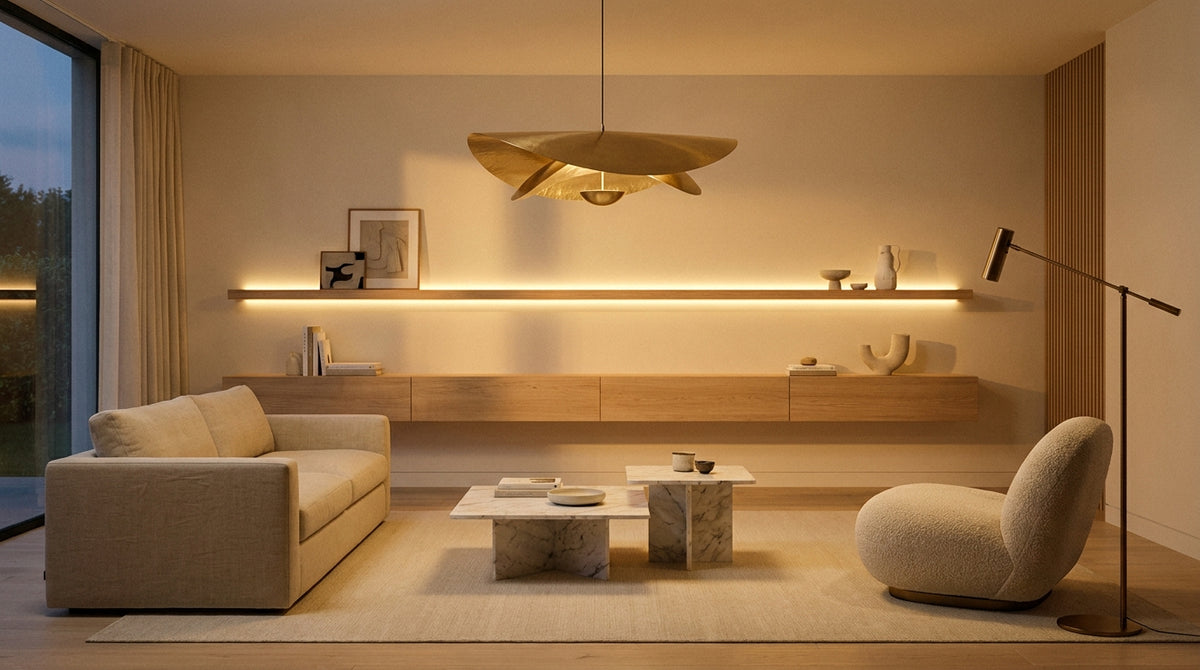
Plan for three light sources at different heights in each room: a ceiling light or spotlights, a table lamp, a wall light or a floor lamp. Set the temperature from 2700 K for relaxation to 4000 K for precise tasks, and aim for a total lumen count suited to the surface rather than a single central point on the ceiling.
What are the tips for lighting the inside of a house?
Layer three lighting functions: general lighting that sets the base level, ambient lighting that softens, and accent lighting that highlights a wall or an object. A single source on the ceiling hardens shadows and strains the eyes. Multiply the points, not the power.
General, ambient and accent lighting
General lighting comes down from the ceiling (ceiling light, spotlights). It is complemented by ambient lighting from table lamps and wall lights, at eye level.
The third layer is used to highlight an object: a directional spotlight on a bookcase, a painting, a plant. It is this layer that gives the room depth.
How do you choose your indoor lighting, room by room?
Start from the use, not the fixture. A kitchen calls for crisp light on the worktop; a bedroom, low and enveloping light. To cover every case, our lighting collection covers the living room, kitchen, bedroom and bathroom with the appropriate protection ratings.
What gives the most light, warm white or cool white?
At equal lumens, cool white (4000 to 6500 K) looks brighter because it renders contrasts; warm white (2700 to 3000 K) lights just as much but seems softer. It is not the colour that doses the quantity of light, it is the lumens. The temperature sets the mood.
Which colour temperature for each room?
Allow 2700 K in the living room and bedroom for relaxation, 3000 K in the dining room, 4000 K in the kitchen and office to work without straining. In the bathroom, 4000 K in front of the mirror and 3000 K in the rest of the room give a good balance.
White or yellow light: how do you decide?
A restful room benefits from warm yellow, a task area from neutral white. To decide without getting it wrong, this detailed comparison helps you choose between white or yellow light depending on the activity. A dimmer lets you switch from one register to the other in the same room.
How do you find the perfect lighting for your home, room by room?
Add up the lumens per surface, then spread them over at least three sources. Allow around 100 to 150 lumens per m² in the living room, 300 in the kitchen and on worktops, 100 in the bedroom. Then choose the protection rating according to the room's humidity.
How many lumens for a living room and a dining room?
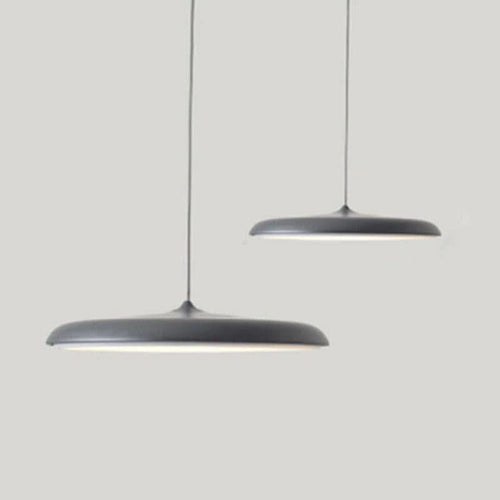
For a 20 m² living room, aim for 2000 to 3000 combined lumens, never concentrated in one point. Above the table, a pendant light placed 70-85 cm from the surface frames the light without dazzling the guests.
To set your figures room by room, this method for calculating the required lighting gives the detail of the calculation per m². A well-divided living area is also arranged by following the benchmarks for lighting your living room effectively.
What bulb wattage for the kitchen?
In the kitchen, allow 300 lumens per m² and reinforce the worktop with task lighting under the cabinets, at 4000 K. Precise tasks (chopping, cooking) need crisp light with no cast shadow.
The classic mistakes and the right spotlight positions are detailed in our advice for getting kitchen lighting right.
Our light fixtures to compose your lighting
 Suspension Luminaire Naturel | Erel
 Dallas Suspension luminaire doré
 Puntes Suspension luminaire doré
 Erich Suspension luminaire argenté
 Lustre Chic et Moderne | Lueur Fluxion
 Erich Suspension luminaire doré
See the whole selection: Lighting, Home Lighting, Online Lighting Store
How many lumens for a bedroom and which IP in the bathroom?
In the bedroom, stay low: 100 lumens per m² in general and two dimmable bedside reading lights. The choice of model depends on space and style, as this guide on which light fixture for the bedroom shows.
The bathroom dictates the protection rating. On a survey of 250 light fixtures from our catalogue as of 23 September 2026, 94% are IP20 (dry interior) and 4% are IP65: reserve the latter for zones close to the shower, and IP44 for the area around the washbasin.
Once your lighting plan is set room by room, you can review it with an advisor before buying to confirm lumens, temperature and protection rating.
Which room do you want to light first?
What are the tricks for lighting a room?
Avoid three costly mistakes: relying entirely on the ceiling, keeping a single temperature everywhere, and neglecting the protection rating in a damp room. Add a dimmer, alternate the heights of your sources, and favour LED, which uses less and lasts longer.
The mistakes that cost dearly
A ceiling light alone flattens the volume and multiplies shadow zones. Uniform light that is too cool makes a living room feel cold; too warm, it darkens a kitchen. An IP20 placed near a shower ages quickly and becomes a risk.
Choosing your bulbs and sockets well
Check the socket before buying: on the same survey of 250 references, E27 comes out at 29%, E14 at 12%, GU10 at 10%. To avoid the wrong format or the wrong rendering, this guide for choosing your bulbs covers each socket.
On reliability, 78% of the same survey carries the LED mention, 96% is guaranteed for 2 years and 100% is CE certified. If you are still hesitating, buyer reviews on the Designix Google listing help you decide.
On the same subject
In stock · shipping costs shown at checkout · up to 30% off in your cart
Ready to turn inspiration into reality?
Tell us about your room, your style and your budget, and we will show you the pieces that truly suit your project.
Get guidance in 30 seconds →