How to choose the right type of lighting for each room
This article is also available in French: Comment Choisir le Type d'Eclairage le Plus Adapté ?

Count three sources at three different heights: one on the ceiling for broad light, one on the wall to follow the eye, one at hand height for reading or working. Before looking at the shape, settle the socket, the protection rating and the mounting method. Style comes last. Three well-distributed points light better than a single powerful ceiling fixture.
What are the 3 types of lighting?
General lighting lights the whole room, task lighting lights a specific area, accent lighting highlights a focal point. A comfortable room combines all three: a base on the ceiling, a low point near the sofa, a beam aimed at a wall.
Our lighting collection brings together 25,950 references as of 30 September 2026. Enough to cover all three layers in the same room without mixing styles, from the discreet ceiling fixture to the design lamp placed on a piece of furniture.
How do you recognise ambient lighting?
A soft light, often indirect, that does not reflect the reader's face. A fabric shade, a wall light aimed upwards, a dimmer: that is what ambient lighting really is. It is judged in the evening, never in broad daylight.
What is task lighting?
A flow concentrated on a gesture: chopping, reading, applying make-up. The source is offset so that the shadow of the hand does not fall on the work. Our article on task lighting, light and function gives the heights for each use.
What is accent lighting for?
It gives depth: a stone wall, a bookcase, a plant gain relief as soon as a beam grazes them. Two points are enough in a living room, three already create a stage. Accent lighting succeeds when you see the object, not the source.
In a living room to be renovated, these three layers are decided before the work starts. The page on living room and everyday space renovation details the order of the work.
What is the difference between 3000 K and 4000 K?
3000 K leans towards amber and invites calm, 4000 K offers a neutral white, close to daylight, that wakes you up. At equal power, a cool white appears brighter. Reserve 3000 K for the living room and the bedroom, keep 4000 K for the worktop, the mirror and the desk.
Which light is best for the living room: warm or cool?
Warm, without hesitation: 2700 to 3000 K in the evening. Cool white cuts through materials, tires the eye over time and cools down a carefully styled interior. If you are still unsure, our guide to choosing between white and yellow light covers every situation.
Which LED bulb does not hurt the eyes?
It is not a matter of temperature but of diffusion. A bright, visible source tires the eye more than an indirect cool white. An opal globe, frosted glass or a wall light that sends the light upwards solves the problem without touching the installation.
How to choose by room?
Start from the gesture before the surface: you sit and read in the living room, you chop and wash in the kitchen, you wake up gently in the bedroom, you look at yourself in a mirror in the bathroom. Each gesture calls for its own source, at its own height. Style is chosen afterwards.
What lighting for the living room?
Count at least three points: a high source for the base, a living room pendant above the sofa or the dining area, an occasional light near the armchair. A dimmer sets the mood without switching the room off.
The exact heights and the distribution of power are in our article on lighting your living room in three layers.
What lighting for the kitchen?
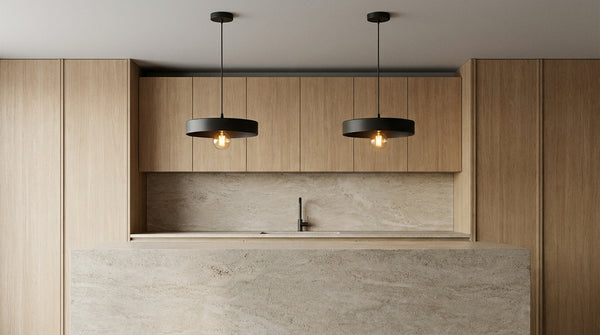
A discreet general light on the ceiling, then one point per work area. An adjustable kitchen light above the worktop is worth more than three ceiling fixtures. The island deserves its own pendant, high enough not to get in the way of the eye.
What lighting for the bedroom?
The goal is to read without waking the other person. Two low points on either side of the bed, a soft ceiling fixture for the rest, 2700 K everywhere. A floor lamp near an armchair adds an occasional point that is easy to move.
What lighting for the bathroom?
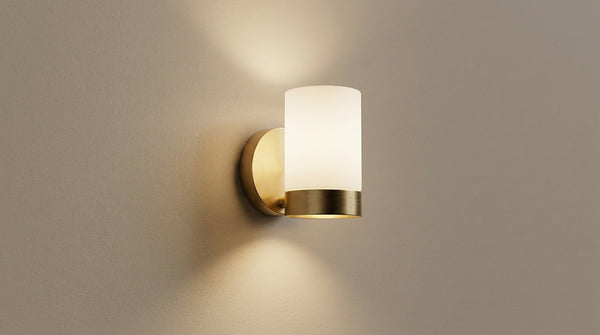
Never a single point on the ceiling: it flattens the features and leaves the mirror in the dark. Two wall lights on either side of the mirror light the face without casting shadows. The colour and the water resistance are then checked on the technical sheet.
Ready-to-install lights, room by room
 Basic form gold pendant light
 Basic form gold pendant light
 Basic form gold pendant light
 Velora brown outdoor light
 Bobi 2-light black pendant
 Gentor 4-light white pendant
See the whole selection: Lighting, Home Lighting, Online Lighting Store
What is the difference between IP44 and IP65?
IP44 protects against water splashes, IP65 against water jets and dust. A wall light above a washbasin is fine with IP44; a fitting exposed to the shower or a terrace requires IP65. The rating is read before the shape, never after the purchase.
| Rating | Protection | Where to install it |
|---|---|---|
| IP20 | No protection against water | Living room, bedroom, hallway |
| IP44 | Water splashes | Around the washbasin, kitchen |
| IP65 | Water jets and dust | Near the shower, terrace, garden |
In a survey of 250 references from our catalogue as of 30 September 2026, 94% declare IP20, 4% IP65 and 2% IP44. A bathroom light is therefore not chosen on style: it is first filtered on the rating.
Should you choose a warm or cool white LED for the bathroom?
Warm around the bathtub, 4000 K above the mirror: you look better in a neutral white, you relax better in a warm white. Our selection of IP44 wall lights for a spa-style bathroom covers both options.
Where do you read the protection rating on the product sheet?
In the technical specifications, next to the socket, the material and the warranty. In the same survey of 250 references, 94% are given for 2 years and 6% for 5 years. These three lines are worth more than the photo of the product in situ.
For the reliability of a specific reference, the reviews left by buyers remain public on the Google listing of the store.
Which room are you looking for light in?
Which socket to choose: E27, E14, GU10 or integrated LED?
The socket decides whether the bulb will ever be replaced: E27 and E14 change in a minute, GU10 too, an integrated LED lives with the light. Out of 250 references recorded in our catalogue as of 30 September 2026, 225 declare their socket: 30% an E27, 15% an E14, 11% a GU10 and 19% an LED.
| Socket | What it changes day to day |
|---|---|
| E27 | The most widespread, all bulb styles, immediate replacement |
| E14 | Small thread, for wall lights, occasional lamps and slim pendants |
| GU10 | Pin spotlight, directed and adjustable beam |
| Integrated LED | Nothing to change, but nothing to repair either |
How do you know which socket to choose before buying?
Look at the gesture before the power: a reading lamp wants a concentrated beam, a ceiling fixture wants a broad beam. The socket follows the shape of the shade, never the reverse. Our guide to bulb types and their sockets covers every case.
What are the drawbacks of LED lamps?
Three come up often: the lifespan depends on the ventilation of the light, some entry-level models flicker, and an integrated LED condemns the light when it fails. A well-ventilated LED ceiling light already limits the first two points.
The third remains. When the electronics fail, all is not lost: our tutorial on replacing an integrated LED explains the possible solutions.
If you would rather decide with us, describe your room and your constraints via our contact page: we start from the socket and the protection rating you need, not from the model that suits us.
On the same topic
In stock · shipping costs shown at checkout · up to 30% off in your cart
Ready to turn inspiration into reality?
Tell us about your room, your style and your budget, and we will show you the pieces that truly suit your project.
Get guidance in 30 seconds →