Changing a halogen bulb: the right move, without breaking it
This article is also available in French: Changer une ampoule halogène
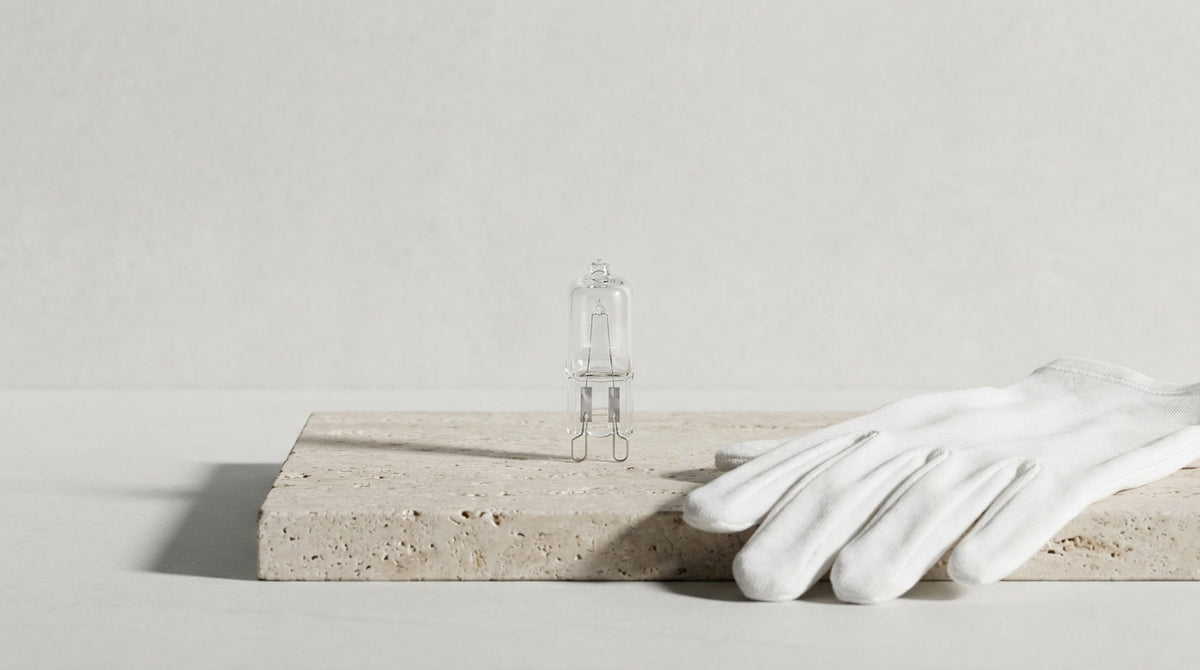
Switch off the power at the breaker, let the bulb cool for five minutes, then grip it with a clean cloth. On a screw base, a quarter turn to the left is enough. On a pencil halogen or a spotlight, press the pin and pull straight, never touching the glass with your fingers.
What precautions should you take when changing a halogen bulb?
Cut the power, wait for it to cool completely, never put your fingers on the glass. A halogen stays hot for several minutes after switching off, and a trace of skin is enough to weaken its envelope. Any doubt about a base can be cleared up in the Designix help and after-sales section, before forcing anything.
- Breaker switched off, not just the wall switch
- Complete cooling, several minutes after switching off
- Clean cloth or thin gloves, never bare fingers
- Stable stepladder rather than a chair for high points
Why should you never touch the glass of a halogen with your fingers?
Skin sebum leaves a trace that concentrates heat when the power comes back on. On a quartz envelope, this hot spot can crack the glass, sometimes within the first few minutes. A dry cloth or a thin glove is enough to keep the bulb clean.
Can you change a halogen bulb without cutting the power?
No, except on an extra-low-voltage fixture that has already been unplugged. The wall switch often cuts the live wire but not the neutral, whereas the breaker truly isolates the circuit. A trip to the consumer unit is better than a socket left live while your fingers go in.
How do you change a halogen bulb, base by base?
The move depends on the base, not on the brand of the fixture. A G9 comes out by pressing its two loops of pins, a GU10 is unscrewed with a quarter turn, an R7s is freed by pushing it sideways. Find your base in the table, and the rest follows.
| Base | Voltage | Fixing | Move |
|---|---|---|---|
| G9 | 230 V | two loops of pins | press the pin, pull straight |
| G4 and GY6.35 | 12 V, transformer | two thin pins | pinch the pins, pull straight |
| GU10 | 230 V | bayonet | quarter turn to the left |
| R7s | 230 V | lugged tube | push on one side, free the other |
| E27 and E14 | 230 V | screw thread | unscrew to the left |
The gap between two sockets often comes down to a few millimetres; recognising an E27, E14 or GU10 base is therefore done by eye, on the diameter and the number of pins.
How do you change a pencil halogen bulb in G9?
Gently press on each loop of pins, then take the bulb out along the axis of the socket. You press the metal, never the glass. A G9 that resists when refitting often has a bent pin: straighten it before insisting. The detail of the move is here: the pencil halogen bulb comes out differently.
Why is a 12 V G4 not changed like a G9?
The G4 and the GY6.35 run on 12 V, behind a transformer housed in the fixture or in the ceiling panel. The pins are thinner: you pinch them between two fingers, without pulling on the glass. If the new one stays off, the transformer deserves a check before blaming the bulb. G4 and G9 bulbs are chosen on this voltage, displayed near the socket.
How do you change a halogen bulb in a GU10 ceiling spotlight?
Cut the power, let it cool, then turn the GU10 a quarter turn to the left: it comes down on its own. On the ceiling, keep one hand free to hold the spotlight ring. GU10 LED bulbs use exactly the same move, with far less heat.
How do you change a long halogen bulb in R7s?
The R7s is a tube: it is freed by pushing one end inwards, then the other comes out of its lug. You take it out from the side, never by twisting it. Refitting follows the reverse path, holding the bulb with a cloth.
Replacement bulbs: the selection by base


What should I do if my halogen lamp no longer works?
Test the bulb in another socket before concluding. If it lights up elsewhere, the problem comes from the holder, the transformer or the fixture. If it stays off, it has blown, and changing a ceiling bulb then only requires a replacement.
How do you know if a halogen bulb has blown?
Three signs can be read without a tool: a broken filament, a greyish glass, a browned socket. Shake the bulb near your ear, a slight rattle confirms it has gone. If the glass is clear but the holder is charred, it is the socket that needs changing, not the bulb.
When it is the whole fixture that is wearing out, replacing the part with an LED ceiling light removes the question of the socket and the base.
To choose the replacement, our catalogue serves as a reference. As of 30 September 2026, the Design Bulbs collection has 282 references. On a sample of 33 of these references on the same date, the E27 base comes out at 42%, the G9 at 27%, the G4 at 24% and the E14 at 15%. LED technology is declared on all 33 listings, and the 2-year warranty on 73% of the sample, 5 years on 27%.
If you would rather start again with a new bulb in the right base than insist on a worn socket, browse the replacement bulbs, base by base.
How do you get a bulb stuck in its socket out?
Cut the power, let it cool, then free the glass with a cloth. If the bulb is stuck or welded, a thin screwdriver slipped between the glass and the socket helps to loosen it. When the holder is brown or charred, it gets replaced: forcing a seized bulb breaks the glass in the socket. The case of the recessed spotlight whose spring holds the bulb is solved the same way, by compressing the springs before pulling.
Which base does your fixture take?
Is it possible to replace a halogen bulb with an LED?
Yes, in almost all cases, on two conditions: compare the lumens and check compatibility with the dimmer. An LED heats up much less and uses far less power for the same flux. Three pieces of information are enough to choose: the base, the flux and the voltage. With these references, switching from halogen to LED can be done without trial and error.
Why compare in lumens rather than in watts?
The lumen measures the light emitted, the watt the power drawn. A low-power LED can outperform a more power-hungry halogen, and the reverse also exists. Read the lumens on the packaging, then the colour temperature: 2700 K for a warm white, 4000 K for a neutral white. For a pencil base, replacing a pencil halogen bulb with an LED follows exactly the same rule.
Can you put an LED on a halogen dimmer?
Only if the bulb is marked dimmable. A non-dimmable LED on a dimmer designed for halogen flickers, buzzes or switches off in steps. The dimmer itself must accept the low load of an LED. The detail is in our note on an LED on a halogen dimmer.
If in doubt about the exact model, asking the Designix team avoids ordering twice.
How do you change a halogen bulb in a bathroom?
Humidity and splashes change the picture: it is not the base that is the problem, but the sealing of the fixture and its distance from the shower. A halogen lamp for a wet room is therefore chosen on its protection rating, not on its power.
Why does steam damage a halogen socket?
Condensation settles on the metal contacts and speeds up oxidation. A socket that buzzes or blackens in a damp room often announces its end. A closed fixture, or a wall lamp designed for damp rooms, solves the problem at the source.
Which protection rating should you choose in a bathroom?
The protection rating describes resistance to water and dust. It is read as IP followed by two digits, and rises as you get closer to the water point.
- IP44 around the sink and the mirror
- IP65 within reach of the shower or the bath
- Class II when the fixture is within arm's reach
- Ceramic socket preferable to plastic in a damp room
One more reference, taken from our sample of 33 references as of 30 September 2026: the IP20 rating is declared on all 33 listings. These bulbs are therefore intended for dry interiors. The question of consumption, meanwhile, is settled everywhere the same way: for the same flux, the LED keeps the advantage, as detailed in our comparison on which bulb uses the least.
In stock · shipping costs shown at checkout · up to 30% off in your cart


Ready to turn inspiration into reality?
Tell us about your room, your style and your budget, and we will show you the pieces that truly suit your project.
Get guidance in 30 seconds →