Replacing a halogen pencil bulb with an LED
This article is also available in French: Remplacer ampoule halogène crayon par led
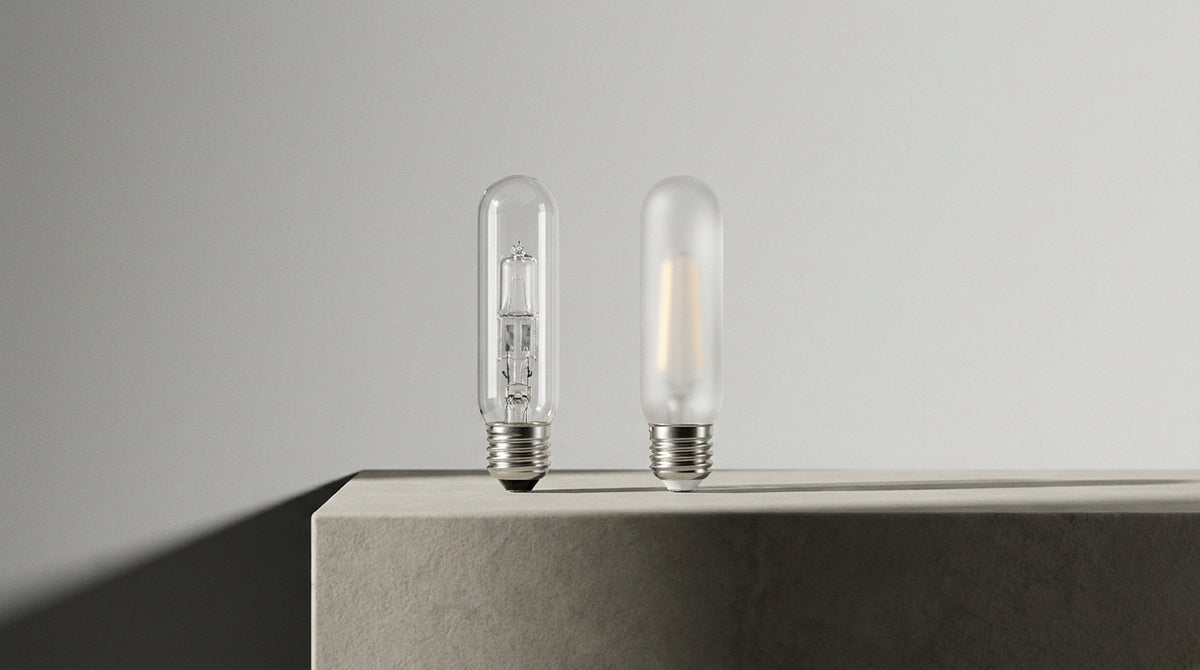
Switch off the power, let it cool, remove the pencil bulb and read the marking on its base. R7s 118 mm, G9, G4 or E14: this reference, engraved on the ceramic, decides everything. Also note whether the fixture is controlled by a wall dimmer or by a transformer housed in the base. The LED bulb is chosen afterwards, never before.
Can I replace a halogen pencil bulb with an LED?
Yes, in almost all cases, with an identical base. On a survey of 33 LED bulbs from our catalogue as of 28 September 2026, the base is stated on all 33 listings and the LED technology on all 33 as well: the halogen pencil bulb no longer has any reason to stay in place. The only thing left to confirm is dimming.
Removing the pencil bulb and reading its base
A halogen pencil bulb is removed cold, never warm: the ceramic burns and the glass becomes fragile. Pull straight, without levering.
- Switch off at the breaker before touching the socket
- Unclip the cover without forcing a pin base
- Read the marking on the ceramic side: R7s, G9, G4 or E14
- Note the length of an R7s: 78 mm or 118 mm
This takes two minutes and avoids an unnecessary round trip. The full procedure is described in our article on changing a halogen pencil bulb.
What the LED really changes in the room
A high-power halogen pencil bulb heats more than it usefully lights. The LED placed in the same spot keeps the shade cool to the touch, and the light reaches full intensity as soon as it is switched on.
- 2700 K to recover the warm tone of halogen
- 3000 K for a slightly crisper living room, without turning white
- Instant start, even in a cold room
- No yellowing of fabric or paper shades
The colour temperature is chosen before the power: it is what decides the atmosphere. Our guide on white or yellow light details the differences by room.
Once the base is noted, everything depends on the product listing. Our selection of LED bulbs brings together 266 references, from long tube to capsule, and can be sorted by base.
When a fixture still resists, the article on replacing a halogen bulb with an LED covers the cases where replacement hits a snag.
Do I need an R7s 118 mm base or another format?
It all depends on the fixture, not the bulb. The R7s 118 mm is found on large floor lamps and floodlights; the R7s 78 mm on compact models. Wall lights, ceiling lights and small lamps mostly use G9, G4 or E14. Measure, do not guess.
R7s 118 mm LED pencil bulb: the format for floor lamps
The R7s is a flat-pin base, fitted at the end of a tube. It is found on 150 W and higher halogen floor lamps, those long tubes that light a whole living room from one corner.
- 118 mm: large floor lamps and floodlights
- 78 mm: compact floor lamps and floor reading lamps
- Flat pins: the bulb engages along the axis, without leverage
- 230 V: no transformer on most of these models
A living room halogen lamp changes appearance when the tube becomes LED: the light is less downward, it spreads more evenly, and the base no longer heats up.
If the marking has disappeared, get out the tape measure: the tube length decides between 78 and 118 mm. The guide on bulb base size also avoids confusing R7s and G9.
G9, G4, E14: short pencil bulbs and capsules
These are the formats for wall fixtures, small ceiling lights and decorative spotlights. The G9 has two pins 9 mm apart, the G4 is reserved for very tight spaces, the E14 screws in like a mini E27.
| Base | Shape | Where it is found |
|---|---|---|
| R7s 118 mm | Long tube | Halogen floor lamp, floodlight |
| R7s 78 mm | Short tube | Floor reading lamp, small floor lamp |
| G9 | Two pins, capsule | Wall light, ceiling light, pendant |
| G4 | Very short pins | Compact fixture, display case |
| E14 | Small screw thread | Wall light, table lamp, chandelier |
On a wall lamp, a G9 LED capsule replaces the halogen of the same size, with a softer effect on the wall.
Which base holds the bulb you want to replace?
Your replacement LED, base by base


If you are hesitating between two formats or if your dimmer buzzes, describe your fixture to us: you can ask us your question and we will give you the exact base, not a range.
Replacing a halogen pencil bulb with a dimmable LED: what to check?
One thing decides: how the dimming is produced. A wall dimmer requires a bulb marked as compatible. A 12 V transformer requires checking its minimum load. Without this check, the LED buzzes, flickers or goes out halfway.
The dimmer: wall, remote control, built-in dimming
Three families coexist: the wall knob or push-button, the radio remote control, and the dimming housed in the fixture. The first two communicate with the bulb, the third does not.
- Dimmable mention mandatory on the bulb listing
- Minimum load: below it, the LED flickers
- One bulb replaced out of three is enough to make the setup flicker
- Built-in dimming: the original bulb is kept, nothing is replaced
The safest is to match the bulb to the dimmer already in place. Our dimmable LED bulb is chosen on this criterion, before power or colour temperature.
When dimming stutters halfway, the dimmer is often the cause: what a dimmable LED changes explains what happens in the circuit.
When it is a transformer, not a dimmer
A 12 V low-voltage halogen hides a transformer in the base. This component expects a specific load: a low-power LED, connected alone to a transformer designed for 60 W, lights poorly or not at all.
- Look for a box in the base or under the stand
- Read the range: 20-60 W means 20 W minimum
- Replace the transformer with a driver of the same voltage
- Several light points: the combined load may be enough
On a fixture with several points, it is the sum of the powers that counts. Our article on wiring several lamps to one switch shows how to distribute a single circuit.
Why are LED lamps increasingly used?
Because they solve three problems at once: heat trapped in a shade, consumption at equal brightness, and replacement frequency. A bulb that heats little puts less strain on its fixture's socket. Comfort of use did the rest.
Heat, socket and safety
A 150 W halogen pencil bulb turns most of its energy into heat. In a closed fixture, the ceramic and the filament suffer, and the shade yellows.
- Less heat: the socket no longer deforms
- IP20: these bulbs remain for indoor use only, away from wet rooms
- No UV: fabrics and wallpapers keep their colour
- Stable output: brightness does not drop over time
The same reasoning applies to other older sources, as in our article on replacing a neon tube with an LED tube.
What our catalogue says
The LED Bulbs collection has 266 references as of 28 September 2026. The detail comes from a survey of 33 of these listings, on the same date.
- LED stated on 33 listings out of 33
- IP20 and CE on 33 listings out of 33
- 2-year warranty on 73 % of the survey, 5 years on 27 %
- Base given on the whole survey: E27 42 %, G9 27 %, G4 24 %, E14 15 %
These mentions are declarative: they come from the listings, not from a promise on our part. For an installer who has to validate a choice in front of a client, the professional area groups the available formats.
If you are still hesitating between two colour temperatures, our guide to choosing bulbs without getting it wrong covers the benchmarks room by room.
On the same subject
In stock · shipping costs shown at checkout · up to 30% off in your cart


Ready to turn inspiration into reality?
Tell us about your room, your style and your budget, and we will show you the pieces that truly suit your project.
Get guidance in 30 seconds →