Wall lights in the dining room: lighting the wall well
This article is also available in French: Applique murale salle à manger
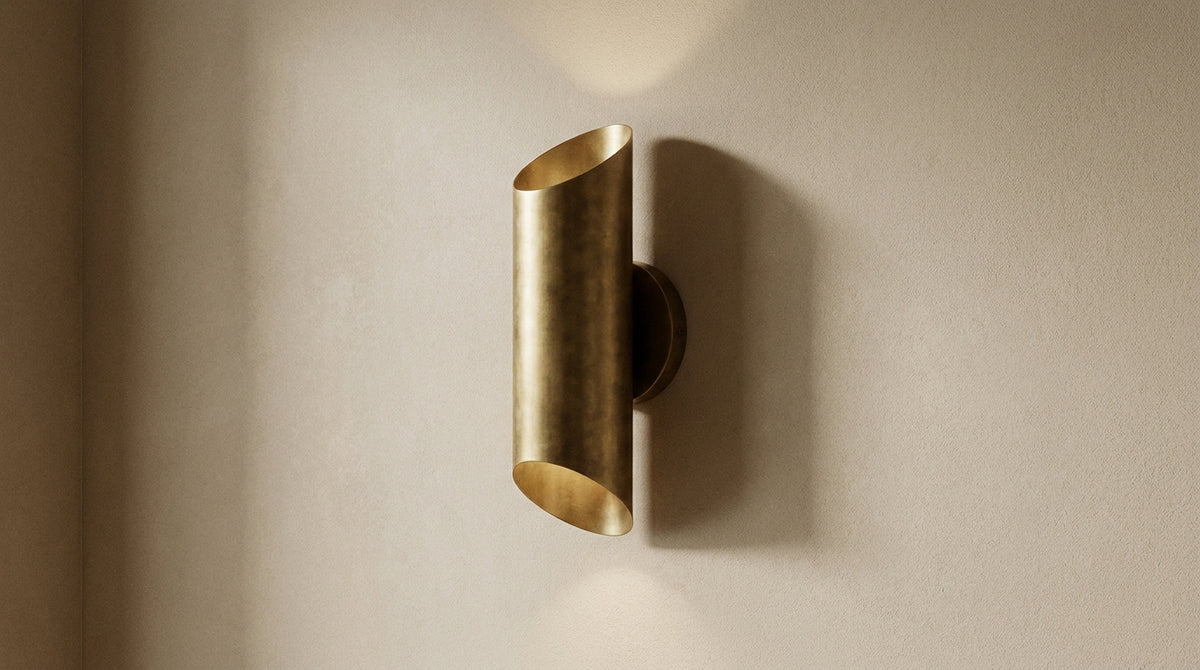
Two wall lights, one on each side of the wall, axis 1.70 m from the floor, and a warm 2700 K light. That is the move that solves a dining room wall. The wall lights illuminate the wall, the pendant light illuminates the table. Each has its role, and the room changes face.
Which wall light should you choose for a dining room?
A wall light that is discreet in size, generous in its beam: diffusing glass or adjustable metal, mounted on a socket you can replace. It remains the second source in the room. Look for a wide beam upwards or downwards, never a spotlight aimed at the guests.
The dining room wall light is therefore chosen in reverse: start from the table, from the pendant light already installed, and dress the rest of the wall.
Designer dining room wall light: what really changes the wall
A bare wall remains a bare wall. Two low, aligned wall lights change the perception of the room without lighting the table more. The design matters less than the direction of the beam: a bowl open at the top and bottom diffuses in a fan, a closed cylinder creates a hard point.
- Tube, 36% of the survey of 163 references as of 9 November 2026: the most discreet shape, it reads as a line.
- Square, 26% of the same survey: more graphic, it marks a stone wall or a tinted plaster.
- Round, 20%: softer light, it forgives imperfect walls.
- Original, 12%: to be reserved for a single wall, never in a series.
On these same product pages, the Modern style appears on 85%, Minimalist on 55%, Industrial on 33% and Nordic on 31%. Modern dominates without overwhelming the other options.
Dining room wall lighting: the two-source rule
A single pendant light above the table leaves the corners in the dark. The wall lights take over and eliminate dark areas. The guideline: one light point every three to four metres of wall, never just one in the middle of a large room.
The height and diameter of the dining room pendant light are calculated first, and the wall lights then align with its axis.
A coherent wall is composed from a single family: the dining room lighting brings together pendant lights, wall lights and table lamps that share the same finish. The dining room chandelier sets the tone above the table, and the wall lights pick up the material.
At what height should you install a wall light in a dining room?
Place the axis of the light fitting between 1.60 m and 1.80 m from the floor, with 1.70 m as the starting value. This height keeps the source above the eye line of a person standing and below the eye line of a person sitting. Two wall lights on the same wall are set at the same height, to the centimetre.
The height that prevents glare when standing
The eye of a standing adult is around 1.60 m. A wall light whose shade opens upwards, placed lower, sends light straight to the face of the guest who stands up. Two or three centimetres more are enough to correct it.
| Situation | Axis height | Reference |
|---|---|---|
| Free wall behind the guests | 1.60 to 1.80 m | above the seated eye line |
| Wall above a sideboard | 1.70 to 1.90 m | 80 cm above the top |
| Narrow wall between two doors | 1.70 m | one wall light, centred |
| Large wall of more than 4 m | 1.70 m, two points | spacing of 2 to 3 m |
And if a sideboard already occupies the wall?
The sideboard dictates the height, not the other way round. Allow 80 cm between the top and the bottom of the wall light: the light falls on the objects without washing the wall. If the furniture is tall, the wall light goes up with it and the gap narrows.
When a sideboard and a table coexist, the height of a wall light is cross-checked with that of the pendant light: two calculations, one single visual axis.
This is the logic of accent lighting, the kind that highlights a volume without lighting it flat.
If the doubt concerns the exact model rather than the height, the team answers directly: contact us and describe the wall, the table length and the light already in place.
LED wall light or bulb wall light: which should you choose?
The integrated LED eliminates bulb replacement and fixes the colour temperature. The bulb wall light lets you choose the socket, the power and the intensity. Out of 161 declared product pages in our survey as of 9 November 2026, G9 comes in at 34%, E27 at 29%, integrated LED at 18% and GU10 at 12%.
LED dining room wall light: comfort without changing a bulb
In the survey of 163 references as of 9 November 2026, LED technology is declared on 96% of the product pages. The module is soldered: the colour temperature is fixed at the time of order, often at 2700 K or 3000 K, and the intensity is adjustable if the product page mentions a dimmer.
Models with an integrated module are grouped in the LED wall light collection, where the question of the socket no longer arises.
The trade-off is simple: when the module ages, the wall light is replaced. The warranty then becomes the real criterion. It is 5 years on 77% of the surveyed product pages, 2 years on 23%.
G9, E27 or GU10 socket: the real criterion
The socket decides the size of the light fitting and the choice of bulbs. It also decides the type of light you will be able to correct in two years.
| Socket | Size | What it allows |
|---|---|---|
| G9 (34%) | very compact | small wall lights, narrow beam, 2700 K easy |
| E27 (29%) | visible volume | large bulbs, filament, dimmer |
| GU10 (12%) | directional spotlight | narrow beam, wall or picture |
| Integrated LED (18%) | closed body | no bulb, fixed temperature |
A dining room wall light does not need much: the bulb power for a dining room is around a few watts per point, the goal being to light a wall.
The calculation is done in lumens, not watts. The number of lumens for a dining room is distributed over all the sources, including the pendant light.
Which wall of your dining room do you expect to light?
Which style for a dining room wall?
A readable style is better than a busy style: one dominant material, one colour, and the same family of shapes on all the walls. The dining room wall can handle contrast, not the accumulation of objects. Two wall lights are enough to set the tone.
Wooden dining room wall light: natural materials
Wood warms a room where people eat, and it accepts both light and dark walls. In the survey, steel appears on 31% of the product pages, aluminium on 26%, metal on 21% and glass on 19%: natural materials make up the rest.
Warm finishes are found in the wooden wall light collection, often combined with a fabric shade that softens the beam.
White, black or gold: the colour that lasts
Out of the 163 surveyed product pages, white appears on 64% and black on 60%, beige on 26%, green on 21%. White fades into a light wall, black draws, gold catches the eye. A dining room wall ages better with two tones than with five.
The choice of model matters as much as the choice of colour: a modern wall light asserts its shape, whereas a classic model is content to light.
On a stone wall or a tinted plaster, a black wall light is visible without shining, and stays right when the paint changes.
Wall lights for dining rooms: the selection


Can you install a wall light without drilling?
Yes, provided the light fitting stays light and the surface is solid. An adhesive plate, a rail or a rechargeable model hold without plugs on painted plasterboard or tiles. A large, heavy wall light, on the other hand, requires drilling and plugs suited to the wall.
The fixings that hold on a solid wall
- Adhesive plate for a light fitting, on a smooth, clean and degreased surface.
- Suitable plug as soon as the load increases: concrete, hollow brick and plasterboard do not accept the same.
- Exposed cable to avoid cutting a channel in an old wall.
- Rechargeable model when no power supply reaches the height of the wall.
The solutions are detailed in installing a wall light without drilling.
What to check before choosing the location
- The electrical supply existing and its real height, measured, not assumed.
- The cable route in the partition, the conduit and the skirting board.
- The height of the sideboard or the serving unit, which dictates the final height.
- The shadow cast by the pendant light on the wall, visible only with the light on.
The rest is a matter of balance: wall lights, the subtle lighting that transforms your walls, are chosen according to what they touch.
In stock · shipping costs shown at checkout · up to 30% off in your cart


Ready to turn inspiration into reality?
Tell us about your room, your style and your budget, and we will show you the pieces that truly suit your project.
Get guidance in 30 seconds →