Outdoor solar lamp: choosing well, no cable or trench
This article is also available in French: Meilleur lampe solaire extérieur
Choose the area to light before the model, then the protection rating: IP65 for a spot exposed to rain, IP44 under a canopy. The format comes last. Of 67 solar listings recorded in our catalogue as of 30 September 2026, 54% are freestanding and 97% state solar technology.
What is the best outdoor solar lamp?
There is no single model: the right lamp is the one that does the job you expect. Marking out a path, lighting a door or covering a terrace call for three distinct formats. Our outdoor solar lamp collection brings together 272 solar references as of 30 September 2026, to choose by use and by protection rating.
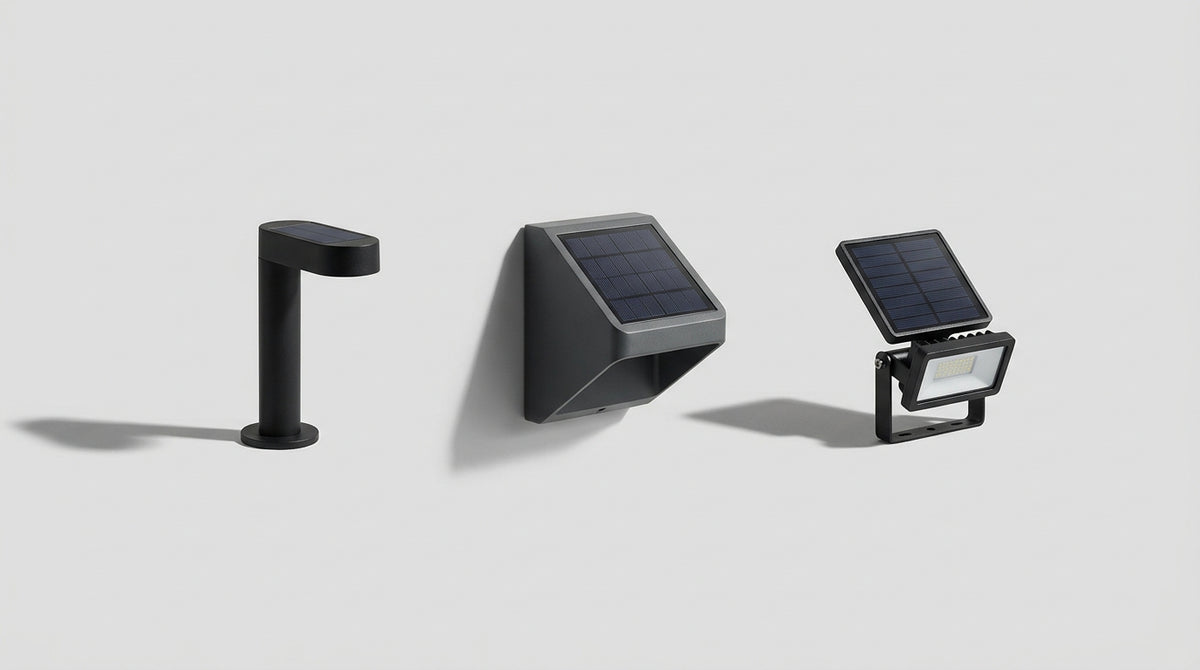
Bollard, wall light or floodlight: which format for which use?
- Bollard: 30 to 60 cm high, a low light that draws the path without dazzling.
- Wall light: fixed to the facade, it lights a door or a passage by washing the wall.
- Floodlight: wide, adjustable beam for a yard or a parking area.
The wall remains the most readable anchor: with an outdoor wall light, the light falls at face height and can be spotted from the entrance. Two wall lights facing each other remove dark zones around a door.
Which outdoor lighting is the most effective?
The most effective is not the most powerful, it is the best placed. Several low, close points light better than a single beam concentrated in one spot. An outdoor solar spotlight aimed at a wall works far better than a spotlight pointed at the ground, which scatters its light into nothing.
A single format never covers a whole garden. The most comfortable approach is to mix two scales, a low point for the path and a high point for the living area, within the same outdoor lighting scheme.
How many lumens do you need to light an outdoor area?
Allow 50 to 100 lumens to mark out a path, 300 to 500 lumens to light a table or a passage, and 800 lumens and more to cover a yard. Height matters as much as output: the same fixture placed at 2.50 m instead of 1 m lights a smaller area and less brightly.
Which lumens for which area?
| Area | Recommended output | Mounting height |
|---|---|---|
| Path, step | 50 to 100 lm | 30 to 60 cm |
| Terrace, table | 300 to 500 lm | 1 to 2 m |
| Yard, facade | 800 lm and more | 2 to 3 m |
To refine this, our guide on how many lumens to light outdoors details the calculation by surface area.
Then there is the question of rendering. A terrace is not judged on total output but on distribution: two low sources are better than a single high point.
This balance takes work, and our article on lighting the terrace and garden in the evening gives the reference points.
Best outdoor solar lamp with motion sensor: which settings?
Three settings make the difference: range, hold time and sensitivity. Set the range to the area to cover, never to the maximum, otherwise the fixture turns on for a cat passing by.
- Range: 5 to 8 m is enough for an entrance or a garage.
- Hold time: 30 to 60 seconds, long enough to cross without constant re-triggering.
- Sensitivity: as low as possible, to avoid repeated triggering.
The rest comes down to placement, detailed in our guide on outdoor lighting with a sensor.
Outdoor solar lamps: our selection


What is the drawback of solar lamps?
They depend on the sun. A grey day, a panel in the shade or a badly oriented post is enough to lower the reserve, and the light fades at the end of the night. Nothing unsolvable: oversize the panel and clear its exposure.
Winter, shade and grey days: what really happens
- In winter: reduced production, longer night, higher consumption.
- In shade: a panel that sees the sun two hours a day charges little.
- In overcast weather: charging slows without stopping, the reserve acts as a buffer.
The full charge and discharge cycle is explained in our article on how a solar lamp works.
Powerful outdoor solar lamp: what the panel changes
Everything starts with the panel. The wider it is and the better exposed, the longer the reserve lasts through the night. A fixture advertised as powerful with a small sensor will shine brightly for a few minutes, then go out. Useful power is read on the panel and capacity pairing, not on the LED alone.
For passages that need a strong light, our selection of powerful outdoor solar lighting with motion sensor is sorted by intensity.
The right question is therefore not the brand, but the match between the sensor, the reserve and the area to light.
Which area do you want to light without running a cable?
If you are hesitating between two formats, the team answers on the technical sheet and the layout: you can talk to a Designix advisor, and we will decide with you.
What are the best high-end outdoor light fixtures?
A high-end outdoor setting is recognised by three signs: a material that ages well, a suitable protection rating and a written guarantee. In our survey of 67 solar references as of 30 September 2026, metal appears on 27% of listings, plastic on 45% and glass on 13%.
Which materials last outdoors?
- Aluminium: stable, it does not rust and keeps its colour for several seasons.
- Glass: a diffuser that does not yellow, it gives a clean light, never milky.
- Wood: warm, best kept for sheltered areas and country styles.
- Plastic: light and affordable, it ages faster in full sun.
The module matters as much as the shell: a well-sized assembly lights correctly with few watts, and that is the whole point of our guide on LED power for outdoor lighting.
Which guarantee and which certification should you look for?
In the 30 September 2026 survey, certification remains a minority, with 36% of listings carrying the CE marking. Written guarantees are even rarer: 24% state 2 years and 12% state 5 years, out of 24 listings that provide this information. A long guarantee is therefore the exception, and it should be checked before confirming a model.
Doubt is quickly cleared with a verifiable review: the Designix Google listing gathers buyer feedback, updated continuously.
For a sheltered outdoor area, a model you can move with the seasons is better, such as this large freestanding outdoor solar lantern.
How do you install it without cable or trench?
No mains connection, no trench, no conduit: the panel recharges the battery during the day, the fixture gives the light back at night. Of the 67 listings recorded on 30 September 2026, 54% are freestanding and 97% state solar technology, two signs of an installation done by hand.
How do you orient the solar panel?
Orientation decides everything. A sensor facing due south, tilted and clear of shadows, recharges correctly even in mid-season.
- Due south: maximum exposure over the day, to be shifted towards south-east or south-west depending on the region.
- Tilt: 30 to 45 degrees, to catch the low winter light.
- Shadows: keep the panel more than a metre away from a wall or a branch.
From the survey to the final adjustment, the steps are detailed in our guide to installing outdoor lighting.
How do you fix it without drilling?
- Freestanding: on a slab, a step or a planter, without tools.
- Stake: pushed into loose soil, perfect along a path.
- Adhesive mount: for a smooth wall, provided it stays sheltered from driving rain.
Moving a solar source costs nothing: you try it one evening, shift it fifty centimetres, start again. This freedom explains why 54% of the survey is freestanding.
Then it is all about consistency: the outdoor light extends the Designix home and announces what you find inside.
On the same subject
In stock · shipping costs shown at checkout · up to 30% off in your cart


Ready to turn inspiration into reality?
Tell us about your room, your style and your budget, and we will show you the pieces that truly suit your project.
Get guidance in 30 seconds →