Outdoor solar spotlight: how to choose it, zone by zone
This article is also available in French: Meilleur spot solaire extérieur
Start with the area to be lit, not the model: a path is marked out with low, repeated grazing light, a facade is picked out with directed pools of light, an outdoor table calls for warm, low light. Only then look at the protection rating and the panel orientation.
An outdoor space is lit in layers: a low point for walking, a high point for the facade, a soft glow for the table. When you set about renovating a balcony or terrace, this framework is laid down before the furniture and plants.
Which outdoor solar spotlight should you choose for each area?
Start from the area, not the model. A path wants low, repeated light, a facade an adjustable spotlight, a table warm and diffuse lighting. In a survey of 219 listings in our catalogue on 29 September 2026, 3% carry the IP65 rating and 2% the IP44 rating. Water resistance is checked before looks.
How do you light a path or a flower bed?
Multiply the low points rather than using a single floodlight. A repeated spike spotlight at knee height draws a readable path without dazzling. A flower bed is lit at an angle: grazing light reveals the foliage instead of flattening it.
In a garden, outdoor decor is as much about the light points as the objects placed there: three low glows have more effect than a single powerful source.
Elevated or spike spotlight: which to choose?
| Type | Ideal area | What decides it |
|---|---|---|
| Spike spotlight | Path, flower bed, lawn edge | Stable stake and high protection rating |
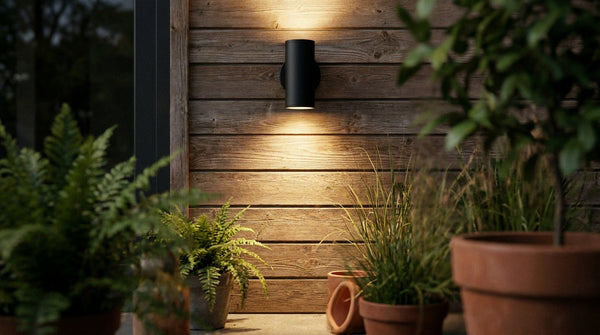
| Wall spotlight | Facade, step, entrance | Mounting height and beam direction |
| Remote floodlight | Large surface, tree, high wall | Cable length between panel and floodlight |
The elevated model is reserved for places where you want to carve out a volume: a trunk, an arch, a section of wall. That is where adjustable spotlights have the advantage, because you set the angle after installation.
The simplest route remains a family designed for outdoors: browse our outdoor lighting and look for the formats that handle rain without shelter.
To go further on ambiences, our article on outdoor lighting for the terrace and garden details each area, from the table edge to the back of the garden.
What is the downside of solar lamps?
Grey skies produce less and winter nights last longer than the charging day. The lamp does not switch off suddenly, it dims: the reserve decides. A shaded or badly oriented panel explains most disappointments.
Why does a solar lamp give less light in winter?
Two effects combine: less light captured, more hours to cover. A well-sized outdoor solar lamp then holds in reduced mode, giving less light rather than switching off.
The badly oriented panel, the first cause of disappointment
A branch, a canopy, a wall: the cast shadow is enough to halve the charge. In a survey of 219 listings in our catalogue on 29 September 2026, 89% declare a 2-year warranty. The hardware holds up, the placement often fails.
Before buying anything new, test the panel for a full day in direct sun, then compare with an outdoor lamp simply moved a few metres.
What is the ideal power for solar lighting?
There is no single value: power is chosen by use. Marking a path requires a moderate and repeated output, lighting a living area a strong, concentrated output, securing an entrance a brief but intense boost. Multiply the points rather than pushing a single model to the maximum.
How many lumens for a path, a terrace, an entrance?
Think in terms of the effect obtained, not the figure on the box. The spotlight angle changes everything: the same output, concentrated, lights far and narrow; widened, it floods and weakens. Our guide on how many lumens for outdoors details each use.
| Need | Type of output | Point to watch |
|---|---|---|
| Marking a path | Moderate and repeated | Even spacing of points |
| Lighting a living area | Strong, wide angle | No glare at seating height |
| Securing an entrance | Intense and brief | Fast triggering, directed beam |
Should you aim for 2,000 lumens?
A figure on its own means nothing. Two spotlights rated at the same output do not give the same light if the angle differs, and the peak value drops through the night. Choose the coverage, not the number.
Hesitating between two mounting heights or two panel orientations? Take the time to describe your outdoor space to us: we will reply on the model and the fixing to plan.
Which outdoor area do you want to light in the evening?
Where should you place an outdoor solar spotlight so it really performs?
Away from what it lights, and never facing the eye. A spotlight placed too close creates a harsh patch and a halo; set back, it draws. The panel, for its part, sits facing due south and unobstructed, even if that means running the floodlight out on a short cable.
At what height should a wall spotlight be fixed?
High enough for the beam to fall, low enough not to light the sky. On a facade, an outdoor wall light placed above the walkway lights the steps without blinding.
A solar outdoor wall light follows the same rule, with a remote panel when the wall stays in shade for part of the day.
Where should the solar panel be oriented?
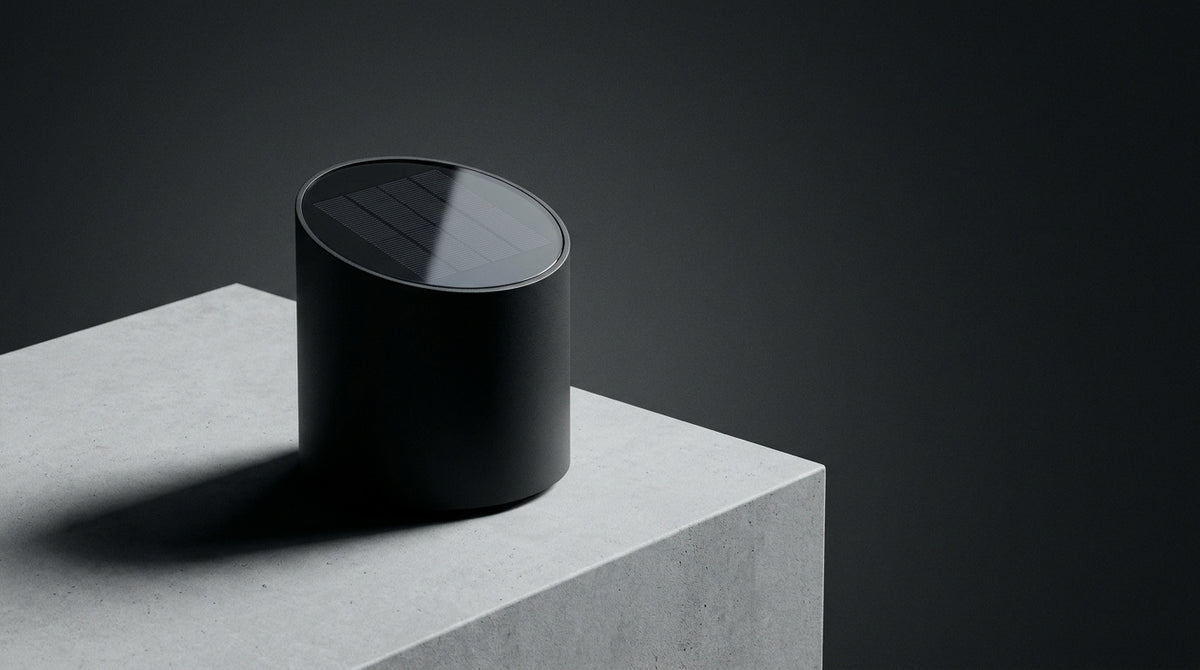
Due south, tilted, with no cast shadow between late morning and mid-afternoon. The panel lives on the wall, on a stake or on a remote bracket: it is what constrains the installation.
On an outdoor renovation project, this constraint is settled before drilling, along with the other light points.
One last useful reflex before settling on a reference: buyers comment on the selection on Designix's Google listing, where the rating and reviews stay up to date.
Solar spotlights and lights for outdoors
 Glass ball pendant light, modern gold and black design | Sphère Céleste
 Danish pendant light | Cocoon
 Tree pendant light | Lueur Sylvestre
 Modern black and gold designer living room wall light | Gravity
 Pendant Light | Lotus
 Wine Glass Pendant Light | Esprit Vinicole
See the full selection: Top Best Sellers and Best Seller Decoration Designix
Does a solar lamp recharge without sun?
Yes, but slowly. A panel also captures the diffuse light of an overcast sky; the charge is simply lower and more spread out. Count the whole day, not one hour in the sun, and know that dust or the shadow of a branch weighs more heavily than a grey sky.
Solar outdoor lighting with motion sensor
The sensor changes the use: the light no longer stays on, it responds. Solar lighting with a motion sensor suits a walkway, an entrance or a garage, where you want to be seen without draining the reserve all night.
What to do when the reserve drops?
Reduce the intensity, shorten the duration, move the panel: three actions that are enough in most cases. An outdoor post light or a marker lamp can be adjusted this way without tools.
At our place in Vaulx-en-Velin, the same mistakes come back: a panel screwed under a roof overhang, a spotlight stuck to the wall. Two minutes of observation before installation are worth more than a second purchase.
Related reading
In stock · shipping costs shown at checkout · up to 30% off in your cart


Ready to turn inspiration into reality?
Tell us about your room, your style and your budget, and we will show you the pieces that truly suit your project.
Get guidance in 30 seconds →