Solar outdoor lighting with motion sensor: how to choose
This article is also available in French: meilleur éclairage extérieur solaire puissant avec détecteur de mouvement
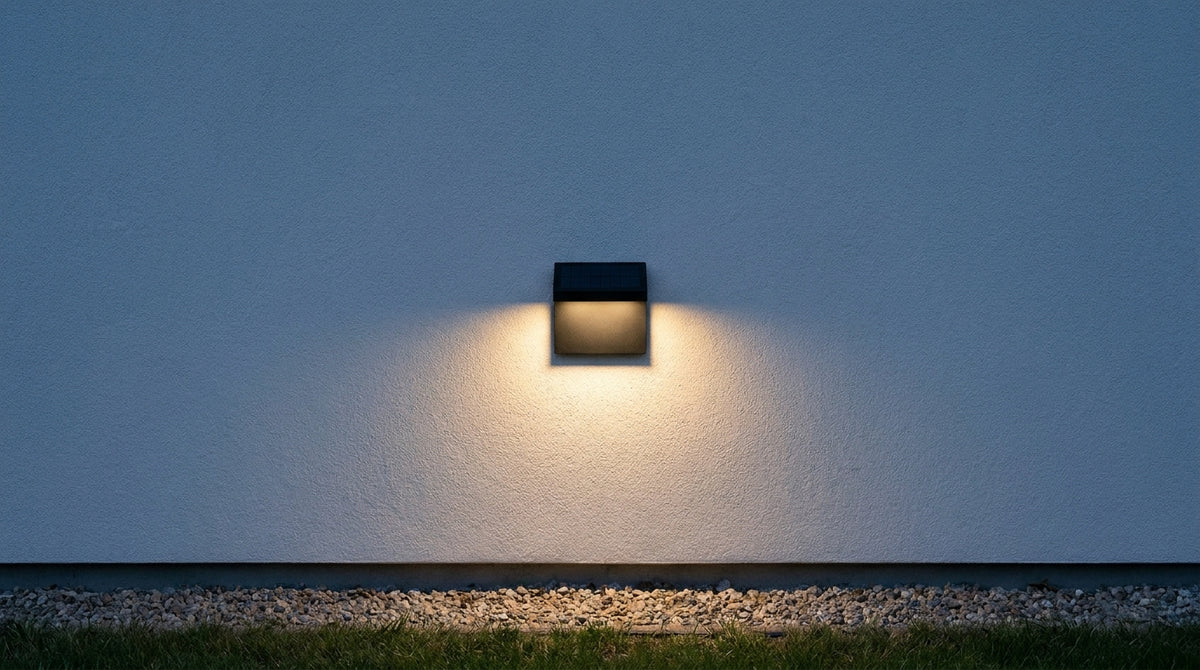
Place the fixture where it will see the sun at noon, not just where the sensor sweeps the street: these two constraints conflict more often than you might think. Take into account the cast shadow of the wall and trees, which halves recharging in winter. This survey is done before drilling, not after the first failure.
What is the best solar outdoor lighting with motion sensor?
The one whose photovoltaic panel is detached from the light unit, because it still recharges when the fixture is under a roof overhang. Then count half the detection range printed on the box. The rest depends on the protection rating and the battery's ability to last a whole night.
The best model is the one your facade can feed. On an urban house entrance, the light comes from the ground or the wall corner, never from the center of the yard. This reasoning guides a balcony and terrace layout, and it applies to two square meters of sidewalk as well as a suburban plot.
What detection range should be planned for a driveway or gate?
Count half the advertised range. A sensor sold for 12 meters actually covers 6 to 7 meters on a walking human body, and much less behind a hedge. The cell can be adjusted, the vegetation cannot.
- Mounting height: between 1.80 m and 2.20 m, lower if the area slopes down to the street
- Angle: 120° is enough for a door, 180° for a wall corner or a wide driveway
- Orientation: the cell must not see the road, otherwise it will turn on with every car
- Real test: test at nightfall, never in broad daylight, sensitivity cannot be judged otherwise
Do you need a floodlight or a wall light for a large facade?
A floodlight covers the surface, a wall light signs the address. The choice is decided by the area to be lit, not by the number of lumens displayed in large print on the packaging.
| Format | What it lights | What it imposes |
|---|---|---|
| Adjustable-head floodlight | Yard, parking, long facade | Technical look, high mounting |
| Wall light | Entrance, gate, wall corner | Panel often integrated into the housing |
| Freestanding lantern | Driveway, step, terrace corner | No drilling, shorter detection |
On a large plot, an outdoor floodlight with sensor avoids multiplying light points and cables.
On a narrow facade, a wall-mounted outdoor lamp takes up little space, lights the door without casting a shadow on the street and blends into the render.
What are the most powerful solar lamps?
Those that combine a large panel and a high-capacity battery, not those that display the highest number. A model advertised at 3000 lumens with a cell the size of a postcard goes out after two passes. Reserve matters more than peak.
What is the ideal power for solar lighting?
Power is chosen by use, not by prestige. An oversized light point drains its battery in three hours in February and leaves the threshold in the dark until morning.
- Driveway, step, threshold: 200 to 400 lumens, sustained all night
- Entrance, gate: 800 to 1500 lumens in detection mode
- Yard, parking: above 2000 lumens, with separate panel
- Standby mode: 10 to 20% of power, enough to mark a path
For a long driveway, a well-sized outdoor solar lamp replaces three weak points. A tall outdoor lamp post carries light further without glare.
Are 2000 lumens a lot?
Yes, largely, for a house yard. No if the panel remains tiny: 2000 lumens consume more than a small cell can recharge in December. The right question is not the maximum reached, but the number of hours sustained on a winter night.
A model with short triggers, thirty passes of ten seconds, consumes less than permanent lighting at 300 lumens. That is why a set of outdoor lamps set to detection mode lasts better than a single point left on continuously.
Which outdoor area do you want to light first?
What is the drawback of solar lamps?
Winter and shade. A cell that receives only two hours of direct sunlight in December does not recharge a battery used by thirty triggers per night. The second flaw is aesthetic: many plastic housings clash on a well-kept facade, even when off.
Why does cast shadow drain the battery in winter?
A panel placed under a roof overhang or directly under a tree still produces a few milliwatts, never enough to fill the battery. The lamp lasts three hours, goes out before midnight, and the next night is the same.
A solar outdoor wall light whose cell is moved twenty centimeters often solves the problem without changing the model. The cable between panel and fixture is your room for maneuver.
Are all outdoor models really waterproof?
No, and the catalog shows it. In a survey of 219 references from our catalog dated September 29, 2026, 3% carry an IP65 rating and 84% an IP20. The waterproofing claimed outdoors remains the exception, not the rule.
- IP20: dry room only, no outdoor use
- IP44: water splashes, under shelter or awning
- IP65: driving rain and jets, permanent exposure
- IP67: temporary immersion, rarely useful on a facade
A solar wall light designed to stay outside displays this rating in its technical sheet. It is the first line to read, before the number of lumens.
How to install and adjust a solar motion sensor light?
First fix the panel, at noon and tilted south, then install the fixture between 1.80 m and 2.20 m. Set the timer to thirty seconds before going to two minutes, and test at nightfall. Two evenings in a row are better than an estimate.
What steps to follow, in order?
- Identify the sunlight at noon, over several days, before any drilling
- Fix the panel bracket due south, tilted, out of arm's reach
- Install the fixture at height, the cell facing the traffic area
- Set the sensitivity to minimum, then increase one notch until the first useful trigger
- Test at nightfall and note the switch-off time in the morning
How to adjust sensitivity to avoid unnecessary triggers?
Sensitivity is adjusted as you go, not from the manual. A sensor that is too open turns on when a cat passes, when a branch moves, when a car's headlights sweep by. Every unnecessary trigger costs battery.
If you are redoing the entire outdoor area, a project to enhance a terrace and garden avoids treating each point in isolation. And if the facade is beyond you, a renovation and home staging project sets the lighting plan straight.
Is your facade south-facing, or shaded by a tree in the afternoon? Describe your configuration: we will tell you what can work, before purchase.
Where to find quality solar outdoor lighting?
Where the technical sheet gives the protection rating, the housing material and the battery capacity, not just the lumens figure on the cover. A seller who publishes these three lines has looked at the product they offer.
Why does design matter as much as waterproofing?
Because an outdoor fixture remains visible twelve hours a day, off. In the survey of 219 references dated September 29, 2026, 85% feature metal and 42% glass, two materials that age better in the sun than yellowed plastic.
The Newgarden lighting collection shows what this choice looks like on a facade without a construction-site style. The rest of the outdoor lighting catalog is filtered on the same criteria, rating and material first.
Can you see the selection without traveling?
Yes. The selection is commented by buyers, and Designix's Google listing shows its up-to-date rating, without a figure frozen in this article becoming wrong in six months. Designix is located in Vaulx-en-Velin, in Rhône-Alpes, which helps for an urban or suburban house exterior.
Around a pond, the constraints change: terrace lighting around a pool is designed with the water, not against it.
[[WIDGET:selection-extérieure]]In stock · shipping costs shown at checkout · up to 30% off in your cart


Ready to turn inspiration into reality?
Tell us about your room, your style and your budget, and we will show you the pieces that truly suit your project.
Get guidance in 30 seconds →