How a solar lamp works: the path of energy
This article is also available in French: Comment fonctionne une lampe solaire
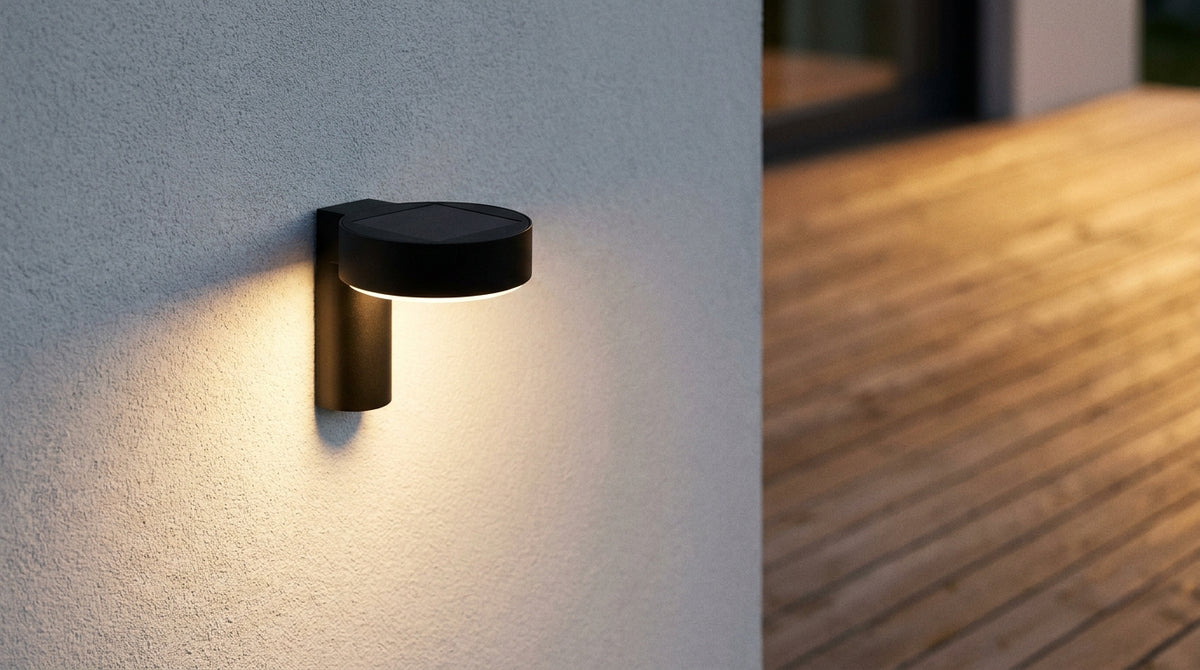
A panel captures daylight, the battery stores the electricity produced, and a twilight sensor switches on the LED as soon as night falls. What the overviews leave out: it is shading that switches a solar lamp off, more often than a lack of sun. Check the exposure zone before the shape of the luminaire.
On a balcony or terrace renovation, this is the first thing to check: the sun's path over the area, even before talking about style. A luminaire installed under a roof overhang or behind a green wall will never fully recharge, whatever its stated power. What follows covers what you only discover in use: winter, water, the colour of the light.
How does a solar lamp work, step by step?
Four elements are enough: a photovoltaic panel, a battery, a twilight sensor and an LED source. The panel charges the battery all day, the sensor measures the drop in light and triggers the switch-on in the evening. No intervention, no switch to touch.
Functional diagram of a solar lamp
The circuit comes down to four links, in this order.
- Photovoltaic panel: converts the light received into direct current, with no moving parts.
- Battery: stores that charge for the night, its capacity determines the actual runtime.
- Twilight sensor: detects the shift from day to evening and triggers the switch-on.
- LED: delivers light while consuming very little, which extends the lit night.
The twilight sensor, or why the lamp switches on by itself
The sensor continuously compares the ambient light with a threshold. When night crosses that threshold, it cuts the charge and switches over to the battery. It is also what turns the lamp off at dawn, and that is why stray light in the evening (a street lamp right next to it) can delay the switch-on. The final result then depends on how the LED is built, a subject covered in detail in our article on how an LED works.
What is the drawback of solar lamps?
Three disappointments come up repeatedly: a charge that collapses in winter, a light that fades at the end of the night, and electronics drowned by rain when the protection rating is undersized. These are not breakdowns. They are product and placement choices.
The three points that disappoint
- Winter runtime: the charge from a short day no longer covers a long night, the intensity drops after a few hours.
- Shaded or dirty panel: a leaf, dust, a gutter overhang, and recharging falls.
- Underestimated waterproofing: a lightweight housing placed facing driving rain lets water in within a season.
- Light too cold: some entry-level LEDs harden the atmosphere instead of softening it.
The remedy is often a question of range: our garden wall lights are designed to stay outside, where an indoor model gives up.
IP20, IP44, IP65: what the number changes outdoors
The first digit matters less than the second: it is the one that states water resistance.
| Rating | What it withstands | Where to place it |
|---|---|---|
| IP20 | No splashing, dust blocked | Under a wide canopy, never exposed |
| IP44 | Slanting rain and light dust | Against a sheltered wall, under a roof overhang |
| IP54 | Dust and water splashes | Covered terrace corner |
| IP65 | Water jets and driving rain | Exposed facade, edge of a path, stake |
For a due-west facade, aim for the IP65 family and check the stated power before comparing prices, as detailed in our guide on LED power for outdoor lighting.
If you are hesitating between two locations, describe your facade or your path on our contact page: we will tell you which shape fits there and at what height to fix it.
Does a solar lamp recharge without sun?
Yes, but slowly and partially. A panel reacts to diffuse light, not only to a blue sky: a grey day recharges a fraction of what a clear day provides, and winter drops even lower. The lamp then lasts less long, without being broken.
Grey day and wall shadow
Two causes add up: the overcast sky, which divides the charge, and the cast shadow of a wall, which cuts it off cleanly. A panel facing south and clear all day compensates for a good part of the grey days. A panel in permanent shade, on the other hand, never catches up, even in summer. Over these periods, the colour temperature chosen greatly changes the feeling of comfort, as explained in our comparison white or yellow light.
Indoor solar lamp: why it does not work
Behind a window, the panel receives almost nothing: the glass filters part of the useful light, and the shadow of the room does the rest. A solar lamp is therefore not a disguised indoor lamp. For an interior with no socket nearby, a model rechargeable from the mains or via USB is better, and you will find one in our selection of rechargeable outdoor luminaires.
Garden or wall-mounted solar lamp: which zone, which shape?
A path is marked with stakes and low bollards, a facade with wall lights, a terrace with a freestanding lantern or a post light. The rule is simple: the wider the area, the higher the luminaire. The shape follows the function.
Path, border and stake
Here, you light the ground, not the sky. A large freestanding outdoor solar lantern marks the entrance, an adjustable outdoor solar spotlight serves a bed or a tree trunk, and an outdoor post light takes over where people sit. Allow one light point every two to three metres along a walkway.
Facade, entrance and wall light
On a facade, height decides everything: too low, the light glares, too high, it no longer lights the door. Aim for shoulder height to eye height, offset to the side opposite the handle. A well-placed solar wall light lights the step and draws the facade, provided its panel stays clear, which is rarely the case under a deep porch.
What our product pages say: the Outdoor solar lamp collection counts 272 references as of 29 September 2026. On a sample of 67 of these references on the same date, freestanding mounting accounts for 54% of the sample, solar technology 97%, the IP65 rating 39% and the LED base 43%. In terms of colour, white comes ahead of black among the stated shades, and plastic remains the most frequently cited material, just ahead of metal.
Outdoor solar lamps: the Designix selection


How do you know if a solar lamp is working?
Check in this order: panel clean and clear, then switch set to ON, then battery. A lamp that stays off after a full day in the sun most often has a dirty panel, a switch left on OFF, or a sensor hidden by a branch.
Solar lamp on/off: read the right sign
Many models leave the factory with the switch on OFF, to preserve the battery during transport. It is the first thing to check before concluding there is a fault, and a reason to read the instructions rather than the box. If you need to buy a new one, our guide to choosing your outdoor solar lamp well lists the points that make a difference in use.
And when a model tempts you without fully convincing you, buyer reviews can be consulted on our Google listing.
Panel, battery or switch: in what order to check
- Wipe the panel and check that no branch, shutter or gutter shades it in full daylight.
- Set the switch to ON and leave the lamp outside for a full day, without covering it.
- If nothing lights up in the evening, the battery or the sensor is at the end of its life: this is the only case where replacement is justified.
One last point, often overlooked: a path lit continuously is more tiring than reassuring. Solar lighting with a motion sensor switches on as you pass, saves the battery and surprises your visitors less.
Which area of your outdoor space do you want to light tonight?
In stock · shipping costs shown at checkout · up to 30% off in your cart


Ready to turn inspiration into reality?
Tell us about your room, your style and your budget, and we will show you the pieces that truly suit your project.
Get guidance in 30 seconds →