Bedside wall light: the glow that frees up your bedroom
This article is also available in French: Chambre à coucher : pourquoi choisir une applique de chevet ?

Place the wall light on the outer side of the bed, not above the pillow: the light falls on the page without dazzling the person sleeping next to you. Three criteria then decide the model: the bulb base, the mounting method, and dimmability.
What is the best lighting for a bedroom?
Three sources are better than one: a soft ceiling light for moving around, a reading light per person, and a very low point for getting up at night. Switching on the ceiling light at 11 pm breaks the transition to sleep.
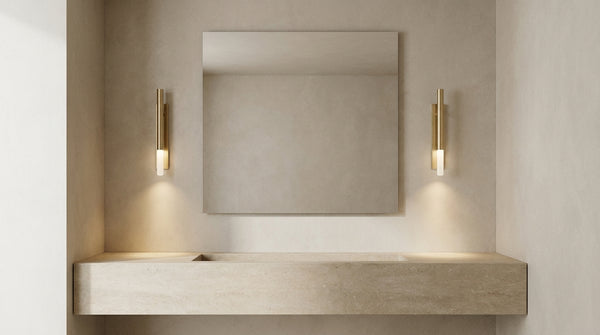
The nightstand fills up fast. Book, glasses, glass of water and phone: the surface disappears and the lamp ends up on the floor. A bedroom wall light gives back the whole surface, and the light ends up where it is useful, above the shoulder.
How many lumens do you need in a bedroom?
Far fewer than in a living room, and never from a single point. The room is happy with a moderate output for moving around and getting dressed; the power is concentrated on the reading area. Our guide on how many lumens to plan for in a bedroom details the calculation according to surface area and wall colour.
Do you need a ceiling light in addition to the wall lights?
A high point remains useful for cleaning and getting dressed, provided it stays discreet. Set back from the bed rather than directly above it, it lights the room without casting a shadow on the pillow. That is the role of a well-placed bedroom light fixture, often sacrificed for the bedside alone.
Which bedside lamp for a bedroom?
The bulb base decides faster than the style. In a survey of 111 references from our Bedside Lamp for Bedroom collection on 29 September 2026, E27 comes first with 57% of the sample. An E27 can be replaced and warmed up without changing the wall light.
- E27: 57% of the sample, the easiest bulb to find and vary
- Integrated LEDs: 20%, output fixed at the factory
- E14: 10%, reduced format for small wall lights
- G9: 8%, common on models with adjustable arms
The collection has 956 references on that same date, plenty to search through. Two markers save time: the base you want, and whether the product has a switch. The selection is reviewed by buyers, and the shop's Google listing lets you check all of that in one click.
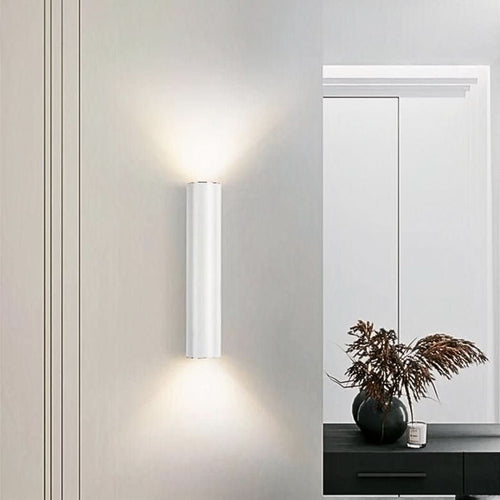
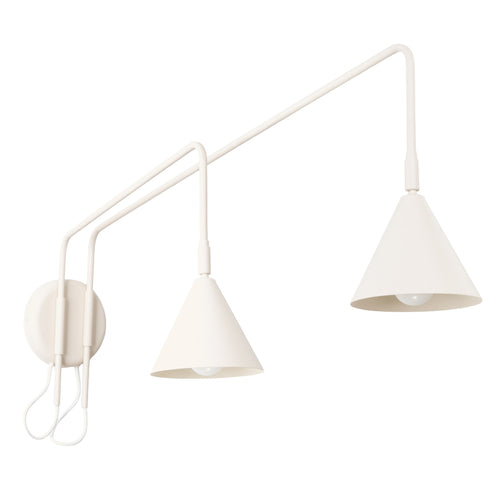
Selection of bedside wall lights to mount on the wall


Wall light or table lamp: which to choose?
The wall light frees the nightstand and fixes the light at the right height. The table lamp can be moved, replaced without drilling and follows a house move. The choice depends mainly on the space available and how often you reorganise the room; the detail that changes a bedroom often comes down to that single decision.
Which bulb for reading in bed in the evening?
A bulb that is neither too cool nor too powerful, with a beam directed at the page rather than at your eyes. An E27 base remains more flexible than an integrated LED, because you can adjust the temperature without changing the wall light. For details on beams, see how to light a headboard without dazzling the person next to you.
At what height should a bedside wall light be installed?
Measure from the mattress, not from the floor. The wall light is installed 40 to 50 cm above the bed base, which most often falls between 1.20 m and 1.40 m from the floor. With a high bed or a thick mattress, the same wall light lights empty space.
What height for a reading light?
The reference changes: the bottom of the shade should reach eye level once you are sitting, with your back to the wall. Too low, the reading light dazzles; too high, it lights the whole room. Our notes on the height of a reading light repeat the calculation for low beds and storage beds.
How to direct the reading beam?
An adjustable head makes up for an approximate height, since you redirect it after installation. This is the case for many wall reading lights with a swivel head, to be placed on the right side of the bed.
For a clean beam, a wall lamp with an integrated LED offers a more even output than a fabric shade, at the cost of one less bulb choice.
In your bedroom, which constraint really decides?
Which light helps you fall asleep?
A warm, low light with no blue. Between 1800 K and 2700 K, turned down to the minimum, it signals to the body that the day is over. A 4000 K ceiling light switched on at 11 pm produces the opposite effect, even at low power.
The choice of lamp matters less than the time you switch it off, as our article on which light to sleep with reminds us.
Which colour temperature to choose?
A bedroom stays under 3000 K. Beyond that, white light remains useful for getting dressed but delays falling asleep when it lasts. If you are hesitating between two references, white or yellow light is decided by how the room is used, not by fashion.
Which colour should you not use in a bedroom?
Walls do not produce light, they reflect it. A bright blue, a red or a saturated orange strongly reflect white light and harden the mood, even with a warm wall light. A matte wall in stone, linen or warm grey tones suits a 2700 K light better.
Do you need a dimmable wall light?
Not always, and that is the trap. In the same survey of 111 references on 29 September 2026, dimmability is declared "no" on 47% of the sample and "yes" on 25%. In other words, one wall light in two cannot be dimmed: the product sheet says so, you just have to read it.
When dimming is announced, it also depends on the bulb. A poorly matched dimmable or variable bulb buzzes or switches off at the low end.
Before confirming your basket, have the base and compatibility with your dimmer confirmed: this kind of doubt is settled with one question, and you can write to us directly.
Wired, plug-in or cordless wall light: how to choose?
First look at what the wall contains. In a survey of 111 references from our catalogue on 29 September 2026, wall mounting is declared on 3% of the sample and surface mounting on 4%, against 90% as "table". Most models plug in or stand, they do not connect to a supply.
What to do when there is no electrical supply?
Three solutions depending on the wall and the freedom you want to keep.
- Hidden cable: a supply run down behind the headboard, the cleanest finish
- Nearby socket: a direct connection, quick, with a visible wire to accept
- No work: a battery version, recharged by USB
On a partition or plasterboard, a plug-in wall light remains the simplest, provided you accept the wire along the wall.
If you do not want to touch anything, a cordless bedside lamp sits on the nightstand and recharges elsewhere.
Do you need a switch on the wall light?
A built-in switch saves crossing the room or hunting for the cord in the dark. On a fixed wall light, it is the point that decides real use: without it, you end up leaving the hallway light on. Our wall light with switch collection answers that specific case.
On the same subject
In stock · shipping costs shown at checkout · up to 30% off in your cart
Ready to turn inspiration into reality?
Tell us about your room, your style and your budget, and we will show you the pieces that truly suit your project.
Get guidance in 30 seconds →