Original pendant light: how to choose, adjust and install it
This article is also available in French: Suspension originale

Choose the light point first, not the shade: an original pendant light is decided on three concrete criteria, the shape seen from the doorway, the material that reflects the light, and the diameter relative to the tabletop. Allow for a diameter close to a third of the table width, and set the drop before tightening a single screw.
What makes a pendant light original?
An original pendant light is recognised by a single deliberate departure from the norm: a shape seen in profile, a material that diffuses light differently, or several light points that fall together. The rest is a matter of proportions. Three criteria are enough to sort through a catalogue, and two of them can be checked on the spec sheet before buying.
A designer light selection is rarely obvious at first glance: it is by comparing it with a classic piece that you spot what catches the eye, the silhouette, the way the light falls on a wall.
What is the difference between a chandelier and a pendant light?
A pendant light hangs from a single cable and lights downwards, a chandelier is built around a central frame and radiates in several directions. The distinction lies in the structure, not the style: a chandelier can be minimalist, a pendant light can be elaborate. Above all, it changes the useful diameter and the drop height. Our article on the chandelier or the pendant light explains this distinction in detail.
What size for a pendant light?
The diameter is calculated from the width of the tabletop, never from the surface area of the room. A wide model remains possible above a narrow table if it keeps a margin of at least 60 cm from the edges, so as not to close off the diners' field of vision.
| Tabletop width | Useful diameter | Light points |
|---|---|---|
| Up to 1 m | 30 to 40 cm | 1 |
| From 1 to 1.6 m | 45 to 60 cm | 1 wide or 2 |
| Beyond 1.6 m | 70 cm and more | 2 or 3 |
Where does the difference actually show?
- The profile shape: it is the line seen from the side that marks a room, not the front view.
- The material: wicker and cane cast a drawn shadow, tinted glass colours the wall without lighting it clearly.
- The composition: two or three globes of different sizes are better than a single large volume.
- The bulb: visible on a glass pendant light, it becomes a decorative element and calls for a well-drawn filament.
A material does not make a whole family: the industrial pendant light lives on black metal and a bare bulb, while cane works with the cast shadow.
To place the main trends before deciding, our feature on the pendant light reviews the shapes that stand the test of time.
Which original pendant light for each room?
The living room calls for a low, wide piece, the bedroom for a subdued point of light, the table for a narrow cone. The family is chosen before the model: the same shape, hung too high, no longer fulfils its role. A simple rule of thumb: aim for the centre of the area of use, not the centre of the ceiling.
Which pendant light for a living room?
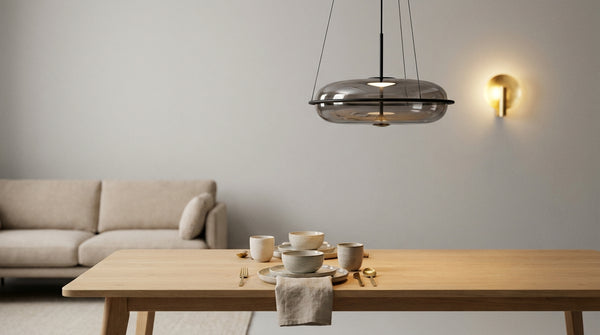
The living room can take generous volumes provided they are hung low. A piece 50 to 70 cm in diameter placed 190 cm from the floor fills the space without getting in the way of movement. Our glass pendant lights play on transparency and let the eye travel towards the window.
Which pendant light for a bedroom?
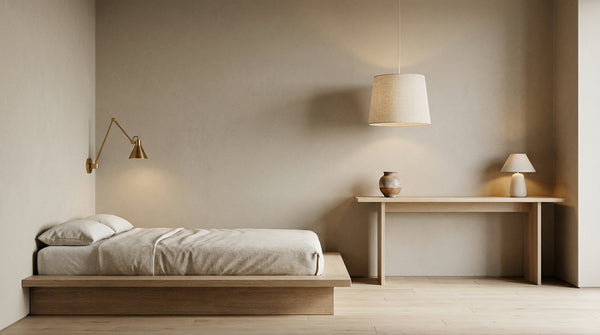
In a bedroom, you want low, enveloping light, never a spotlight above the pillow. A fabric or linen shade, a colour temperature of 2700 K and an off-centre light point are enough. The guide on bedroom pendant lights gives the installation benchmarks.
How do you compose above a table or an island?
Above a table, the line matters more than the model: three small aligned globes are better than a single large volume that is badly centred. The dining room light is chosen according to the number of place settings, not the floor area.
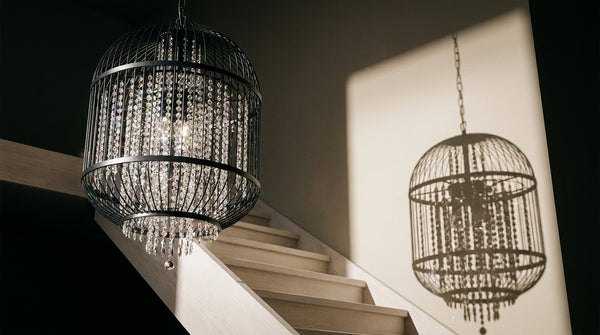
On a large reception table, a dining room chandelier with a fine frame brings the same visual comfort with a more decorative presence.
On a kitchen island, the rule reverses: the worktop calls for frontal light and a small footprint. A kitchen chandelier in matt metal wipes clean with a sponge, which matters above the hob.
| Room | What works | What to avoid |
|---|---|---|
| Living room | Large volume, translucent material | A high piece that decorates the ceiling |
| Bedroom | Soft diffusion, 2700 K | Direct flux above the bed |
| Table, island | Aligned composition, low | A model that hides faces |
Shapes change from one season to the next, and our watch on trending pendant lights helps you avoid buying a model that is already dated.
How do you adjust the height of a pendant light?
Measure from the lowest point of the pendant light, not from the top of the shade: it is this line that the eye and shoulder meet. Above a table, allow 75 to 90 cm between the bottom and the tabletop. In a circulation area, leave at least 210 cm from the floor so people can pass without ducking.
At what height above a dining table?
Start at 90 cm for a standard ceiling height, then lower it towards 75 cm if the room is large and the ceiling high. The light tightens as the pendant light comes down: at 75 cm, the centre of the table is sharp and the edges softer, which suits a dinner.
On a cable model, the drop is set before final fixing, never after: a height-adjustable pendant light is set once the light is in place, with someone sitting at the table to confirm.
How do you set the drop under a high ceiling?
Under a cathedral ceiling, you do not bring the pendant light down to human height: you add a cable and keep the light point in the lower zone of the room. A useful benchmark: the pendant light should not drop below the upper third of a double-height wall.
- Table: 75 to 90 cm above the tabletop.
- Circulation: 210 cm minimum from the floor.
- Large volume: a wide piece kept high, a low point for practical light.
How do you align three pendant lights on the same line?
Draw the line in pencil on the ceiling from the two end points, then divide the remaining interval. Check each drop with a tape measure from the floor, not from the ceiling: it is the only measurement that guarantees a perfectly horizontal bottom edge.
If you are unsure about the ceiling load or the drop to order, the quickest route is to talk to a Designix advisor: the answer takes a few minutes.
How do you install a pendant light without nasty surprises?
Read the box before drilling: the number of conductors and the presence of a hook decide what comes next. A DCL box accepts a pendant light directly, a solid ceiling requires a plug suited to the actual load of the fixture. Identify the nature of the surface, cut the power, set the drop, then tighten.
How do you install a pendant light on a DCL box?
The DCL box gathers the three conductors behind a round cover, with a central thread. Unscrew the cover, connect live, neutral and earth to the light's terminal block, then screw the cover back on: no plug, no drilling. The full procedure is in our tutorial on pendant lights on a DCL box.
How do you install a pendant light without drilling?
When renting, the existing fixing point can be reused as it is, or you switch to a wall-mounted light. A non-electrified pendant light, with no cable or socket, needs only a hook and an indirect source: it decorates without any work. See the method for a pendant light without drilling.
Load and drilling: what to check before screwing?
- The surface: concrete, hollow brick and plasterboard do not take the same plug.
- The anchor point: an existing hook should be tested by hand before loading it.
- The cable: it must stay free in its sheath, with no tension at the terminal block.
- The adjustment: drop confirmed at working height before final tightening.
An installation done in reverse order, screwed then adjusted, always ends up being redone. Our tutorial to install a hanging light details the order of the steps.
In stock · shipping costs shown at checkout · up to 30% off in your cart
Ready to turn inspiration into reality?
Tell us about your room, your style and your budget, and we will show you the pieces that truly suit your project.
Get guidance in 30 seconds →