What light to sleep by: lighting your bedroom well
This article is also available in French: Quel lumiere pour dormir
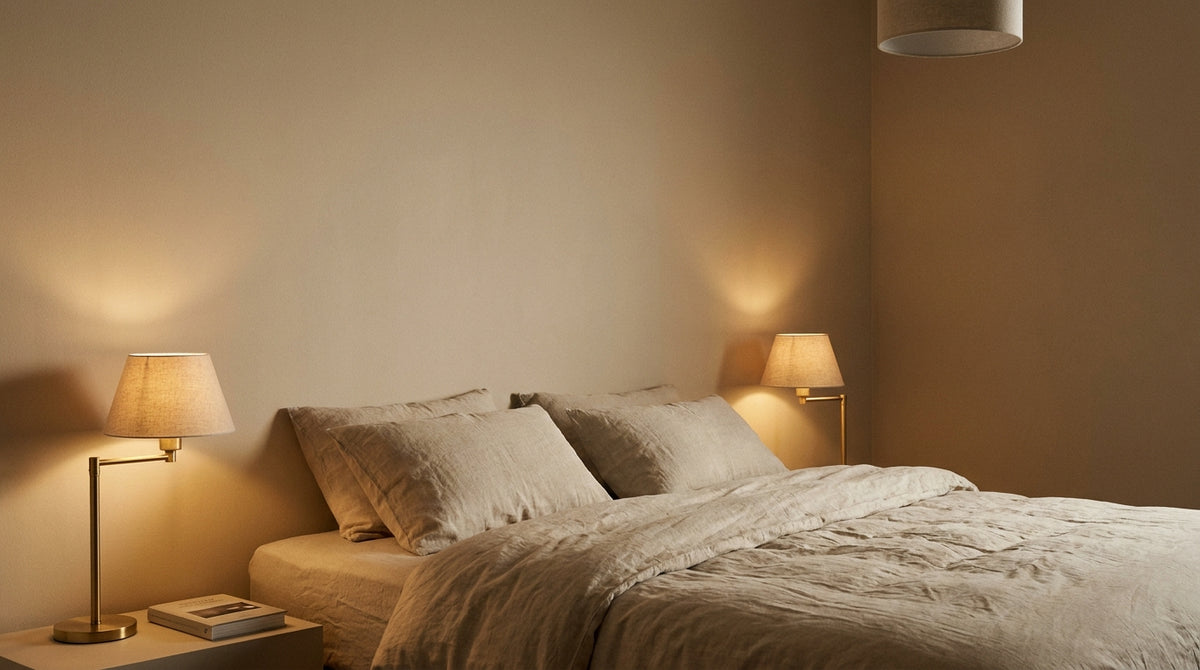
Move any light source out of sight from the pillow, place two warm lights on either side of the bed, and make the switch reachable without getting up. For sleep, aim for light between 2,200 and 2,700 K, under 100 lumens in your line of sight, switched off in the quarter hour before bed.
What is the ideal light for sleep?
A warm, indirect, low-intensity light: between 2,200 and 2,700 K, aimed at the wall or ceiling, never in your line of sight. Two separate low sources are better than one central point, because they can be switched on one at a time and adjusted to the hour.
What is the light that helps you sleep?
The one you can dim very low without it flickering. The body expects an end-of-day signal: an intensity that drops in stages over twenty minutes is better than a sudden switch-off. Our selection of bedroom lighting brings together wall and pendant sources that dim low without dazzling.
Decor matters as much as technique. An opaque shade, a dark wood, a matte wall: warm light settles there without bouncing back. If you are rethinking the room, choose the bedroom lighting in the same materials, the ones that soothe in the evening.
How many sources should you plan for in a bedroom?
- Two bedside points flanking the bed, each with its own control
- A wall light or reading light to read without disturbing the other person
- A low night light for night-time trips
- No visible source from the pillow once you are lying down
The ceiling point can stay, provided it is dimmable. If there is no wall socket, plan the electrics before buying: the page bedroom and office renovation project sets out the steps in order.
What colour of light for sleep?
Warm, between 2,200 and 2,700 K, the soft orange of a candle. This hue contains very little blue, the part of the spectrum that delays falling asleep. Above 3,000 K, the light turns whiter and the brain receives a daytime signal.
What is the worst colour for sleep?
Blue and cool white. Between 4,000 and 6,500 K, a screen, a bathroom neon or an entry-level LED ceiling light says the opposite of what you are looking for. Even at low power, they stay whiter than they appear.
A diffusing shade makes up for a lot: frosted glass and fabric filter out blue. A bedroom pendant is chosen for this material before its shape.
Light for sleep: warm colour or neutral white?
Warm for the end of the day, neutral for uses that require distinguishing colours. There is no need to choose if both exist in the room.
| Use | Temperature | What it changes |
|---|---|---|
| Reading in bed | 2,700 K | enough contrast, little blue |
| Night-time trip | 2,200 K | minimal waking |
| Choosing clothes | 3,000 K | accurate colours, short use |
| Morning wake-up | 2,700 K | no harshness when switched on |
A well-diffused pendant and a wall light are often enough to cover both needs. To choose between the two families, our comparison white or yellow light sets out the cases room by room.
How many lumens for a bedroom?
Allow 100 to 150 lumens per square metre for general bedroom lighting. A 12 m² room therefore needs only 1,200 to 1,800 lumens on the ceiling, spread out rather than concentrated. The bedside, for its part, works well below these values.
What intensity for a bedside lamp?
300 to 500 lumens for reading, 50 to 100 lumens for falling asleep. Look for the low range before maximum power: an LED bedside lamp that really dims low is more useful than a very bright model.
Should you switch everything off or keep a night light?
Complete darkness remains the reference. A night light is justified for a child, for an adult who gets up at night, or in a home where people move around. It is then placed on the floor, at 2,200 K, out of the field of vision from the bed.
- To place on a skirting board or low piece of furniture, with no visible cable
- To plug in when there is a socket near the floor, with a timer
- For a baby: out of reach, low grazing light, no visible light point from the cot
The detail of intensities by use is set out in our article on lumens for a bedroom.
In your bedroom, how do you experience bedtime?
If your bed wall has no socket or the ceiling is low, describe the room to us: we answer on the possible solutions, with no obligation, via write to us.
Is it possible to sleep with LED lights?
Yes, if the LED is warm and dimmable. The problem does not come from the technology but from cool white pushed to high intensity. On a survey of 250 references in our catalogue as of 29 September 2026, 82% of the listings state an LED technology, i.e. 205 listings concerned.
Dimmable LED or fixed LED?
Dimmable, without hesitation, as soon as the room is also used for reading or relaxing. On the same survey, dimming is stated as Yes on 28% of the listings and No on 16%, out of 110 listings that state it.
In practice, a dimmable bulb is only worthwhile with a compatible light fitting. The dimmer is on the bulb or on the switch, rarely on both, and an old installation sometimes makes an LED buzz at low intensity.
This technical point is detailed in our article on dimmable LED and its use cases, starting with the bedside.
Is changing the bulb enough?
Often, yes, provided the socket matches. Still on the 250 listings surveyed, the stated sockets are E27 on 31%, E14 on 14% and GU10 on 12%, out of 232 listings that state it. Replacing a cool bulb with a warm one of the same socket transforms a bedroom in ten minutes.
- 2,700 K maximum at the bedside, 2,200 K for a night light
- High CRI: skin and wood tones stay accurate
- No flicker at low intensity
Our guide on which bulb for a bedroom sorts what is dimmable from what is replaceable. On the 250 references surveyed, the 2-year warranty and CE certification are stated on 100% of the listings concerned, a point that matters when an electrician approves the light fitting.
Light fittings and bulbs for a bedroom that helps you sleep
 Barn 3-light ceiling light black and gold, Premium
 Barn 3-light ceiling light black, Premium
 Gravity 6-light pendant black, opal glass
 Barn 3-light ceiling light black
 Aurore Boréale wall light | Rian
 Wood and black wall light | Fusion Élégante
See the whole selection: Alternative Laurie Lumière: your new lighting destination | Designix
How to install your bedroom light without getting it wrong
Three markers: sources at 1.20 m from the floor on each side of the bed, no source in the field of vision once lying down, and a switch reachable from the mattress. The rest is a matter of style.
At what height should a bed wall light be placed?
Between 1.20 m and 1.40 m from the floor, i.e. 60 to 75 cm above the mattress. Below that, the light hits the pillow; above, the beam falls into the other person's eyes.
- Locate the existing sockets before choosing the shapes
- Mark the height in pencil, on each side of the bed
- Test the switch lying down, arm outstretched
- Check the field of vision: no bare bulb visible
An adult bedroom wall light with an integrated switch avoids drilling a second hole for the control.
Reading in bed without lighting up the other person
Aim the beam at the page, not at the room. A bedroom floor lamp with an adjustable arm or a reading wall light replaces the classic bedside lamp when reading lasts.
The position of the bed itself changes things: the head away from the door, the bedside on the side opposite the window, avoid reflections on the page.
Place the head of the bed taking the window and traffic into account, then the bedroom lighting around it. Style comes after measurements, and there, interior decoration takes over: our catalogue lists 21,057 lighting references as of 29 September 2026, from designer lighting to the most understated.
On the same subject
In stock · shipping costs shown at checkout · up to 30% off in your cart


Ready to turn inspiration into reality?
Tell us about your room, your style and your budget, and we will show you the pieces that truly suit your project.
Get guidance in 30 seconds →