Off-center ceiling light: 5 ways to install your fixture
This article is also available in French: 5 solutions pour installer un luminaire sur un plafonnier décentré

Measure the gap between the electrical point and the optical center of the room. Up to 15 cm, an offset canopy is enough. From 15 to 40 cm, a patère and a textile cable do the job. Beyond that, an offset arm, a track of adjustable spotlights or several sources take over.
What solutions are there for installing a fixture on an off-center ceiling light?
Five solutions can compensate for an offset point: the offset canopy, the patère with textile cable, the fixture with offset arm, the track of adjustable spotlights and abandoning the central point in favor of several sources. The choice depends on the gap to cover and the nature of the ceiling.
Our ceiling light collection has 4,441 references as of September 29, 2026. On a sample of 130 of these references on the same date, 100% state a 2-year warranty and CE certification, which leaves little room for improvisation on the fixing.
| Stated mounting | Share of the 130-reference sample |
|---|---|
| Surface-mounted | 90% |
| Pendant | 7% |
| Wall-mounted | 1% |
How do you offset a ceiling light with an offset canopy?
The offset canopy is a plate that screws onto the existing box and moves the cable start by a few centimeters. It remains the most discreet as long as the gap is small: nothing hangs, nothing is visible from the floor, and the fixture appears to be placed in the right spot.
- Short gap: the plate compensates the offset without drilling elsewhere in the slab.
- Solid ceiling: the plate must sit flat, otherwise the screw works in the plaster.
- Light fixture: a heavy model requires an anchored support, not a simple canopy.
The details of compatibility between plate and cover are covered in our guide on the ceiling canopy, useful before ordering a specific model.
How do you install a patère and a textile cable?
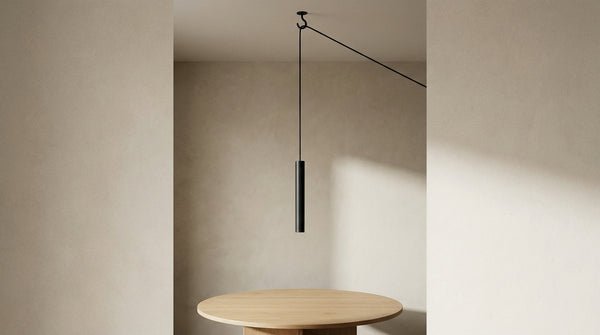
The patère turns the flaw into an accepted attachment point: it is fixed directly above the center, then a cable runs down to the fixture. The offset becomes visible, and that is often what saves the room, because the eye follows the cable instead of looking for the fault.
A pendant light with textile cable can be adjusted in height, which leaves room to align the shade with the center of the table rather than the box. On a sample of 130 references from our catalog on September 29, 2026, metal accounts for 78% of the listings that state a material, versus 22% for glass: the two give very different light above a worktop.
Which fixture should you choose when the point is offset?
Choose a fixture that carries its own offset: articulated arm, bracket or offset wall light. It mounts on the original box and reaches the center of the room through its own geometry. No additional electrical work, no visible cable to negotiate.
The fixture with offset arm
The rigid or articulated arm moves the source 20 to 50 cm to the side. It is the most elegant solution when the point falls near a wall: the fixture seems to have been designed for the room.
- Rigid arm: fixed offset, clean line, single adjustment at installation.
- Articulated arm: orientation can be changed at any time, handy above a worktop.
- Wall fixing: preferred if the slab can no longer be drilled.
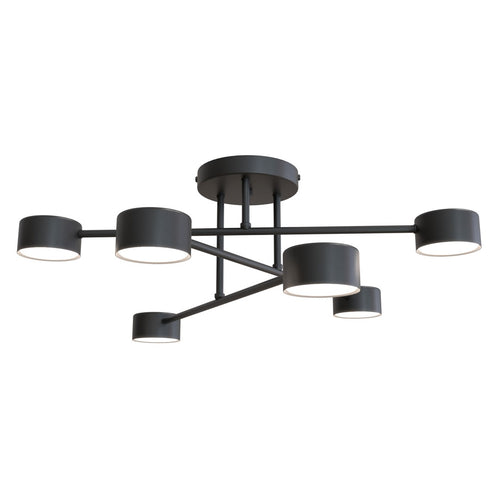
A LED ceiling light with integrated arm solves the question in a single reference, source and support included.
The track and the rail of adjustable spotlights
A rail spreads light along a line and compensates an offset axis without ever aiming at the center. Each adjustable spotlight is set independently, which makes it possible to light a wall, a bookcase or a worktop from a single power point.
- Exposed track: suited to high ceilings and technical ceilings.
- Short rail: enough for a hallway or a narrow entrance.
- GU10 socket: 7% of the 130 listings that state a socket on September 29, 2026, to check before buying the bulbs.
Pendants and ceiling lights to compensate an off-center point


Where is the electrical point in relation to the center of your room?
What offset distance changes the solution?
Below 15 cm, the canopy is enough. Between 15 and 40 cm, the patère and textile cable remain the best compromise. Beyond 40 cm, no accessory will hold: the light must be offset by an arm, a rail, or spread across several sources.
| Point / center gap | Solution | Main constraint |
|---|---|---|
| Less than 15 cm | Offset canopy | Solid ceiling, light fixture |
| 15 to 40 cm | Patère and textile cable | Height adjustment, visible cable |
| More than 40 cm | Arm, rail or multiple sources | Drilling at a distance, lighting plan to redo |
What matters under 40 cm
- Weight decides the support: plasterboard plug for drywall, hammer-in plug for concrete.
- Ceiling height limits cable length: under 2.40 m, a horizontal offset is better.
- Ingress protection matters in the kitchen and bathroom: IP20 in a bedroom, IP44 near a water point.
Concrete ceiling or sloped ceiling
On a solid slab, every hole counts: drill at the exact diameter and only once. On a sloped surface, the question changes completely, as explained in our article on the sloped ceiling.
Beyond a large offset, moving the electrical point becomes heavier than offsetting it: describe your configuration before ordering the fixture.
How do you wire a pendant to a DCL box?
Switch off the breaker, remove the cover, identify the three conductors: live, neutral, earth. The DCL box serves both as connection and support. The pendant is wired to the terminal block, then fixed to the hook or plate provided for it.
The step-by-step wiring, wire by wire, is detailed in our guide to installing a chandelier on a DCL box.
What are the different types of fixing for a ceiling light?
- Hook: the historic support for pendants, provided the box is designed for it.
- Plate and canopy: surface mounting, 90% of the 130 listings in our catalog on September 29, 2026.
- Patère: wall or ceiling support that takes the weight away from the power point.
- No drilling: possible on some slabs, provided the permitted load is respected, as our method for fixing a ceiling light without drilling reminds.
When the hook is missing, the solution is an added support: our article on installing a ceiling pendant without a hook details the possible assemblies.
Is it possible to install a ceiling light without a DCL?
Yes, many older homes have only a wire coming out of the ceiling. A fixture can be connected there provided the three conductors are properly reconnected and the assembly is left inaccessible once the cover is in place.
- Connector block: never left exposed, always housed in the cover.
- Earth: to be connected as soon as the fixture is class I, i.e. a metal body.
- Load: a heavy fixture requires a support anchored in the structure, not in the plaster.
How do you light a room when the central point is no longer enough?
Give up the single point. Two or three distributed sources light better than one large badly placed fixture: a pendant above the table if the point falls right, wall lights on the sides, a floor lamp near the sofa. The ceiling becomes a support again, not a center.
Multiplying sources rather than offsetting the main one
A wall light placed on either side of a sofa or bed replaces an off-center ceiling light without ever raising the question of offset. The light comes down, faces are lit, and the original electrical point only serves as backup.
On the sample of 130 references from our catalog on September 29, 2026, 22% of the listings that state a material mention glass: a glass pendant diffuses a soft light that forgives imperfect placement.
Rethinking the lighting plan rather than the point
When an off-center ceiling light is added to poorly distributed lighting, the real answer is a living room renovation planned source by source. It is also the simplest approach when you want to light a room without a ceiling light: each zone gets its light, none depends on a single point.
Installers who need to validate an assembly before ordering will find the technical elements in our professional area: references, warranties and product specifications are grouped there.
In stock · shipping costs shown at checkout · up to 30% off in your cart
Ready to turn inspiration into reality?
Tell us about your room, your style and your budget, and we will show you the pieces that truly suit your project.
Get guidance in 30 seconds →