Installing a ceiling pendant without a hook: the method
This article is also available in French: Installer une suspension au plafond sans crochet
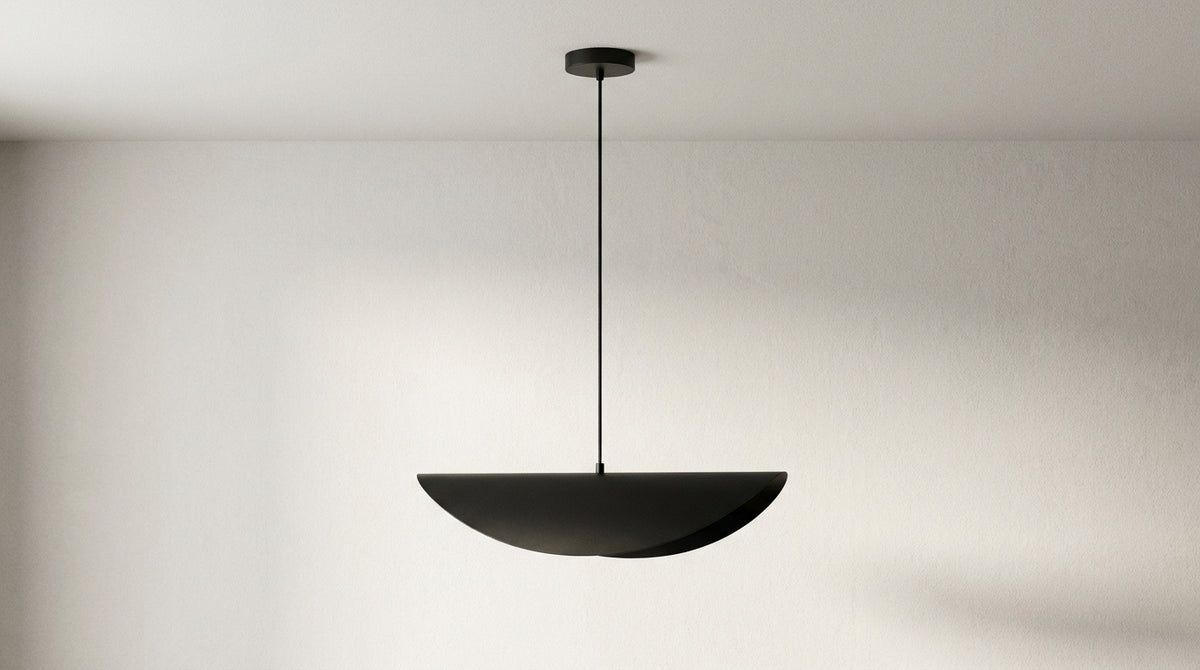
Screw the bracket supplied with the light fixture directly into the ceiling, using the wall plug suited to the surface: expansion plug in plasterboard, nylon plug in concrete, coach screw in wood. The hook is no longer needed; the mounting bar replaces it on almost all pendants sold today.
How do you fix a pendant to the ceiling without a hook?
The mounting bar supplied with the light fixture replaces the hook. You screw it to the ceiling at two points, then hang the cover and the wires on it. No hook to add, no part to buy separately.
What the hook is replaced by on a contemporary pendant
On a current pendant light, the hook has disappeared from the box. The fixture arrives with its own system: a metal bracket drilled with two holes, a round mounting plate, or a square box that also serves as the electrical connection.
On a survey of 92 pendants from our catalogue as of 28 September 2026, 98% of the survey carries the mention suspended mounting and 33% an E27 socket. The collection contains 7,608 references. The hook therefore belongs to old chandeliers, which are still fixed to the ceiling with a hook.
Bracket, plate, box: the three cases
The mounting follows the ceiling, not the style of the fixture. A living room pendant with a wide canopy calls for a mounting plate, a single-cable model for a bracket.
- The bracket: two screws in the ceiling, the cable height is then adjusted
- The mounting plate: a disc pressed against the ceiling, for a wide canopy
- The box: fixing and electrical connection in the same part
- The hook: reserved for heavy chandeliers and old fixtures
| Mounting | Ceiling | Fixing |
|---|---|---|
| Bracket | Concrete, wood | 2 screws, nylon plug or coach screw |
| Mounting plate | Plasterboard, slab | 4 screws, expansion plug |
| Box | Slab with DCL box | 2 screws in the box lugs |
How do you make a pendant stay on the ceiling?
It is not the fixture that holds, it is the wall plug. A 2 kg pendant requires a plug suited to the ceiling material, not a longer screw. The nature of the surface decides everything: plasterboard, concrete, wood or hollow slab.
Plasterboard, concrete, wood: the plug that holds
- Plasterboard: expansion or toggle plug, which grips behind the board
- Concrete: nylon expansion plug, 6 or 8 mm diameter
- Wood: direct coach screw, no plug
- Hollow slab: material detector before drilling, the anchor must bite into solid material
The surface dictates the screws far more than the chosen fixture: a metal and glass model is installed exactly like an acrylic model of comparable weight.
What the real weight of the fixture changes
Weigh the complete piece, shade, socket and bulb included. A heavy pendant needs two anchor points in solid material, never a single point in the board.
The method described for installing a ceiling lamp applies here as is, only the adjustment height changes.
If your ceiling is hollow, damp or you do not know how to describe it, you can describe your ceiling to us with a photo: we will tell you which mounting to use before you drill anything.
Do you install fixtures on different sites one after another? The professional space gathers what you need to prepare your configurations without going through the same questions again.
Pendants ready to mount: the Designix selection


Is it possible to fix a ceiling light without a DCL box?
Yes. The DCL box is not mandatory: it serves to take up the wires neatly and to offer two fixing points. Without it, the conductors arrive directly in the canopy of the fixture, with a connector block or terminals. The fixing itself does not change.
Spotting a DCL box under a canopy
Switch off the power, unscrew the canopy. A DCL box is a plastic square with three openings and two metal lugs on each side. If it is there, installing a pendant on a DCL box takes a few minutes: you screw into the lugs, without a plug.
When the box already exists
Check that the lugs are not split and that the centre distance matches that of your fixture. If the box is damaged, two options: drill again next to it, or choose a lighter LED ceiling light, often mounted on the same centre distances.
The connection detail is explained step by step in installing a fixture on a DCL box, including the case of a fixture without a dedicated electrical supply.
How do you fix a light fixture without drilling the ceiling?
Three options exist: structural adhesive for a flat, lightweight ceiling light, the floor lamp or wall light that move the light, and tensioned systems from one wall to another. None carries a heavy pendant: without drilling, the useful load remains low.
Drill-free solutions and their limits
- Structural adhesive: a flat, lightweight ceiling light, never a pendant
- Tensioned rail between two walls: takes a small pendant, but requires wall fixings
- Floor lamp or wall light: lights the room without touching the ceiling
A glued ceiling light holds if the surface is clean, dry and flat. The limit comes quickly: the adhesive works with heat and dust, and it does not forgive an uneven surface.
For a reversible mounting, pendant light without drilling reviews the solutions that leave no trace on the ceiling.
And when drilling remains possible, fixing a light fixture to the ceiling without drilling details the cases where you can do without it without sacrificing hold.
The case of rented housing
When renting, a plug hole is filled with filler and a touch of paint. The real constraint lies elsewhere: no chasing, no new light point, and a condition report on leaving. A drill-free mounting is reversible, that is its main argument.
At what height should the pendant be set after installation?
Allow 75 to 80 cm between the bottom of the shade and the top of a dining table, and 85 to 90 cm above an island worktop. In a circulation area, leave 210 cm of clear passage under the fixture. These dimensions are set on the cable, once the fixing is complete.
Above a table or an island
| Location | Height under the shade | Reference |
|---|---|---|
| Dining table | 75 to 80 cm above the top | centred on the table |
| Kitchen island | 85 to 90 cm | two or three points aligned |
| Hallway, entrance | 210 cm of clear passage | clear of the door swing |
Above a round table, the piece benefits from staying simple: a dining room fixture placed in the centre lights better than a cluttered trio.
Above an island, and the case of a sloped ceiling
On an island, a kitchen pendant is set higher than over a table: you must see what you are cutting without lowering your head, and without the fixture entering your field of vision.
With a sloped ceiling, the adjustment is made relative to the floor and not to the slope: it is the vertical that counts, otherwise the fixture appears crooked.
In which room are you installing your pendant?
In stock · shipping costs shown at checkout · up to 30% off in your cart


Ready to turn inspiration into reality?
Tell us about your room, your style and your budget, and we will show you the pieces that truly suit your project.
Get guidance in 30 seconds →