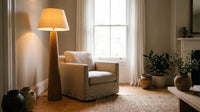
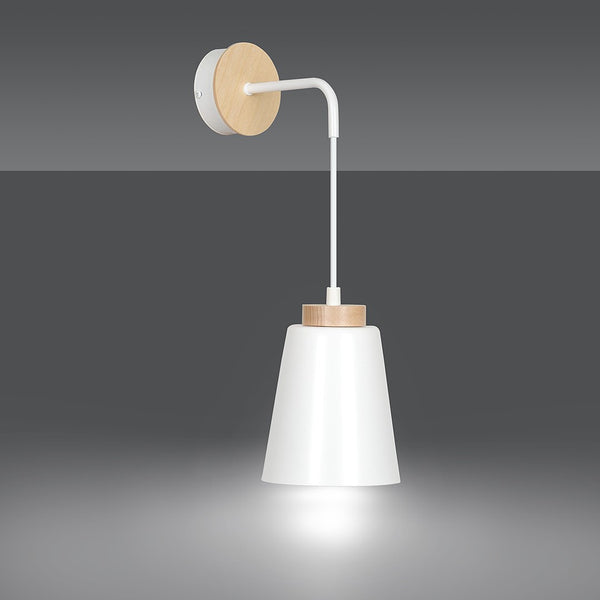
Wooden wall lamp
- Tracked delivery to your country Tracked delivery
- Secure payment at checkout Multiple payment methods
- 14 days to change your mind 14-day returns
- Secure payment Secure payment


Not sure of your style? Find it in 30 seconds
A few questions, and we will show you the pieces made for you.



















Frequently asked questions
How do I choose the right product?
What are the delivery times?
Can I return an item?
Can I pay in instalments?
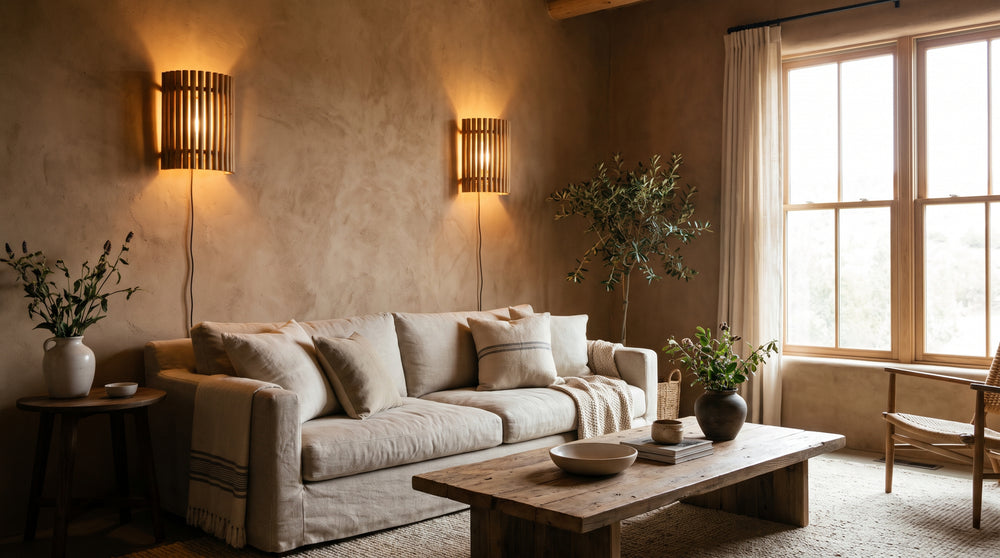
An interior that reflects who you are
Carefully selected pieces, shipped from our warehouses. Our team advises you before you buy, so you choose with confidence.
- Tracked delivery
- Pay in instalments, where available
- 14 days to change your mind
- Advice & showroom in Lyon, France
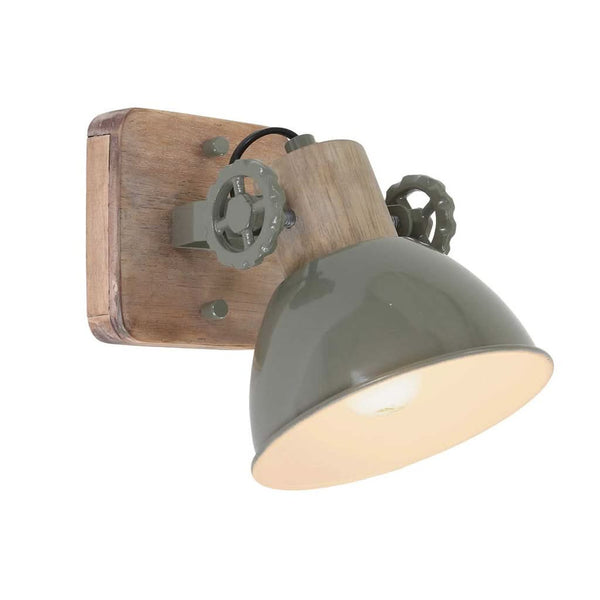
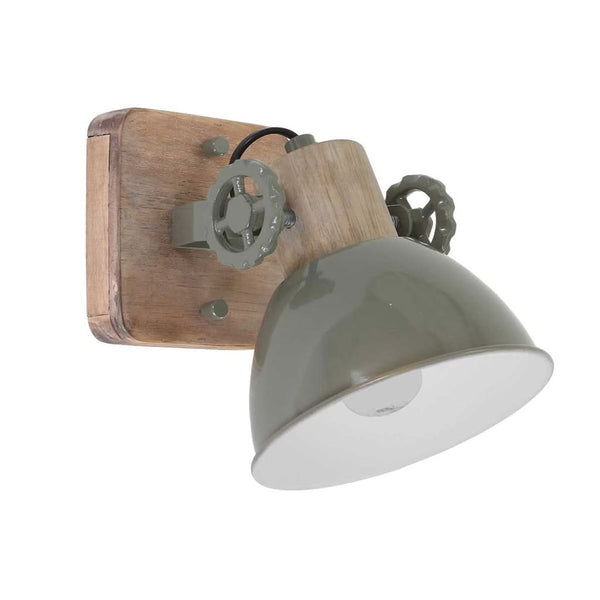
For a living room, place the wood wall light on either side of the sofa or a bookshelf, at armrest height or slightly above, and choose the light spread before the shape. A conical shade or a dome lights widely, a panel or an adjustable arm targets an armchair; the wood backplate warms the wall and matches the furniture.
Which wood wall light for a living room?
Choose the light spread before the shape: a conical shade or a dome lights widely above the sofa, a panel or an adjustable arm targets a reading chair. The wood backplate warms the wall and matches the furniture, in black, white, brown or gold depending on the model.
Wood wall light: what changes on the living room wall
The wood grain shows on a light wall and softens on a dark painted wall. Here it combines with metal, fabric or steel, which moves away from the rustic effect if you want a clean look. The Ylae wall light brings together a conical shade, a leather strap and warm white light, with a dimmer. To broaden your search, browse all our lighting.
Modern living room wall light: which shape for which wall?
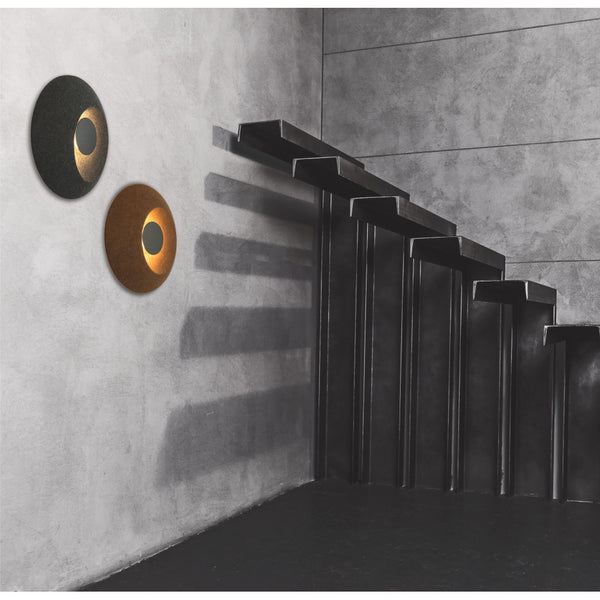
A dome or a shade suits a large bare wall. A rectangular panel or a square shape frames a narrow wall between two openings better. In an already busy room, a compact model like Cuprum, a black cube with copper interior and G9 fitting, lets the light speak. Find these formats in living room wall lighting.
Which wood wall light for a bedroom?
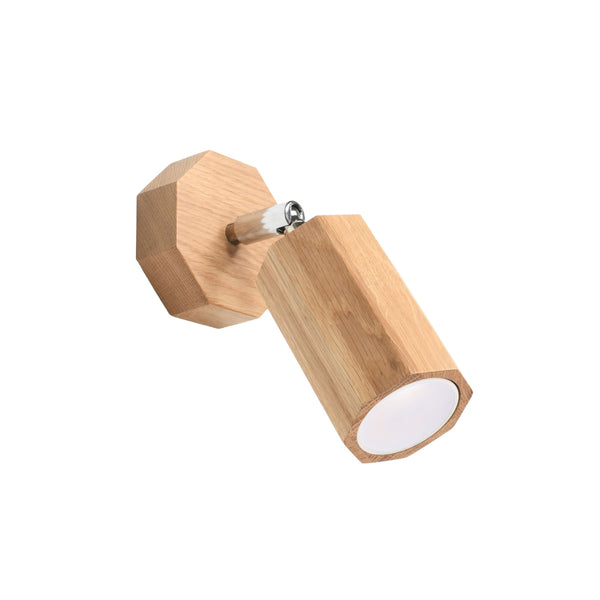
Place the light at shoulder height once seated in bed, on either side of the bed frame, to replace the bedside lamp and free up the nightstand. An articulated arm or a tilted head brings the light closer to the book, and a warm white model makes reading more restful in the evening.
Bedroom wood wall light: on each side of the bed
Allow one wall light per sleeper, aligned at the same height, about 50 to 70 cm above the mattress depending on the seat, and at least 60 cm from the edge of the bed. The Tena wall light, with an extended arm and tilted head in GU10 fitting, adjusts in both directions. The Belranora features a wood-effect band with gold interior in G9 fitting.
Warm white or cool white: which temperature for sleeping?
Most of the listed models in the selection are warm white, between 2700 and 3500 K, a few references are cool white, between 4500 and 6500 K. In a bedroom, warm white remains the comfortable reference for reading and waking up. Cool white, sharper, is reserved for work areas and hallways. Compare in bedroom wall lamps.
Which wood wall light for a hallway, staircase or entrance?
Fix the light at hand height, around 1.10 m to 1.30 m from the floor, aligned with the door frame or the step, then repeat the same spacing from one point to the next. A conical shade lights up and down, which removes dark areas without glare.
Staircase, hallway, entrance and WC: heights and alignments
For WCs, a compact IP20 wall light, like the wood and metal models, suits small spaces. Searches for "design WC wall light" and "toilet wall light" find solutions here, as does "customisable wood wall light".
On a staircase, alternate the two mounting levels, one point at the top of the flight and one at the bottom, to avoid shadow pockets on the steps. In a long hallway, keep a regular gap rather than a close grouping at the end. The Viridora, with an adjustable dome on a wood backplate, suits passageways as well as entrances. See also hallway wall lights.
Wood wall light for bathroom: what the IP rating says
Almost the entire selection is rated IP20, protection against contacts and dust, without resistance to splashes. Only a few references are IP45. In a bathroom, rely only on the rating shown on the model's specification: an IP20 is placed outside the splash zone. See bathroom wall lights.
Which wall light for good lighting?
Look at the beam direction before the power. An adjustable dome or a wide shade lights a room as a supplement, a GU10 spot or a panel concentrates light on a surface, and an extended arm brings the source closer to the book or worktop. The power ratings in the selection range from a few watts to several tens of watts.
Powerful LED wall light: what really matters
High power is useless if the light goes in the opposite direction to the need. An integrated LED module, like the Lignia or the Davora, stays slim on the wall and is installed without a bulb to change. An E27 or G9 fitting accepts a more generous and replaceable bulb. Browse LED wall lights.
Lighting a worktop or a reading corner
For a worktop or an armchair, bring the source less than a metre from the surface, on the side, to avoid the shadow of your hand. An articulated arm or a tilted head does this work without drilling above the worktop. Two-arm models, like Bronzor, light two separate areas with a single point on the wall.
| Room | Need | Recommended fitting | Installation |
|---|---|---|---|
| Living room | wide supplementary light | E27 | dome or shade, near the sofa |
| Bedroom | reading and atmosphere | E27, G9 or GU10 | articulated arm, at seated shoulder height |
| Hallway | guidance without glare | E27 | compact model repeated, at hand height |
| Staircase | passage safety | E27 | aligned with the step, up and down lighting |
| Entrance | first light of the evening | G9 or E27 | near the frame, without blocking the opening |
| Bathroom | targeted light | integrated LED or E27 | check the stated IP rating |
E27, G9, GU10 or integrated LED fitting: how to choose?
The E27 fitting accepts a classic screw or filament bulb and remains the most common in the selection, the G9 a pin bulb in a small space, the GU10 a directional spot, the E14 a reduced format. Integrated LED is not replaceable and allows slimmer shapes, like Lignia, Silexa or Davora.
E27, G9, GU10, E14: what does each fitting mean?
The choice of fitting mainly decides your future freedom: a replaceable bulb is changed in seconds, an integrated LED module is not. The G9 fits square volumes and wood cubes, the GU10 fits adjustable heads, the E14 fits narrow shades like the one on Ondissa. A dimmer is only possible on some models.
Integrated LED: when to prefer it?
Prefer integrated LED when you want a reduced thickness on the wall, a rectangular panel for example, or when you no longer want to change a bulb. It pairs well with modern wall lights and busy rooms. If you like varying the intensity or the shade, an E27 fitting remains more flexible.
| Fitting | Bulb type | What it changes | Examples |
|---|---|---|---|
| E27 | screw bulb | wide beam, replaceable bulb, frequent dimmer | Umbella, Maeve, Ylae, Viridora, Blyn |
| E14 | small screw bulb | reduced format for narrow shade | Ondissa |
| G9 | pin bulb | bright light in a small wood or steel space | Belranora, Volto, Cuprum |
| GU10 | pin spot | directional beam, adjustable | Tena |
| Integrated LED | non-replaceable module | no bulb to change, reduced thickness | Lignia, Silexa, Davora, Bronzor |
How to install a wall light without drilling?
This only works on a smooth, load-bearing surface, with an adhesive fixing designed for the weight of the light. On plaster, brick or a hollow partition, a wall plug remains necessary. On a piece of furniture or a headboard, a wall light with an exposed cable is easier to install.
Installing without drilling: when it is possible and when it is not
A well-flat painted wall and tiling accept a suitably sized adhesive fixing. A plasterboard partition, an uneven old wall or a damp surface do not allow it: drill and use a plug. For a wood wall light placed on a headboard or a shelf, a model with an exposed cable avoids running a supply through the wall.
Where to place the power supply and the dimmer?
First locate the existing conduit or box, then align the backplate on it before drilling. Some models with an exposed cable leave a free length up to the switch, which avoids electrical work. The dimmer is only available on some references: check the model's specification before ordering.
Original, bohemian or country chic wall light: which style to choose?
Style is played out in the material and the detail. Solid wood or veneer streaked with black metal leans industrial, a light wood with soft curves gives a country chic wall light, and a round or cage volume with rope signs a bohemian wall light. The measured registers of the selection remain modern, contemporary, nordic, minimalist and industrial.
Driftwood, carved or acacia wood wall light
Driftwood gives a raw finish, never identical from one piece to another. Carved wood adds relief and stands out on a plain wall. Acacia wood brings a more pronounced grain, which works in a room with natural tones. The Nari wall light mixes wood, twisted rope and glass for an industrial spirit, in metal wall lights.
Bohemian chic and country chic wall light: the details that make the difference
A bohemian chic wall light plays with soft volumes, rope, ball shapes. A country chic wall light stays on more classic curves, a conical shade, a light wood, a beige fabric. For a white or beige wall, these two directions pair well, while a dark interior calls for gold finishes that catch the light.
How to care for a wood wall light and protect its finish?
A soft cloth is enough for dust, without abrasive product and without immersion, especially on an IP20 model. Wipe the wood along the grain and use only a slightly damp cloth on the metal, then dry. Check the tightness of the backplate once a year.
Cleaning a wood and metal wall light
Avoid alcohol and abrasive sponges on steel and varnished wood: they dull the finish and remove the protection. A soft brush dislodges dust from cages and metal loops, like those on Blyn. For a consistent look between several wall lights, clean them on the same day with the same method.
Removing varnish from a wooden piece of furniture and managing a table without a tablecloth
Varnish is removed with a suitable stripper, applied then taken off with a scraper, before progressive sanding with a fine grit, in small areas and in a ventilated room. An oiled or varnished table handles a meal without a tablecloth if stains are wiped quickly. These steps also apply to the support of a wood wall light, often varnished or oiled.
Secure payment, tracked delivery, returns and Designix customer service accompany every order. Find all the wall lights, wall lamps and design wall lighting, or compare the other wood wall lights and the most affordable models.
Frequently asked questions
How to install a wall light without drilling?
You need a smooth, load-bearing surface, plus an adhesive fixing sized for the weight of the light. On plaster, brick or a hollow partition, a wall plug remains necessary. On a piece of furniture or a headboard, a wall light with an exposed cable is easier to install than a recessed model.
Which wall light for good lighting?
Choose the beam before the power: a conical shade or an adjustable dome gives a wide, soft light, a GU10 spot or a panel concentrates it on a surface. An extended arm brings the source closer to the book or worktop when lighting must be precise.
Which wall light for a living room?
In a living room, a wood wall light works as supplementary lighting: wide spread above a sofa, beam directed towards a reading chair, or a pair on either side of a bookshelf. The material, dimensions and fitting of the model then determine the effect on the wall.
Which powerful LED wall light to choose?
A powerful LED wall light is only useful if the beam is suitable: an integrated LED lights without a bulb to change and stays slim on the wall, a G9 or E27 fitting accepts a more generous and replaceable bulb. Look at the direction of the light before the number of watts.
How to light a staircase with a wall light?
Install the wall lights at hand height, aligned with the step or the stringer, repeating them at regular intervals. A model that lights up and down avoids dark areas, and an E27 fitting allows you to adjust the bulb according to the passage height.