Pendant bedside lamp: the right height, a clear table
This article is also available in French: Lampe suspendue de chevet

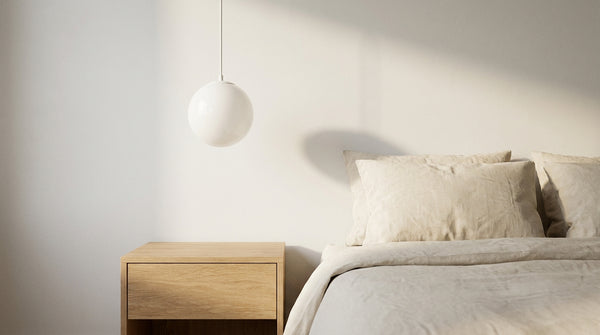
Allow 45 to 60 cm between the top of the bedside table and the bottom of the shade. That is the zone where light falls on the open book, not in your eyes. Higher, and you light the wall; lower, and you light empty space. Always measure from the top of the table, never from the floor.
At what height should a bedside lamp hang above the bedside table?
Aim for 45 to 60 cm between the top of the table and the bottom of the shade, which is eye level for someone sitting up in bed. The socket sits at that level, and the body of the shade hangs below it. Under 40 cm, the light grazes the table and is lost; beyond 70 cm, it goes onto the wall.
A bedroom to rewire or a desk to equip are best planned together: a bedroom and desk lighting project handled in one go avoids drilling the same ceiling twice.
The socket should peak at seated reading height
Sitting with your back to the wall, an adult's shoulder is around 60 cm above the mattress. Set the socket at that reference point, with the shade out of the line of sight. That is what separates a comfortable bedside pendant from a decorative one.
- 45 to 60 cm from the table to the bottom of the shade: the comfort zone
- 60 cm above the mattress: the shoulder height of a seated reader
- 15 to 20 cm from the wall: enough to let a wide shade breathe without pressing it against the paint
- Opaque shade: light comes out from below, aim for the lower end of the range
- Diffusing shade (glass, fabric, rattan): light also spreads sideways, go up towards 60 cm
Low bedside table, high bed: recalculate the drop
A 45 cm table under a mattress at 65 cm breaks the symmetry of the bed and the installation measurement. The bottom of the shade must stay above the mattress, otherwise you bump into it when lying down. In that case, raise the pendant and shorten the cable drop: it is the only adjustment that needs no tools.
A model with an adjustable drop can be set once the bed is in place, which avoids starting over if the mattress changes. Take the final measurement once the bed base is assembled, never from a plan.
Cordless or wiring-free pendant bedside lamps: what are the options?
With no power supply at the ceiling, there are two families: the rechargeable model you unhook to charge, and the battery-powered wall light fixed at the head of the bed. Neither connects to the mains. The real constraint is not the light, it is the recharging routine.
What really works without a ceiling supply
- Rechargeable pendant on a hook: the closest to the look of a wired pendant, you unhook it to charge
- Cordless wall light: no cable drop, just a fixing point, but the light comes from the side
- Clip-on model on the headboard: useful in rented accommodation, where no holes are allowed
- Track or tensioned cable: a wall supply run up high, provided you accept the visible route
Of 155 bedside lamp listings recorded in our catalogue on 14 November 2026, 96% state a surface-mounted setup and only 1% a suspended setup. Pendant lighting remains a deliberate choice, not a default purchase.
When the wall is free, the bedside wall light often solves the problem more simply than a pendant, and the light arrives right at shoulder height.
Rechargeable or battery: the limit to know
A classic battery lamp switches off without warning, and the evening reader is the last to know. A rechargeable one plugs in like a phone: you get into the habit. Above all, check that the switch stays accessible once the light is in place.
Our selection of cordless bedside lamps can be browsed before drilling, and the adult bedroom wall light covers the case of a load-bearing wall with no supply.
Fixing the light directly to the headboard also solves the problem of a cluttered bedside table. The method is detailed here: fixing the light to the headboard.
How to choose a pendant bedside lamp well
First choose the shape according to the light you want: a sphere or dome spreads light widely, a tube or cone directs it towards the book. The material then decides the finish: black metal makes a statement, glass lets light through, fabric softens everything. Colour comes last, once the shape is settled.
Shape, material, colour: what the data really says
Of 157 listings recorded in our catalogue on 14 November 2026, metal appears on 75% of them, black on 40% and the sphere shape on 36%. In other words: the black metal sphere is the dominant look, which says nothing about what will suit you.
A fabric or linen shade softens a very white bedroom; a smoked glass bedroom shade holds evening light better without glare.
Pendants and bedside lamps that free up the bedside table


Base and bulb: what wattage for a bedside lamp?
The base determines everything else: of 154 listings recorded on the same date, 59% state an E27 and 14% an E14. An E27 opens the door to higher-output bulbs and visible filaments, while an E14 is limited to small volumes. In the end, a 6 to 8 W bulb at 2700 K is enough to read without waking the room.
For a warm finish, 2700 K E27 bulbs give that amber tone that suits bedrooms. The details of colour temperatures by use are here: choosing a bedroom bulb.
Two pendants or one: symmetry
One is enough when there is a single bedside table or the bed is against the wall. Two are placed 40 to 50 cm from each edge of the bed, never at the centre of the tables: the spacing should follow the bed, not the furniture. That is what breaks the matching pair of table lamps.
The rest of the choice is a matter of detail. Our guide to choosing a bedside lamp well covers small-bedroom cases, and the bedside lamp collection has 1362 references as of 14 November 2026.
What is your situation above the bed?
The workshop settles the tricky cases
Still hesitating between two cable drops? Describe your bedroom and your bedside table, and we will decide with you before the first drill hole: contact the workshop.
How to install it in the bedroom without getting it wrong
Three possible setups: a ceiling hook with a ceiling rose, a DCL box already in place, or a track fixed to the wall. The hook suits a bedroom with no central light point. The DCL simply replaces an existing ceiling light, without running a new line.
Hook, ceiling rose or DCL box
| Support | When to choose it | What it requires |
|---|---|---|
| Hook + ceiling rose | No light point on the ceiling | A supply to connect, drilling |
| DCL box | A ceiling light already installed | Nothing more than replacement |
| Wall track | Load-bearing wall, high ceiling | An accepted route, a supply up high |
The DCL box installation is the simplest of the three: the line exists, the terminal block is accessible, and all that is left is to connect and screw on the ceiling rose.
The switch: the point everyone forgets
A pendant with no control within reach forces you to get up to turn it off, which cancels out all the benefit. Three solutions: a control at the head of the bed, a dimmer on the cord, or a connected bulb controlled from a phone. The third avoids any work.
On a pendant model, the dimmer matters as much as the base: it is what brings the evening light down to a reading level. Before ordering, our selection reviewed by buyers helps you see how a model really looks.
If your hesitation is about the shop itself, the public Google listing for Designix shows the address and up-to-date reviews.
In stock · shipping costs shown at checkout · up to 30% off in your cart


Ready to turn inspiration into reality?
Tell us about your room, your style and your budget, and we will show you the pieces that truly suit your project.
Get guidance in 30 seconds →