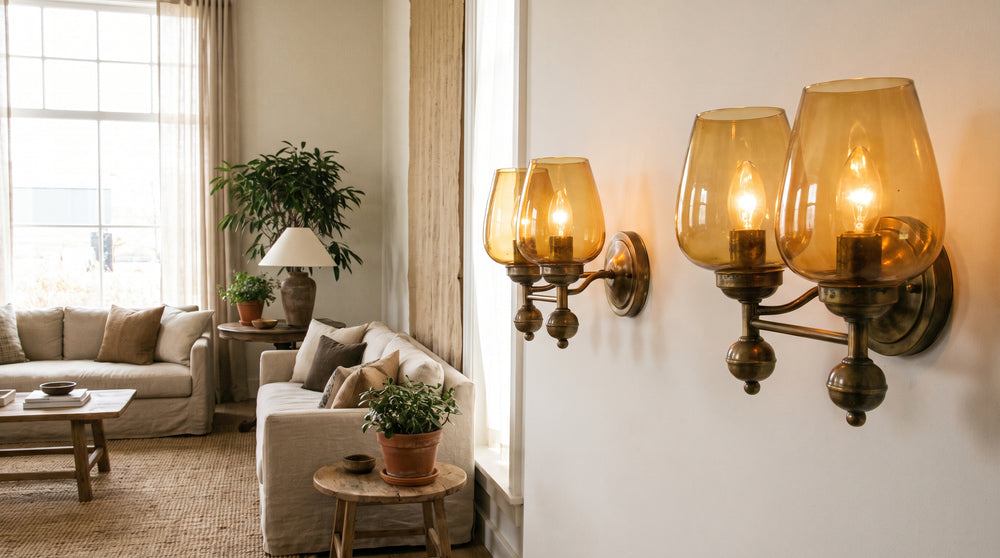
Vintage glass wall lamps
This selection is also available in our French store: Appliques murales en verre vintage
- Tracked delivery to your country Tracked delivery
- Secure payment at checkout Multiple payment methods
- 14 days to change your mind 14-day returns
- Secure payment Secure payment


Not sure of your style? Find it in 30 seconds
A few questions, and we will show you the pieces made for you.


Frequently asked questions
How do I choose the right product?
What are the delivery times?
Can I return an item?
Can I pay in instalments?
An interior that reflects who you are
Carefully selected pieces, shipped from our warehouses. Our team advises you before you buy, so you choose with confidence.
- Tracked delivery
- Pay in instalments, where available
- 14 days to change your mind
- Advice & showroom in Lyon, France
Choose the shape before the finish: a glass tube for a hallway or a living room wall, a globe or sphere for the bedroom. The socket decides the bulb, E14 most often and G9 on small formats, and the protection rating settles the choice between a dry room and a damp one.
What defines a vintage glass wall light?
A vintage glass wall light combines worked glass, ribbed, fluted or opal, with a metal frame fixed to the wall. The glass spreads the light in a halo and throws it back as reflections, the frame holds the bulb. E14 and G9 sockets dominate, and these models are mainly intended for the living room, the bedroom and the hallway.
Antique glass wall light or current production: how do you tell the difference?
All the models in this collection are current production, in a modern and contemporary style, not a stock of antique pieces. A period wall light can be spotted by the wear on the metal, the irregularities of the moulded glass, an original socket and dimensions that vary from one example to another. A current production piece has a regular finish and a standard socket, which makes replacing the bulb easier. To compare the mounts, browse the vintage metal wall lights.
Vintage Murano glass wall light: what this name really means
Murano refers to the blown glass produced on the Venetian island, with its techniques and its workshops. The name is often used for any worked glass, which keeps the confusion alive. No model in this collection claims that origin: the glass here is ribbed, fluted or opal, mounted on a metal frame. Our lighting catalogue groups these families by use.
How do you light a living room with wall lights?
In a living room, a vintage glass wall light serves as accent lighting: it frames a sofa, highlights a wall or replaces a lamp sitting on a console. It is placed about 1.50 m from the floor, often in pairs, aiming at a wall rather than a television screen, to avoid a direct reflection in the line of sight.
How do you place two wall lights on either side of a sofa?
Align both wall lights at the same height, roughly a third of the sofa width in from each end, and not pressed against the armrests. Allow a mounting height of around 1.50 to 1.70 m from the floor, above the shoulders of a seated person. The Bivora tube duo and its double ribbed glass works alone or as a symmetrical pair.
How many light points should you plan on a living room wall?
A single point is enough to mark a wall or light a painting. Two points create symmetry around a sofa or a console. Beyond three, the repetition becomes a deliberate decorative choice. For lower, softer light, look at the LED wall lights for living rooms.
Glass tube, globe or ball: which shape should you choose?
A glass tube directs light upwards and downwards and stays discreet on a small wall. A globe or ball spreads a wider, softer light, with a decorative effect at the centre of the wall. Both come in ribbed, fluted or opal glass, usually on a gold frame.
Ball glass wall light: what effect in a small space?
A ball takes up wall space in width as much as in depth: allow a diameter of 15 cm on the opal globe of Lumena, curved arm and opal globe, against only 5 cm on the small sphere formats. So it is the one that dresses a wide, sparsely furnished wall best, while the tube suits a narrow or cluttered wall.
Ribbed, fluted or opal glass: what difference in light?
Ribbed glass and fluted glass keep some transparency and cast stripes of light on the wall. Opal glass, on the other hand, hides the source and gives a uniform halo, softer on the eye. If you are after a darker shade, smoked glass filters the light and lowers the perceived level.
| Model | Material | Socket | Max wattage | Protection rating | Recommended rooms |
|---|---|---|---|---|---|
| Calvesano | Metal and glass | E14 | 40 W | IP20 | Living room, bedroom, hallway |
| Curva | Metal and glass | E14 | 40 W | IP20 | Living room, bedroom, hallway |
| Nivia | Metal and fluted glass | E14 | 40 W | IP20 | Living room, bedroom, hallway |
| Mavello | Metal and glass | G9 | 28 W | IP20 | Living room, bedroom, hallway |
| Lumena | Metal and opal glass | E14 | 40 W | IP20 | Living room, bedroom, hallway |
| Mireia | Aluminium and glass | G9 | 8 W | IP44 | Living room, bedroom, kitchen, hallway, entrance |
Art deco wall lights: how do you take inspiration without getting it wrong?
Art deco wall lights are recognisable by their geometric lines, their stepped shapes and their frosted glass mounted on brass. A current wall light in ribbed glass and gold metal picks up these codes with standard dimensions and an E14 or G9 socket, without the upkeep constraints of an antique piece.
Antique art deco wall lights: how do you recognise them?
On a period piece, the mount is solid brass or patinated gold metal, the glass is blown or moulded and often frosted, and the whole plays on symmetry around an axis. The wear is clear: oxidation, original screws, sometimes a bakelite socket. These signs are not found on a current production piece, whose finish is deliberately regular.
1930s art deco wall lights and modern gold glass wall lights: how do you pair them?
Keep a single register of mount per room and let the shapes talk to each other rather than the eras: a slim tube near an antique stepped piece, or two spheres framing a mirror. Matching gold metal is enough to create unity. The retro models and the black metal wall lights cover both directions.
Which socket, wattage and protection rating should you choose?
Most of the wall lights in the collection have an E14 socket, a good share have G9, and a few models have E27 for outdoors. The stated wattage ranges from 8 W to 60 W depending on the format. An IP20 rating suits dry rooms, IP44 suits damp rooms and outdoors.
Which bulb should you put in an E14 or G9 wall light?
The E14 socket is a small screw socket, the bulb that is easiest to find in shops. The G9 is a pin socket, more compact, suited to globes and slim tubes. On most models, the bulb is chosen separately: you decide the colour temperature and the brightness. Only a minority of references use integrated LED technology.
IP20 or IP44: which wall light for a damp room?
IP20 is reserved for dry rooms: living room, bedroom, hallway, dining room. For a bathroom, a kitchen or a sheltered terrace, you need an IP44 model, such as the round Mireia rated IP44. The outdoor wall lights in an old style and the vintage wall lights for bathrooms cover these uses.
Which wall lights for an adult bedroom?
In a bedroom, a glass globe or sphere is the better choice, as it spreads a soft light and does not dazzle. The wall lights are placed on each side of the bed, at shoulder height once seated, and small compact formats with an E14 or G9 socket are preferred, more discreet on either side of a headboard.
At what height should you place a wall light on each side of the bed?
Allow around 1.10 to 1.30 m from the floor, at the shoulder level of a person sitting on the mattress, and align both sides to the millimetre. Keep them about 30 to 40 cm from the headboard wall to avoid the shadow of a book or a phone. A curved arm lets you bring the diffuser forward without moving the fixing point.
How do you vary the brightness of a bedroom wall light?
Dimming requires a compatible bulb, and a wall light model designed for it. The dimmable versions adjust the evening level without changing the bulb. For low, even light, the LED wall lights for bedrooms give a uniform result. The small Mavello format, with two tubes and spheres, fits on a narrow headboard.
How do you light a hallway or staircase with wall lights?
In a hallway, the same model is repeated at regular intervals, about 1.50 to 1.80 m from the floor. On a staircase, the wall light is placed at hand height above the step, preferably a slim tube that lights upwards and downwards without dazzling while you climb.
At what height should you install a wall light on a staircase?
The practical rule is the handrail: the wall light goes at the height where your hand slides, around 1.00 m above the nose of the step, never in the line of sight as you go up. Repeat a point every six to eight steps or so, or a single point at the top of the flight if the staircase is short.
How many wall lights should you plan for a long hallway?
Space the points 1.50 to 2 m apart to avoid dark zones between two sources. A 4 m hallway works well with three aligned points, plus one at the entrance. The models for hallways and the design wall lights for staircases come in this same series spirit.
| Room or use | Shape to favour | Protection rating | Models mentioned |
|---|---|---|---|
| Living room | Ribbed glass tube, alone or in pairs | IP20 | Calvesano, Curva, Bivora, Lumena |
| Bedroom | Globe or sphere, soft light | IP20 | Mavello, Revera, Lumena |
| Hallway and staircase | Slim tube, several repeated points | IP20 | Nivia, Adara, Luminae |
| Bathroom and kitchen | Round shape in a damp room | IP44 | Mireia |
| Outdoors and terrace | Cylindrical glass lantern | IP44 | Lantia |
High-end design wall lights: what makes the difference when buying
On a quality wall light, you look at the glass itself rather than an imitation, the metal frame rather than plastic, the regularity of the gold finish, and the precision of the assembly between the glass and the mount. The whole selection in this collection is covered by a 5 year warranty, the most concrete marker for judging how it holds up over time. Payment is secure, delivery is tracked, and returns are possible; the Designix customer service helps with choosing the socket and the colour. Many hesitate between a gold mount and a black mount: the gold and black finishes can be compared side by side, and the brass and glass wall lights give the metal a warmer tone.
To go further depending on the room, all the lighting families for the home are gathered in one place. In a kitchen, one point above the worktop is worth more than two on the ceiling: see the vintage wall lights for kitchens and the LED wall lights for kitchens. For a very exposed wet room, the watertight outdoor wall lights and the design wall lights for bathrooms complete the selection. In a small space, a single tube point is often enough: the wall lights for toilets show this compact format.
Frequently asked questions about vintage glass wall lights
How do you choose a ball glass wall light?
A glass ball spreads light in several directions and dresses a shallow wall. You choose it according to the socket of the model, E14 or G9, the finish of the frame, gold or bronze, and the space available on the wall to be decorated.
Are there wall lights with a brass and vintage glass finish?
Several models combine a gold metal frame with ribbed or fluted glass, whose look comes close to brass. The collection also offers bronze, brown and black finishes depending on the model and the room to be lit.
How do you recognise antique art deco wall lights?
An antique art deco wall light shows geometric lines, sometimes stepped, frosted or moulded glass and a brass or gold metal mount. A current wall light in ribbed glass and gold metal picks up these codes with a standard E14 or G9 socket.
How do you install wall lights on a staircase?
The wall light is placed at hand height above the step, generally between 1.50 and 1.80 m from the floor, repeating the same model at regular intervals. A slim tube that lights upwards and downwards avoids dazzling while you climb.
What are high-end design wall lights?
They are wall lights with real glass mounted on a metal frame with a regular finish, and precise assembly. The whole selection in this collection is covered by a 5 year warranty, the most concrete marker for judging quality.
One last point often decides it: the actual space on the wall. Measure the free width before choosing between a tube and a globe, and check the depth of the arm if the passage is narrow, from 12 cm on a small format to 31 cm on a globe. Find the round shapes for wet rooms or the design LED wall lights depending on the look you want, and order with tracked delivery, secure payment and possible returns.