
Solar garden lights

- Tracked delivery to your country Tracked delivery
- Secure payment at checkout Multiple payment methods
- 14 days to change your mind 14-day returns
- Secure payment Secure payment
Not sure of your style? Find it in 30 seconds
A few questions, and we will show you the pieces made for you.
Frequently asked questions
How do I choose the right product?
What are the delivery times?
Can I return an item?
Can I pay in instalments?
An interior that reflects who you are
Carefully selected pieces, shipped from our warehouses. Our team advises you before you buy, so you choose with confidence.
- Tracked delivery
- Pay in instalments, where available
- 14 days to change your mind
- Advice & showroom in Lyon, France
Plant your solar powered garden lamp where its panel stays clear all day: the evening light depends on that exposure. The choice then comes down to three simple things, height, material and shape, to light a path, a terrace, a flower bed or an entrance without running a single cable.
Which solar garden lamp should you choose?
Three things decide the model: height, material and shape. A 177.2 cm stem structures a path and lifts the light above eye level; a 100 cm format slips against a low wall or into a flower bed, at flower height. In between, 119 cm covers most path borders. On materials, plastic alone gives a light fixture that is easy to move, plastic and metal a more assertive stem. The whole selection (16 references) runs on solar energy, carries an IP65 rating and a two-year warranty.
Solar garden lamps: conical tube or original shape?
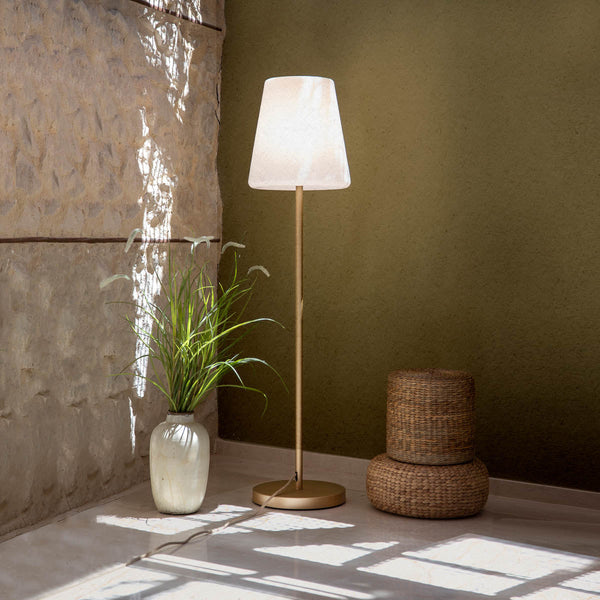
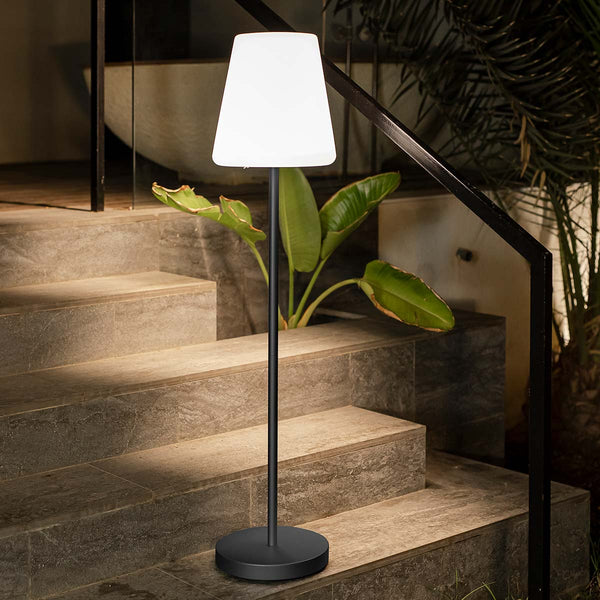
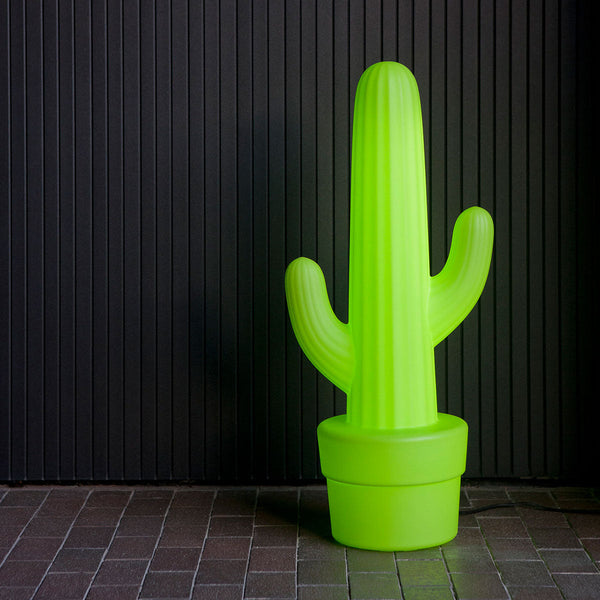
The Castalia conical LED tube goes for the straight line: a 119 cm or 177.2 cm stem in plastic and metal, in anthracite, gold or pink, with a dedicated LED module. The Siltorina solar cactus embraces the decorative object: 44 x 31 cm at the base for 100 cm of height, in plastic, green or white. The first marks out a passage, the second decorates a corner of the terrace.
Solar lamps for planters, flower beds and borders: which format works best?
In a planter or a flower bed, a low fixture lets the eye travel and highlights the foliage: the 100 cm format of the solar cactus suits that use well. To border a path, a 119 cm stem is enough; on a long path, a 177.2 cm stem marks the stages better. More options in the garden lamps, and for outdoor lighting without wiring, see the solar outdoor lamps.
| Model | Shape | Material | Height | Colours | Room | Light output |
|---|---|---|---|---|---|---|
| Castalia, conical LED tube | Tube | Plastic and metal | 119 cm and 177.2 cm | Anthracite, gold, pink | Outdoor, terrace, living room | Cool white 4500 to 6500 K |
| Siltorina, solar cactus | Original | Plastic | 44 x 31 x 100 cm | Green, white | Outdoor, terrace, living room | Cool white 4500 to 6500 K |
How does solar garden lighting work?
A photovoltaic panel charges a battery during the day, and that battery powers the LED in the evening. No cable, no outdoor socket, no connection to the fuse box. Everything therefore comes down to exposure: a clear panel facing the brightest area charges far better than one in the shade of a wall.
Solar lamps for outdoors: what recharges during the day
The panel captures daylight, the battery stores it, the LED gives it back at nightfall. There is nothing magic about this cycle: it depends on the capture area and the actual hours of sunlight. A fixture placed under a tree or against a north wall starts with a handicap, whatever its spec sheet says. The solar LED models aim here for stable output while sparing the battery.
Solar garden fixtures: why exposure changes everything
Two identical fixtures do not light the same way depending on where they stand. The one that gets direct sun holds its charge, the one living in shade drops faster. Before buying, look at your garden at midday: the most open spot at that hour is often the best candidate. To compare models designed for extended outdoor use, see the solar LED outdoor fixtures.
What is the downside of solar lamps?
The light depends on the sun: in winter, in a very shady garden or under a tree, charging is weaker and runtime drops. Battery capacity also declines gradually over the years. Two habits offset these limits: expose the panel with nothing in front of it, and choose an IP65 model built to stay outside. A well-chosen spot matters more than any spec sheet argument.
Where to install a solar lamp in the garden or on the terrace?
Along a path, at the edge of a terrace, near a flower bed or an entrance: where the panel stays clear and where the light accompanies a passage. A 119 to 177.2 cm tube is planted in the ground to mark out a path; a 100 cm model finds its place against a low wall or in a corner. The rule stays the same everywhere: keep the sky clear above the panel.
Solar lamp for terrace: the right spot
On a terrace, you want a source placed above eye level, otherwise you light your guests' feet and dazzle yourself. A 177.2 cm stem meets that requirement, set at an angle rather than in the middle of the walkway. The 100 cm format suits a reading corner or a planter better. To light a threshold, see the entrance lamps.
Several solar garden fixtures: how to spread them out?
Give the space a rhythm rather than concentrating everything: a tall fixture at the entrance, two lower formats along the path, a decorative model near the flower bed. Space them evenly to avoid dark zones and patches of light too close together. The adjustable fixtures make this setting easier when the source can pivot.
| Use | Suitable format | What to check | Watch out for |
|---|---|---|---|
| Path edge | 119 to 177.2 cm tube | Clear panel, IP65 | Avoid the shadow cast by a wall |
| Flower beds and planters | Short 100 cm format | Stable base, IP65 | Keep foliage clear of the panel |
| Terrace | Tall 177.2 cm tube | Bright exposure, LED | Keep the source above eye level |
| Entrance | 119 cm tube | Distance from the wall, IP65 | Light the passage, not the door |
| Living room | 119 or 177.2 cm tube, 100 cm cactus | Direct light to recharge | Take the fixture outside or pick a very bright room |
Which light colour and style for a solar lamp?
All the models in the collection light in cool white, between 4500 and 6500 K: a crisp, readable output close to daylight, rather than a warm mood. The anthracite, gold, pink, green and white finishes, in plastic or metal, sit within a modern or contemporary register.
Light colour for the living room: is cool white the right choice?
Cool white suits rooms where you read, where you move around, where you want to see clearly. In a living room, it brings out a pale wall and raw materials, but it does not create the cosy mood of warm light. If you want that softer output indoors, the LED living room lamps offer other colour temperatures.
Modern kitchen decor: carrying the same material consistency indoors
Modern kitchen decor often rests on clean lines and understated tones. An anthracite or black finish, or a gold finish, carries that language from the terrace to the living area. To stay in a contemporary register, the modern style groups the most graphic shapes.
How to install and maintain a solar lamp?
You clear the ground or push in the stake, point the panel towards the brightest area and check that no leaf covers it. Maintenance is limited to a soft cloth on the panel and the LED. The IP65 rating allows lasting exposure to rain.
Installing a solar lamp with no wiring or socket
Fitting needs neither drill nor conduit: the fixture is planted or placed, full stop. Just check that the base is stable on soft ground, and that nothing blocks the space between the panel and the sky. Half a metre of clearance already changes the charge.
Cleaning the panel and the LED without damaging them
A dusty panel captures less: a pass with a soft cloth, no abrasive product, is enough a few times a year. Do the same on the LED surface. Do not take anything apart, the IP65 rating provides the sealing and dismantling puts it at risk.
Can a solar lamp be used in a living room?
Yes: both models are also listed for the living room. The 119 or 177.2 cm conical tube becomes a graphic floor fixture there, the 100 cm cactus a more decorative object. Note that the panel needs direct light to recharge.
Solar fixture in a living room: which spot to choose?
Near a south-facing bay window, the fixture captures enough to hold its charge. A dark corner of the room will not work. For a more decorative look, the green version or the white colourway suit bright interiors and plants.
How to recharge a solar lamp placed indoors?
The simplest way is to take it out for a few hours on the terrace or balcony during the day, then bring it back in the evening. A very bright room may be enough, a dark room never. For strictly indoor use, the designer LED lamps avoid that constraint.
Why order your solar fixtures from Designix?
Secure payment, tracked delivery, returns and Designix customer service: ordering works the same way as anywhere else on the site. Every solar lamp in the collection also comes with a two-year warranty, which covers outdoor use on a terrace or in a garden. To place these models within the wider catalogue, browse our lighting catalogue and all our lighting.
A height chosen for the room, a finish matched to the wall, a clear panel: all that is left is to place the fixture. Find the rest of the selection in the garden lamps and order the Castalia conical LED tube or the Siltorina solar cactus.
Frequently asked questions
What is the price of a 300 watt solar lamp?
We do not reason in watts on this collection: output depends on the panel, the battery, the LED and above all the exposure. The price varies with height, shape and finish, and it is shown up to date on each product page.
How do you install a solar garden lamp?
You choose a clear spot, with no wall or foliage in front of the panel, then plant the stake or set the base flat. No cable is needed: the fixture recharges on its own during the day and goes where it needs to light.
Is one solar lamp enough to light a terrace in the evening?
For a terrace, aim for a tall model, such as the 119 to 177.2 cm stem: the source places light above the eyes and covers a wider area than a short format. A 100 cm model suits a corner, a low wall or a flower bed.
Which light colour should you choose for the living room or outdoors?
The collection lights in cool white, between 4500 and 6500 K. This output gives a crisp, readable light close to daylight, and brings out a pale wall as well as a flower bed. The anthracite, gold, pink, green and white finishes match it.
Can a solar lamp be left outside all year round?
Yes, the models in the collection are IP65 protected and guaranteed for two years, which covers continuous outdoor use. In winter, keep an eye on the panel above all: once cleared of snow or leaves, it recharges during the day.




