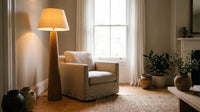
Green floor lamps for living room















- Tracked delivery to your country Tracked delivery
- Secure payment at checkout Multiple payment methods
- 14 days to change your mind 14-day returns
- Secure payment Secure payment
Not sure of your style? Find it in 30 seconds
A few questions, and we will show you the pieces made for you.
Frequently asked questions
How do I choose the right product?
What are the delivery times?
Can I return an item?
Can I pay in instalments?

An interior that reflects who you are
Carefully selected pieces, shipped from our warehouses. Our team advises you before you buy, so you choose with confidence.
- Tracked delivery
- Pay in instalments, where available
- 14 days to change your mind
- Advice & showroom in Lyon, France
Count on a green floor lamp with an E27 base, a velvet or fabric shade, placed in the corner of the sofa: the bulb you screw in sets the shade of white, and the base only takes up floor space. Two things to check before buying: the height of the stem (150 cm on a tube, 210 to 240 cm on an arc) and the shade material.
What light does a green floor lamp give in a living room?
A green shade filters light rather than reflecting it: the glow falls on the seat and leaves the wall calm. That is exactly what is missing when a green living room light is placed only on the ceiling, a low source that can be adjusted separately.
A green that filters light rather than one that reflects it
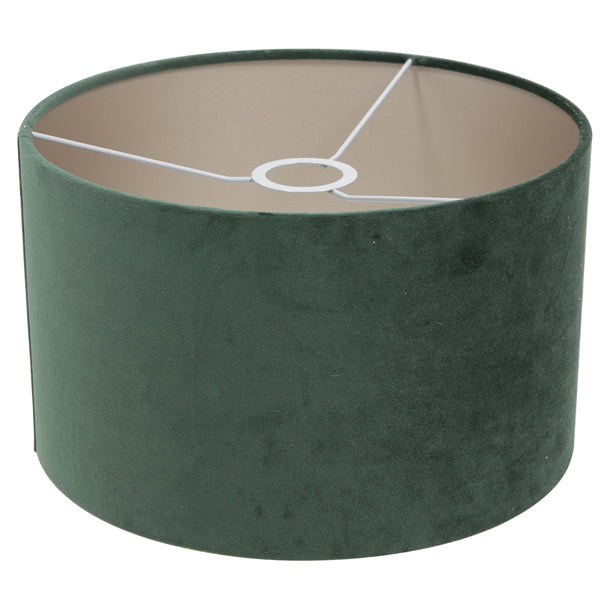
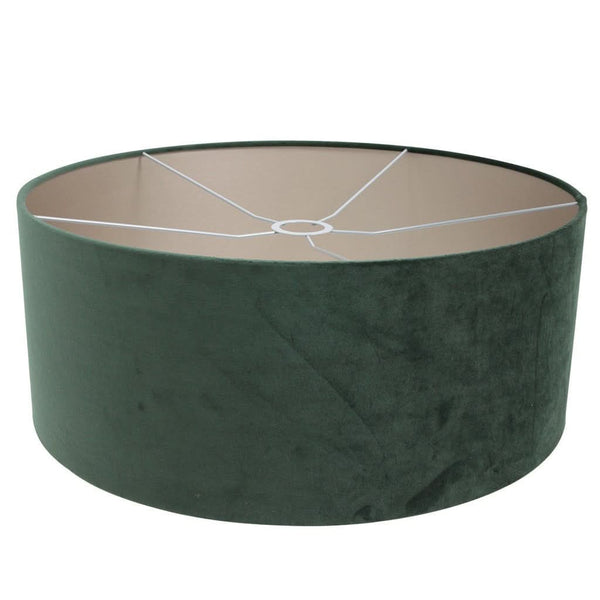
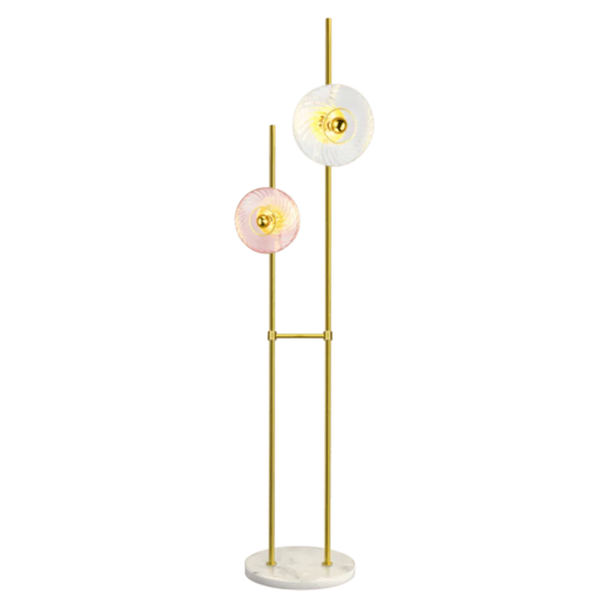
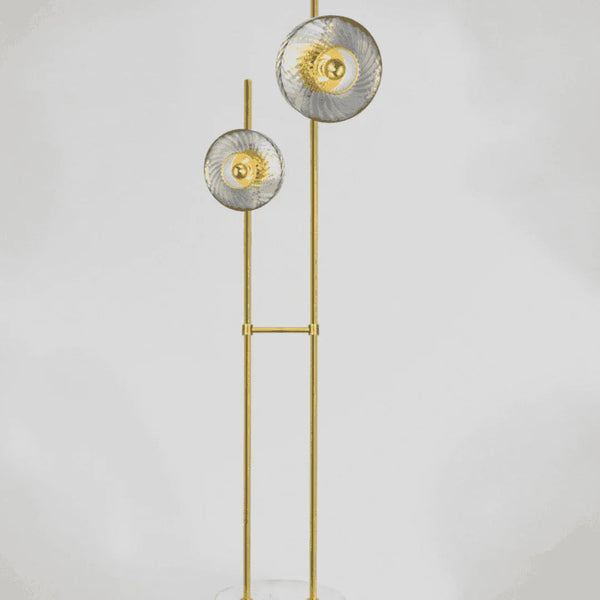
Velvet absorbs and softens, the light comes out matte. Fabric diffuses more brightly and more evenly. Metal and steel do not colour the beam: they refine the silhouette and let the light flow upwards. So the same green does not give the same evening depending on the shade. To play with transparency, look at the glass versions, more graphic than an opaque shade.
Warm white or cool white: which bulb in a green floor lamp?
Most models have an E27 base: the bulb decides the shade, not the fixture. A warm white, around 2700 to 3500 K, warms the green in the evening; a cool white, around 4500 to 6500 K, gives a sharper look near a desk or table. All our lighting fixtures are chosen first for this freedom to change bulbs. Check the maximum wattage marked on the socket before screwing in.
Where to place a green floor lamp in the living room?
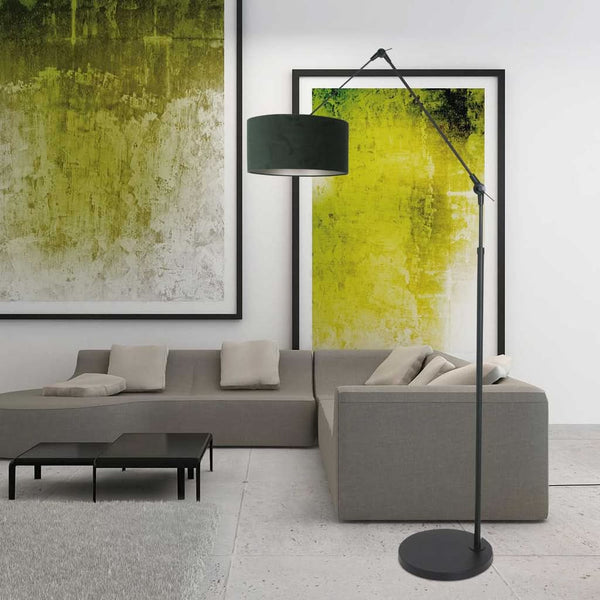
Place it in the corner of the sofa or along the wall, set back from the seat, so the light falls on your shoulder and not in your eyes. An arc model slips behind the sofa and lights over it. For reading, a straight stem near the armchair remains the simplest to adjust.
How to light a reading corner without turning on the ceiling light?
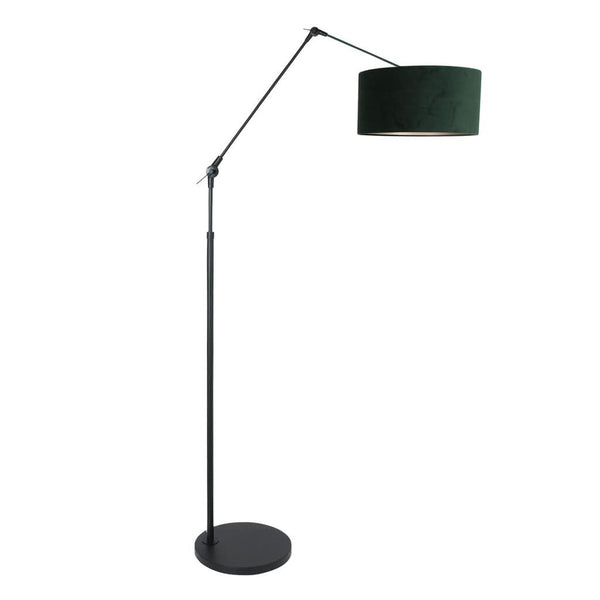
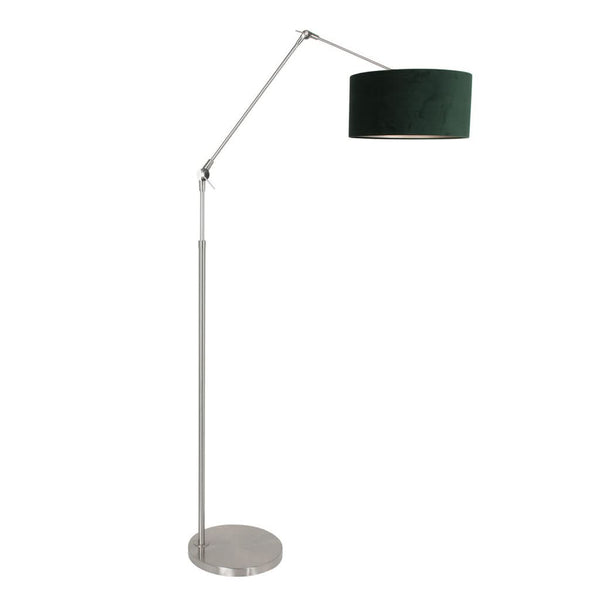
A straight stem 170 to 180 cm tall, placed 40 to 50 cm from the armchair and slightly behind, lights the pages without glare. An articulated arm does better: its reach goes up to 250 cm high and 100 cm deep, as on the Lumiro, which brings light over the shoulder and then folds away.
Small living room or large room: what footprint to allow?
A straight stem takes up a square of about 30 cm on the floor, a vertical tube 25 cm, an arc almost nothing since it passes over the sofa, provided you keep 100 cm of clearance behind the seat. In a small living room, choose a slim base and a light wooden stem, which lightens without taking up more space.
Straight stem, arc, three heads or tube: which green floor lamp format for your living room?
The format is chosen by height and floor space, before style. An arc spans a seat, a straight stem fits in a corner, a three-head covers several areas from one point.
| Format | Measured dimensions | Where it works best | Collection examples |
|---|---|---|---|
| Straight stem with cylindrical shade | 180 cm high, shade 30 cm | corner of the sofa, reading corner | Nuora, Trevia (170 cm) |
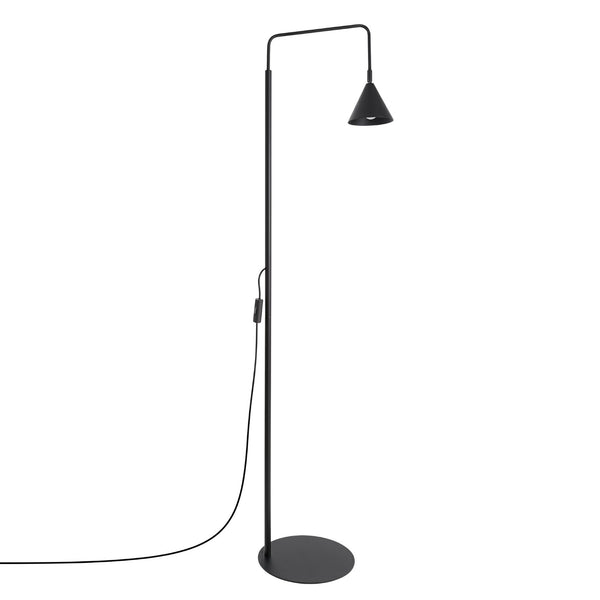
| Arc | 210 cm, up to 240 cm, shade ø 45 cm | above a sofa or armchair | Kano, Velia, Vertessa (210 cm) |
| Three heads or three spots | 180 cm high and 75 cm wide; 155 to 160 cm for spots | large living room, several areas | Giro, Tovena, Pavena |
| Articulated arm | up to 250 cm high, 100 cm deep | sofa and coffee table together | Lumiro, Artex, Sylvena (172 cm) |
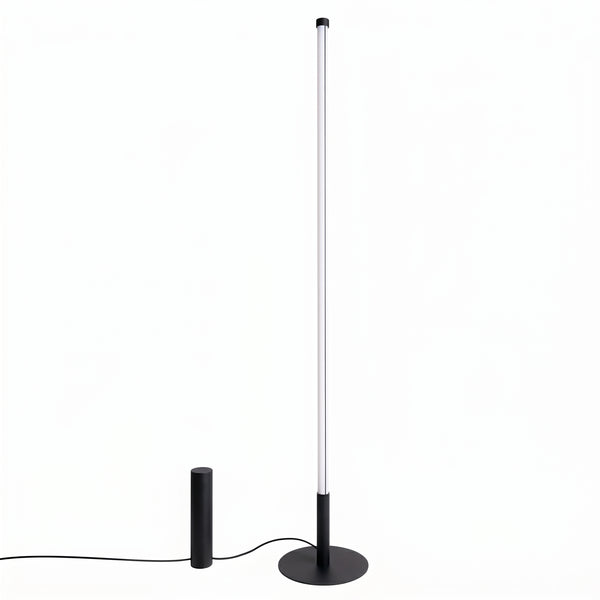
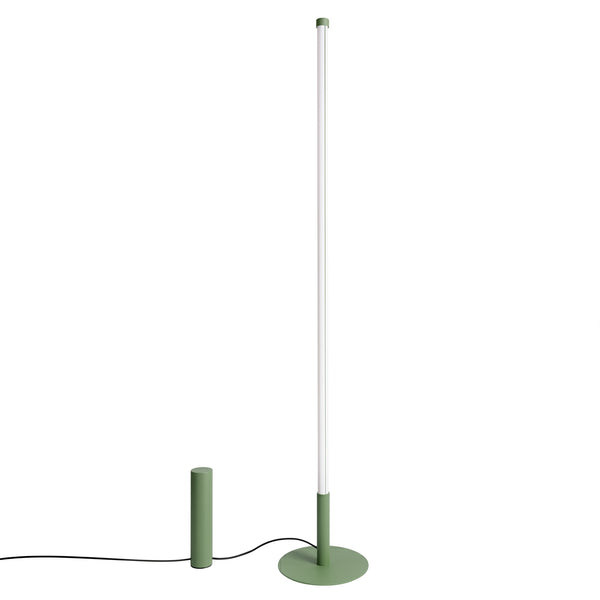
| Vertical tube | 150 cm high, 25 cm footprint | minimalist living room, atmosphere | Mahaut |
| Without stem, round format | 165 cm high, ø 30 cm | entrance, hallway, desk corner | Cirella |
A sofa against the wall rules out the straight stem, which can no longer pass behind: this is the typical case where the Kano arc solves the problem, with its ø 45 cm shade lighting the whole seating area. For more directed lighting, compare the LED floor lamps for living rooms and their tighter beams.
Velvet, fabric, metal or wood: which material to choose for a green floor lamp?
The material does two things at once: it changes how light renders and how you maintain it. Velvet gives a deep matte green, fabric a brighter white, metal a fine silhouette, wood a warm stem that ties the green to the furniture.
| Material | Light rendering | Care | Collection models |
|---|---|---|---|
| Velvet | filtered, matte, no harsh reflection | gentle dusting, soft brush | Nuora, Vertessa, Trevia, Jila, Marilo, Giro |
| Fabric | even, slightly brighter | soft cloth, regularly | Lumiro, Kano, Velia, Artex |
| Metal and steel | fine silhouette, directed light | soft slightly damp cloth | Marilo, Giro, Cirella |
| Wood | warm stem, natural contrast | dry cloth | Trevia |
| Glass | transparency and reflections | soft lint-free cloth | Bela |
| Aluminium | adjustable spots, clean beam | soft cloth | Tovena, Pavena |
A wide shade stands out more than a fine frame: in a small living room, steel or aluminium go unnoticed. See also the black metal frames, which match dark green without competing with it. For care, never use harsh products: regular dusting is enough on velvet as on fabric.
E27, GU10 or integrated LED: which bulb for a green floor lamp?
Most models have an E27 base: you choose the bulb, so the white temperature. GU10 models take adjustable spots, with a more directed beam. A few references are E14, a compact small base, or integrated LED, with a source fixed at manufacture.
Should you still choose a halogen bulb for a living room?
No, the E27 base does not impose any technology: it accepts several types of bulbs, halogen included. What changes the rendering is the white temperature, warmer around 2700 K and more neutral beyond. Several models accept up to 40 W: this limit is on the product page, respect it for the life of the socket. Vintage floor lamps are the ones that benefit most from a warm shade.
Can you replace the bulb of an LED floor lamp?
On integrated LED models like the Mahaut tube, the source is fixed at manufacture, in warm white 2700 to 3500 K, and cannot be replaced: that is a choice to accept at the time of purchase. On an E27 or GU10 base, you change the bulb whenever you want, including switching from warm white to a more neutral white. The white colours that brighten the room lend themselves well to this flexibility.
How to match a green floor lamp with living room decor?
A sage or olive green sits on light walls, beige or off-white, and matches wood, rattan and natural textiles. In an already colourful living room, better to choose a discreet model that picks up a shade present in the room. Dark green, on the other hand, needs lightness around it.
Sage, olive or dark green: which shade to place in the living room?
Sage goes with almost everything and ages well. Olive supports dark woods and brass. Dark green needs white, linen or stone to avoid darkening the corner. Stay within a single family of greens: two too-different greens in the same room cancel each other out. For an even softer look, see the green floor lamps with assertive design and their crafted shades.
An open living room onto the kitchen: repeat the green or reserve it?
In an open space, repeating the same shade on both sides holds the room together, bringing it back in small touches in modern kitchen decor, a textile, a container, a small light. If you prefer to mark the separation, keep the green for the living room and leave the kitchen neutral. Rattan floor lamps help to link the two areas.
Floor lamp, chandelier or wall light: how to distribute sources in a living room?
A chandelier or a large modern living room chandelier lights from above, a living room wall light highlights a wall, a green floor lamp brings the extra light near the sofa. Together, they avoid the flat ceiling light and let you turn on only what you need in the evening.
How to arrange ceiling spots in a living room?
Place them around the perimeter rather than in a central line, and keep them away from the wall to avoid harsh shadows. Cross the beams towards use areas, not towards the television. For a successful living room ceiling spot layout, better to have few well-aimed points than many competing sources. A large living room chandelier is reserved for rooms with high ceilings.
When to turn on the floor lamp rather than the ceiling light?
In the evening, for example in front of a film or during dinner: the floor lamp gives enough light to move around and read, without the frontal ceiling light. Keep the ceiling light for cleaning, children's games or entertaining. For a workspace, a compact model like the LED desk floor lamps complements the whole well.
How to choose without making a mistake: guarantee, returns and Designix service
Most green floor lamps in the selection are guaranteed for two years, part of the selection for five years. The budget difference comes from the material and the structure: a velvet shade on a straight stem is among the most accessible, an arc or a three-head is above, due to the length of metal and the number of shades. No price is written here, the collection grid shows the current price.
Secure payment, tracked delivery, returns and Designix customer service: you order, you install, and if the green does not go with the wall, you write to us. For choice, bet on height: the Nuora green velvet floor lamp, 180 cm and 30 cm shade, fits in a corner, the Velia arc and its green shade spans a seat, and the Trevia wooden tripod suits a warm living room.
Frequently asked questions about green floor lamps for living rooms
Where to place lamps in the living room?
Spread them out instead of concentrating everything: a high source for general lighting, a floor lamp near the sofa or armchair for reading, a small light in the corner or near the entrance. Two or three points lit separately are better than a single ceiling light turned up full in the evening.
What is the difference between a floor lamp and a candelabra?
A floor lamp is a light fixture on a stem placed on the floor, with a shade or one or more sources. A candelabra refers to a multi-branched support raised on a stem; in common usage, the word also names a floor lamp with several light points. The difference lies in the number of branches.
Can you use a green floor lamp for a garden living room?
This selection is designed for indoor use, with an IP20 protection rating on most models. For a terrace, check the IP65 marking on the product page before buying: an unprotected socket suffers from humidity. Otherwise, choose an outdoor floor lamp, designed to stay outside.
How to choose the paint colour for a bright living room?
Light shades, off-white or beige, reflect more light and make the room look larger. A darker accent wall, green included, is placed on a single wall to keep brightness. The rendering also depends on the orientation of the windows and the colour of the floor.
Can a green floor lamp replace a modern living room chandelier?
No, not completely: a chandelier lights from above and covers the whole room, while a floor lamp works as extra light, lower and closer to the seats. In a large living room, combining a central chandelier and two floor lamps gives a softer, more adjustable light.