Outdoor wall floodlight
This selection is also available in our French store: Projecteur extérieur mural
- Tracked delivery to your country Tracked delivery
- Secure payment at checkout Multiple payment methods
- 14 days to change your mind 14-day returns
- Secure payment Secure payment


Not sure of your style? Find it in 30 seconds
A few questions, and we will show you the pieces made for you.


Frequently asked questions
How do I choose the right light output?
At what height should the light be installed?
What type of bulb?
Compatible with LEDs and dimmers?

Light changes everything
From statement chandeliers to discreet wall lights, we help you choose the right brightness, height and style for every room.
- Tracked delivery
- Pay in instalments, where available
- 14 days to change your mind
- Advice & showroom in Lyon, France
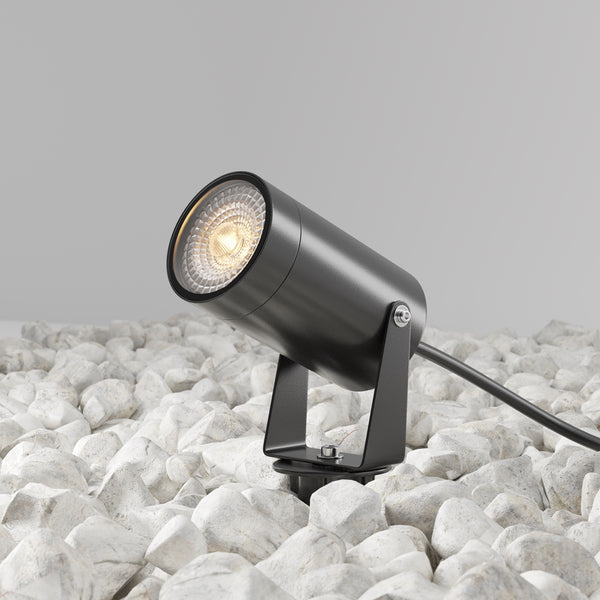
Start with the mount: a wall plate for a facade or terrace wall, a spike for a garden border, a base for a zone you want to move around on the ground. All three models in this selection are adjustable, made of black aluminium, rated IP65 and fitted with a GU10 socket, with a stated wattage of 20 W or 50 W depending on the model.
Which outdoor wall spot light should you choose for the area to be lit?
An outdoor wall spot light is chosen first by its mount: a wall plate for a facade or terrace wall, a spike for a garden border, a base for movable use. All are adjustable, made of black aluminium, IP65 and fitted with a GU10 socket, with a stated wattage of 20 W or 50 W depending on the model.
Wall plate, spike or base: which mount for which use?
The wall plate screws onto a sound wall and keeps the beam close to the facade. The Ruvex adjustable wall spot measures 5.5 cm in diameter and 9.5 cm long, in black aluminium. The Piquetta spike spotlight is planted along a garden border or a path. For light you can move around, the Nocturno base spotlight combines aluminium and glass.
Other fixing methods are available in the shop's outdoor spotlights.
20 W or 50 W: which stated wattage for which model?
The stated wattage indicates what the fitting can take, not the light it will deliver to the ground. The models rated at 50 W, the Ruvex and the Nocturno, are intended for a tall facade or a large terrace wall. The Piquetta, rated at 20 W, is enough to mark out a path or light a low border, and the full range of spotlights covers both uses.
| Model | Mount | Material | Colour | Socket | Protection rating | Stated wattage | Warranty |
|---|---|---|---|---|---|---|---|
| Ruvex | Wall plate | Aluminium | Black | GU10 | IP65 | 50 W | 5 years |
| Piquetta | Spike | Aluminium | Black | GU10 | IP65 | 20 W | 5 years |
| Nocturno | Base | Aluminium and glass | Black | GU10 | IP65 | 50 W | 5 years |
What is the most efficient outdoor lighting?
The most efficient outdoor lighting is the one that reaches the useful area without glare: an adjustable spotlight, IP65 rated, with a bulb suited to the surface to be covered. The GU10 socket leaves the choice of bulb open, and the wattage of the fitting indicates what it accepts, not what it gives back.
Why does direction matter more than wattage?
The same bulb, aimed downwards or pressed against the wall, does not give the same result. The beam is adjusted towards the path, the step or the trunk you want to highlight; badly aimed, it lights empty space or your neighbour's eyes. These models are adjusted after installation, without any special tool. To compare other light fittings, browse our lighting catalogue.
IP65 and aluminium: what does that change outdoors?
IP65 means a housing sealed against dust and protected against water spray. Outdoors, this protection matters more than wattage: it is what keeps the fitting going season after season. Black aluminium keeps its colour and rigidity, and a glass panel protects the face of the Nocturno. If exposure to rain is your first criterion, look at the waterproof outdoor models.
How many lumens do you need to light an outdoor space?
The number of lumens depends on the GU10 bulb installed and the area to be covered, not on the spotlight. These models impose no particular bulb: you adjust the brightness to suit the distance and the use, avoiding both oversizing a small terrace and under-lighting a tall facade.
GU10 bulb: what result for a facade, an entrance, a border?
For a terrace or an entrance, warm light, around 2700 to 3000 K, stays comfortable in the evening and flatters both stone and wood. On a facade you want to highlight, a more neutral tone brings out the relief and the material. LED spotlights are suited to this fine tuning, as are outdoor LED spotlights.
Avoiding glare: aim rather than increase wattage?
Increasing wattage does not fix glare: the angle decides. A grazing beam lights a wall better than a frontal beam, and a moderate bulb aimed well tires the eye less than a strong bulb badly framed. Adjust the direction at night, from where people walk, not from the window.
Why do these outdoor wall spot lights use a GU10 socket?
The GU10 socket is a standard: the bulb is replaced without changing the fitting, which leaves the choice of light output depending on the area lit. This simplifies maintenance and allows the lighting of a facade, a terrace or an entrance to be adjusted over time.
Outdoor wall spot light with LED or replaceable GU10 bulb?
An outdoor wall spot light with a fixed LED source is replaced entirely when the light fades. Here, it is the bulb that goes, not the fitting: you fit a GU10 LED bulb of the right format, in the tone and intensity that suit the area. The black aluminium housing stays in place, with its 5.5 cm diameter.
Changing the bulb rather than the fitting: what does that involve
It involves buying a GU10 format bulb, nothing more. A bulb at the end of its life is removed by hand, without dismantling the spotlight. Then check that the seal and the glass go back correctly into place: that is what preserves the IP65 protection of the fitting.
Waterproof outdoor wall light or wall spotlight: what is the difference?
A waterproof outdoor wall light spreads light close to the wall and is mainly used to mark out an entrance, whereas an adjustable wall spotlight projects a beam further and is aimed at a facade, a tree or a terrace. Both are fixed to the wall, but only the spotlight can be aimed precisely.
Outdoor wall lighting: marking out or lighting an area?
Marking out means lighting the way: a few steps, a threshold, an entrance wall. Lighting an area means covering a surface: a facade, a corner of a terrace, a border. If your need is to see where you are walking, a wall light is enough. If you want to read outside or highlight a volume, the adjustable spotlight is the right tool, like the garden spotlights.
Outdoor wall lamp: what a facade demands
On a facade, two constraints matter: the fixing height and the direction of the beam. Fixed too high, a spotlight lights the ground from a distance and loses sharpness; placed near the walkway, it serves better day to day. For other wall shapes, compare all Designix light fittings and their fixings.
How do you install and maintain an outdoor wall spot light?
Installation starts by cutting the power, then fixing the plate or the mount to the wall before connecting and aiming the spotlight. After that, regular cleaning of the glass and the aluminium and a check of the sealing are enough to preserve a fitting guaranteed for five years in this selection.
Height and direction: placing the spotlight well
Place the spotlight high enough for the beam to fall on the area without catching people's eyes, low enough to stay sharp. For a path, aim at the ground a few steps ahead of you. For a facade, graze the wall rather than hitting it head on. Adjustment is done after installation, then checked after a gust of wind.
Cleaning and checking the sealing of an IP65 fitting
- Clean the glass and the body with clear water and a soft cloth, without abrasive products.
- Check the seal and the cable entry, without pinching it when reassembling.
- Check the direction and the tightness of the fixing after a spell of strong wind.
| Mount | Where to install it | What it lights | What to check |
|---|---|---|---|
| Wall plate | Facade wall, gable end, terrace wall | Facade, entrance, terrace wall | Fixing in a sound part, beam direction |
| Spike | Garden border, path, lawn | Border, shrub, path | Stability of the spike in the ground |
| Base | Terrace, poolside | Corner of a terrace, area to modulate | Stability on the ground, direction adjustment |
Do you need a wall spotlight with a motion sensor?
None of the models in this selection includes a motion sensor: they run on an existing switch. A sensor becomes useful for a path or an entrance that is rarely used; in that case, it is better to choose an outdoor spotlight with a motion sensor designed for that purpose.
Outdoor wall lamp with motion sensor: in which cases?
The sensor switches on when someone passes and then switches off: handy for a garage, a long path or an access point that is not lit continuously. It needs an unobstructed location, with no branch or wall blocking detection. See the outdoor lighting with detection. Other models are grouped in the LED spotlights with sensor.
RGB, dimmer, base: other outdoor lighting options
Other options exist depending on the mood you want. Adjustable intensity fine-tunes the light on a terrace. RGB variants add coloured ambience. Rechargeable spotlights do without a cable. Base spotlights can be moved. For a large volume, look at industrial spotlights and garage lighting.
Frequently asked questions
How do you choose an outdoor wall light fitting?
Look first at the mount: a wall plate for a facade, a spike for a border, a base for movable use. Then check the IP65 protection, the GU10 socket and the stated wattage of the model. The black aluminium body stays discreet on most facades.
What is the difference between an outdoor wall light and an outdoor wall spotlight?
The wall light illuminates close to the wall, often upwards or downwards, to mark out an entrance. The spotlight is adjustable: its beam is aimed at a facade, a border or a terrace. Both can be waterproof and fixed to the wall, but only the spotlight can be aimed.
Can an outdoor wall spotlight be aimed at the ground or at a wall?
Yes, these spotlights are adjustable: they can be aimed at the ground to light a path or a terrace, and at a wall to bring out its material. Aim the beam after installation, then check the setting after a spell of wind.
Does an outdoor wall spotlight stand up to rain?
The three models highlighted are IP65 rated, a rating that covers water spray and outdoor use. The aluminium body and, on the Nocturno, the glass complete this resistance. Still check the cable entry after installation.
What warranty comes with an outdoor wall light fitting?
The models in this selection are guaranteed for five years. This cover applies to the fitting; the GU10 bulb installed comes under its own warranty. Keep the invoice and use routine maintenance to check the direction and the sealing.
Delivery, payment and customer service
Payment is secure, delivery is tracked and returns are possible. Designix customer service answers questions about fixing, socket or adjustment before and after purchase. For an entrance or a terrace wall, the Ruvex spot on a wall plate is the most direct mounting. For a garden border, the Piquetta spotlight is planted without a plate. For a terrace you are rearranging, the Nocturno on a base moves with the seasons.