
Orange-colored light bulbs
This selection is also available in our French store: Ampoules coloris orange


- Tracked delivery to your country Tracked delivery
- Secure payment at checkout Multiple payment methods
- 14 days to change your mind 14-day returns
- Secure payment Secure payment
Not sure of your style? Find it in 30 seconds
A few questions, and we will show you the pieces made for you.
Frequently asked questions
How do I choose the right product?
What are the delivery times?
Can I return an item?
Can I pay in instalments?

An interior that reflects who you are
Carefully selected pieces, shipped from our warehouses. Our team advises you before you buy, so you choose with confidence.
- Tracked delivery
- Pay in instalments, where available
- 14 days to change your mind
- Advice & showroom in Lyon, France
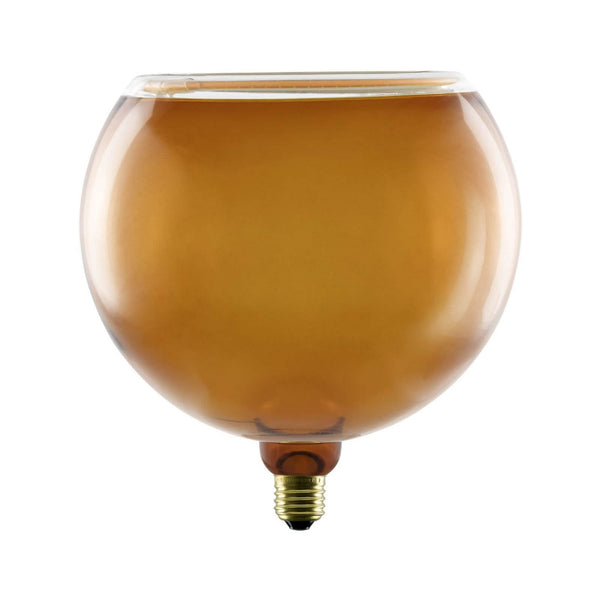
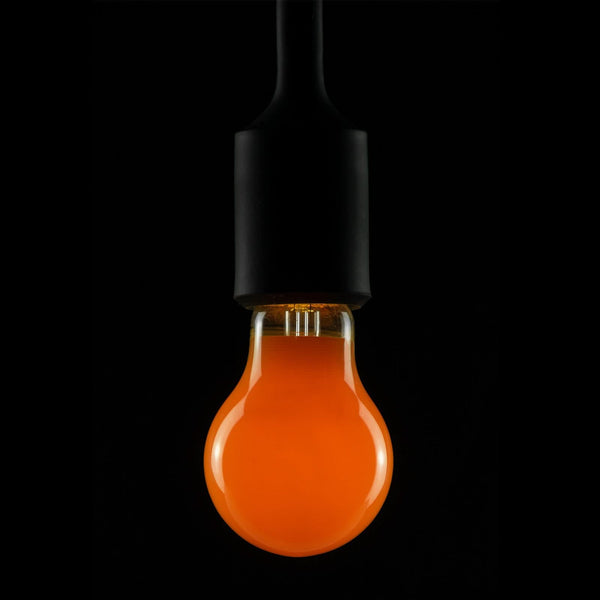
First check the base of your fixture, then choose the tint: an orange light bulb is for atmosphere, behind a shade or in a reading corner, not as a work light. Tinted glass gives a soft orange and lets the filament show, while a coloured LED gives a stronger, more even orange.
What is orange light?
An orange light bulb emits light whose spectrum is dominated by warm tones, giving a coppery, amber or frankly orange result depending on the glass. It is used as ambient lighting: it colours walls and materials, and does not replace a neutral light for reading or working for long periods.
Orange light bulbs: pale tint or strong orange?
The glass decides. A pale tinted glass over a warm white source lets through a pale, almost golden orange that warms a wall without strongly tinting it. A denser glass, or a directly coloured LED, gives a frank orange that becomes the dominant colour of the room. In between, amber tinted bulbs keep a more discreet honey hue, useful in a small hallway where a vivid orange would quickly feel heavy.
What is an orange light bulb for in a room?
It creates a zone, not general lighting. An orange globe in a reading corner, a tinted wall light in a hallway, a low pendant above a table: coloured light draws a space and leaves the rest of the room darker. So plan a second neutral source for moving around, and reserve the orange for moments when you are not doing a precise task.
What colour goes with orange?
Orange goes with blue, its complementary colour, with green and terracotta brown, or with neutrals such as off-white and grey. Under an orange light bulb, these shades stay legible, whereas pink or bright red blend into the light and weigh the room down.
What colour with orange in a living room?
A navy sofa or a blue-grey wall brings out the warmth of the light, and the living room feels deeper in the evening. If you prefer a wrapping atmosphere, stay with browns, ochres and raw linen: the orange light then blends into the decor instead of cutting through it. Living room bulbs are chosen on this criterion as much as on the base.
Orange colour pairing: mistakes to avoid
Two vivid, saturated shades side by side cancel each other out and give a dull result. In a small room, multiplying warm sources ends up crushing pale materials: one coloured bulb is often enough. And if you vary the shades, keep a coherent family by pairing, for example, an orange and a red tinted model rather than an orange and a bright blue of the same intensity.
| Paired colour | Effect achieved | Where to use it |
|---|---|---|
| Blue | Strong contrast, the orange looks brighter | Living room, hallway, desk corner |
| Green | Natural, soft harmony | Bedroom, dining room |
| Brown and terracotta | Warm, wrapping atmosphere | Living room, library |
| Off-white | Visual rest, materials brought forward | Kitchen, hallway |
| Anthracite grey | Contemporary look, sharper orange | Hallway, staircase |
| Plum or aubergine | Deep harmony, muted light | Bedroom, reading corner |
What is the complementary colour of orange?
The complementary colour of orange is blue, placed opposite it on the colour wheel. A navy textile, a blue-grey wall or an indigo detail bring out the warmth of an orange light bulb. Two vivid opposite colours on large surfaces cancel each other out and give a heavy atmosphere.
Complementary colour of orange in decoration
The right balance lies in proportion: a large neutral surface, a medium orange surface carried by the light, a small blue touch. A cushion, a frame, an accent wall behind the lamp are enough. You will get a softer contrast by bringing the orange closer to a white tint on the shade side, which lets the light diffuse without saturating.
And with green or purple?
Green works as a neighbouring harmony rather than a contrast: it calms the orange and suits rooms where you stay for a long time. Purple and plum play on depth, to be reserved for already dark volumes, as they absorb a lot of light. In both cases, a model such as green tinted bulbs or a smoked glass pairs more easily than a saturated shade.
Orange light bulbs: which base for which room?
The base depends on the fixture, not the colour: E27 for pendants and ceiling lights, E14 for wall lights and bedside lamps, G9 for spots with ceramic sockets, GU10 or GU5.3 for recessed lights depending on voltage. Checking the base and voltage before ordering avoids a return. To choose the wattage and brightness of an orange light bulb, compare the LED equivalence shown on the packaging and the lumen output suited to ambient light.
| Base | Socket type | Fixtures concerned | To check before ordering |
|---|---|---|---|
| E27 | Large screw, 27 mm | Pendants, ceiling lights, floor lamps | Globe diameter and space under the shade |
| E14 | Small screw, 14 mm | Wall lights, bedside lamps, small pendants | Maximum wattage shown on the socket |
| G9 | Two pins, 9 mm | Spots and ceiling lights with ceramic socket | Heat output and socket type |
| GU10 | Two pins, 230 V | Recessed spots and tracks | Fixture voltage and dimmer compatibility |
| GU5.3 | Two pins, 12 V | Recessed lights on transformer | Presence and type of transformer |
| G4 | Two fine pins, 12 V | Small spots and low-voltage wall lights | 12 V voltage and dimensions |
Orange bulbs: E27 or E14, how to decide?
Look at the socket of the fixture, not the bulb you had before: an E27 globe does not fit an E14 socket, even by a few millimetres. Large E27 screws equip generous volumes, E27 screw sockets accept wide globes, while E14 bulbs for wall lights require a narrower glass. Only then come to the orange result.
Orange bulbs 12 V or 220 V: the check to make
A fixture on a transformer only works at low voltage, and 12 V low-voltage models never replace a mains socket. Conversely, a 220 V bulb connected to a transformer will not light or will burn out. For small spots, also take a look at G4 and G9 bases and GU5 bulbs, which cover most bathroom recessed lights.
You have the base and the voltage? All that remains is to choose the glass tint: browse the full bulb catalogue and find the shape that dresses your fixture for an orange light bulb.
How to colour a bulb?
A bulb is coloured in two ways: orange tinted glass over a warm white source, or a directly coloured LED. Tinted glass gives a softer orange and lets the filament show; a coloured LED gives a stronger, more even orange. Painting or varnishing a bulb traps heat and is not recommended.
How to colour a white bulb yourself?
The honest answer: you do not do it on a bulb in use. Paint, varnish and sleeves trap heat from the base, distort the glass and can crack the envelope. The tint is therefore chosen at purchase, either with coloured glass or an already tinted source. If you simply want to soften a white light, an amber shade or a diffuser is enough and installs without risk.
Tinted glass or coloured LED: which to choose?
Tinted glass pairs well with filament bulbs: you see the filament, the light is uneven and warm, the orange stays soft. A coloured LED produces an even, consistent, stronger orange, and suits rooms where you want a clear colour. In both cases, thick glass and a well-tightened base matter as much as the tint.
Which bulb does not hurt the eyes?
Discomfort comes mainly from glare and contrast, not from colour alone. An orange light bulb, low in blue, is softer at the end of the day provided it stays behind a shade, the wattage is limited and you never look directly at the source. For reading, a well-distributed warm light remains preferable.
What is the best light colour for the eyes?
There is no single ideal colour: comfort comes from lighting without glare, well distributed and strong enough for the task. In the evening, a 2700 K warm white light is more restful than a cool tint, and an orange light bulb remains an ambient complement, not the main source of a work room.
Which light damages the eyes?
No domestic bulb is designed to damage the eyes. What tires them is a bare, powerful source in the field of view, a screen darker than the room, or a harsh contrast between a brightly lit worktop and the rest. You protect your eyes by diffusing the light and avoiding staring at a direct source.
How to wire 3 bulbs in parallel?
Three sockets are wired in parallel: each socket receives the live and neutral from the same supply, never one after the other in a chain. Switch off the power at the breaker, tighten each connection and respect the total wattage allowed by the switch. If in doubt, an electrician validates the installation.
Wiring 3 bulbs in parallel on one switch
The supply comes from the switch, then splits to each socket: two wires per socket, live and neutral, and earth if the fixture has one. In series, one blown bulb would switch off the others. Tighten the terminals, check that no strand sticks out, then switch the breaker back on only once everything is closed.
Can you mix orange and white bulbs on the same circuit?
Yes, the same circuit can supply sources of different tints: colour changes nothing in the wiring. What matters is not exceeding the wattage allowed by the switch and keeping bulbs compatible with the same type of control. Simply avoid mixing a green tint and an orange in the same multi-socket fixture, the result becomes muddled.
How to install and maintain an orange light bulb?
Install the bulb with the power off, let a bulb that has just been running cool down and screw it in without forcing on the base. A dry cloth is enough for the glass, without water or product on the socket. If the bulb flickers, first check compatibility with the dimmer or timer.
Flickering orange bulbs: intended effect or problem?
A regular, slow blink may be a decorative effect built into the model. Rapid flickering rather reveals an incompatibility with a dimmer, a timer or a transformer: test the socket with another bulb, then switch to a model designed for dimmers, such as dimmer-compatible bulbs. The flickering effect quickly tires in a living room.
Cleaning and small checks
Switch off the power before any handling. The glass is cleaned dry, with the power off and once cold; water on a live socket is the real risk. Check from time to time that the bulb stays well screwed in, especially on a pendant that moves. In a bedroom, prefer a low-intensity model behind a shade, such as those offered in bedroom bulbs.
Unsure about the tint before confirming? Compare a frank orange with the amber tints and the glass bulbs, the difference is clear once lit. Secure payment, tracked delivery, returns and Designix customer service support you from choice to installation.
Frequently asked questions
What colour goes with orange?
Orange goes with blue, green and terracotta brown, but also with neutrals such as off-white, beige and anthracite grey. Under an orange light bulb, it is better to avoid pink and bright red, which blend into the light and make the room feel heavier.
How to choose your bulbs?
Start from the fixture: base, voltage and maximum wattage are shown on the socket or the instructions. Then come the use, the light colour and the shape of the glass. For an orange light bulb, check that the tint stays legible once lit behind the shade, and that the globe does not touch the fitting.
What is the most soothing colour for the eyes?
Warm shades, from orange to warm white around 2700 K, are the most restful at the end of the day because they contain little blue. Soothing also depends on intensity: a soft, indirect and steady light is more restful than a vivid colour directed at the eyes.
Which light damages the eyes?
No domestic bulb is designed to damage the eyes: discomfort comes from direct glare, too strong a contrast or a cool light late in the evening. Looking at a bare source tires the eyes, especially if it is powerful. You protect your eyes by diffusing the light with a shade.
Flickering orange bulbs: how does it work?
A bulb that flickers is either a model with a flickering effect intended for decoration, or a bulb incompatible with the dimmer or timer. Before blaming the bulb, test the socket with another model. The flickering effect quickly tires in a living room.




