
Jute pendant lights
This selection is also available in our French store: Suspensions en jute






- Tracked delivery to your country Tracked delivery
- Secure payment at checkout Multiple payment methods
- 14 days to change your mind 14-day returns
- Secure payment Secure payment
Not sure of your style? Find it in 30 seconds
A few questions, and we will show you the pieces made for you.
Frequently asked questions
How do I choose the right product?
What are the delivery times?
Can I return an item?
Can I pay in instalments?

An interior that reflects who you are
Carefully selected pieces, shipped from our warehouses. Our team advises you before you buy, so you choose with confidence.
- Tracked delivery
- Pay in instalments, where available
- 14 days to change your mind
- Advice & showroom in Lyon, France
Choose a dome or an openwork bell shape to light a table, a ball or an oval for low light: a jute pendant light is first chosen for the light you want. The shade woven from plant fibre filters and warms the light, the socket is most often E27, IP20 for indoors and IP54 for a sheltered outdoor area.
- What is jute material?
- Natural jute or woven jute?
- Which pendant for which room?
- At what height should it hang?
- Which colour to choose?
- Decoration ideas
- Does jute fabric rot?
- Installing and caring for it
- Ordering
What is jute material?
Jute is a plant textile fibre, woven into cloth or braided into rope. In a pendant light, it forms a shade that filters the light: the grain of the weave lets through a warm glow and casts soft shadows on the walls and the worktop. The material is fitted like a classic shade, on a socket and a cable.
It differs from linen, which is finer and softer and softens the light, whereas jute filters it and marks the shadows more strongly. To compare other materials worked in the same way, our range of light fittings is a good starting point.
What is jute cloth?
Jute cloth is the fabric obtained by crossing the threads of this fibre. The weave remains visible, with irregularities in thickness that give the shade its character. It is also found as rope, textile cord or crocheted jute depending on the model chosen.
What does the word jute mean in French?
The word refers both to the plant and to the fibre obtained from it. It came through English, itself inherited from Bengali. In everyday French, people say jute cloth for the fabric and jute rope for the braided fibre, with no other distinction in use.
Natural jute pendant or woven jute pendant: which to choose?
Natural jute keeps the raw grain of the fibre, with irregular beige and brown shades from one shade to another. Woven jute is worked into rope or a regular braid: the structure marks the cast shadows more strongly. Both are often combined with a metal, wood or glass support.
Woven jute pendant: what light effect?
The braided rope draws a tight, regular weave: the light comes out through the gaps in the braiding in clean lines, which structures a wall or a worktop. The Nash pendant combines this braided rope with a glass shade and a ceramic base, a more dressed-up look, to be placed among the glass pendants for the kitchen.
Natural jute pendant: the raw grain
The natural version leaves the fibre as it is. The shadow is more diffuse, the shade more irregular, with passages of light beige and brown. The Nonna with its openwork bell shade plays this register in crocheted jute, with openings that let the bulb show through.
Which jute pendant to choose according to the room?
In the kitchen and above a table, a dome shape or an openwork bell lights widely without dazzling. In a bedroom, a ball, an oval or a tube gives a lower, more enveloping light. For a terrace or a sheltered outdoor area, you need an IP54-rated model.
Jute pendant for the kitchen and dining room
Above an island or a table, choose a wide shade: dome, oval or openwork bell. The diameter matters more than the height, because it decides the pool of light cast on the worktop. The LED pendants for the kitchen show the same intention with a different source.
The colour also matters: white models for the kitchen reflect the light and leave the room brighter than a brown shade.
In the living room and bedroom
In a room for resting, you look for a low, enveloping light: sphere, oval or tube. The Rosberella with its spherical shade drops to 140 cm and covers widely without dazzling. For a softer effect, white pendants for the bedroom brighten the ceiling.
A jute pendant for outdoors?
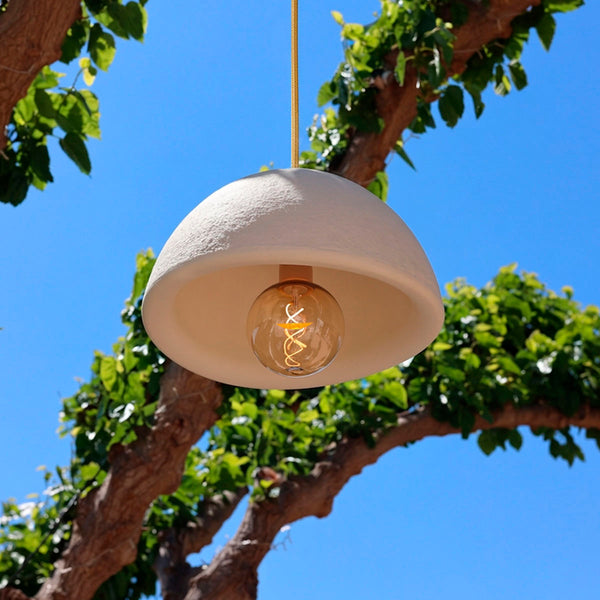
Only one rule matters outside: the protection rating. The Cordella pendant, rated IP54, withstands water splashes under an awning or a covered terrace. An IP20 model stays indoors, even under an exposed balcony.
| Room | Shape that works | What it changes | What to check |
|---|---|---|---|
| Kitchen | Dome, openwork bell | Wide light above the worktop | E27 socket and cable length |
| Dining room | Dome, oval | Light centred on the table | Shade diameter |
| Living room | Ball, dome | Ambient light, reading corners | IP20 is enough |
| Bedroom | Sphere, oval, tube | Low, enveloping light | E27 or E14 socket |
| Sheltered outdoor area | Dome rated IP54 | Withstands water splashes | IP54 protection rating |
At what height should a jute pendant be hung?
There is no universal height: the models in the collection range from about 55 cm total height, like the Nash in glass and braided rope, to 140 cm for Rosberella and Caruba Blanche. The cable is adjusted during installation according to the room, keeping the view clear on either side of the table.
100 cm jute pendant: how to adjust the cable?
Several models drop to around 100 to 110 cm total height, like the Livdanara in cream jute. Once the ceiling rose is fixed to the ceiling, the cable is pushed back up into the socket before tightening: the clearance above the table can then be adjusted to the centimetre. The bottom of the shade stays high enough to see the faces opposite, low enough for the bulb to be out of your line of sight.
Height and shape: dome, oval or tube
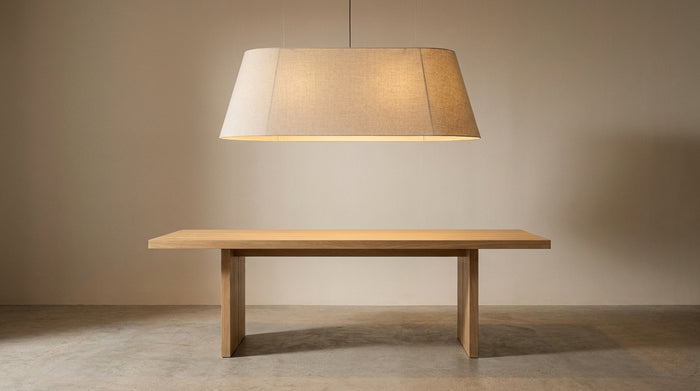
A wide dome forgives a higher installation, because its light goes down and spreads out. An oval or a tube, being narrower, require more precise adjustment if you want to mark an axis above an island. This is where a dimmable model changes everyday life: the same height serves the meal and the evening.
Beige, white, brown or cream jute pendant: which colour to choose?
Natural jute leans towards beige and brown; white or cream models brighten the room and blend with a light wall. A dark colour absorbs the light and concentrates it downwards, which works above a table. The choice is therefore based on the light you want as much as on the decor.
Beige or cream jute pendant: for a bright room
On a white or linen wall, beige and cream bring texture without clashing. These shades reflect a soft light, never cold, and let wooden furniture stand out. A discreet oval plays this role better than a large sphere, because it takes up less visual volume.
Brown, grey, yellow and pink: when to dare a strong shade
A brown shade acts as a tight filter: less light reflected onto the ceiling, more contrast on the table. Grey and silver lean towards the contemporary, visible in the grey pendants. The yellow and pink of crocheted jute warm up a hallway or a reading corner.
For a brighter metal, look at the gold-coloured metal pendants, keeping in mind that a strong gold stands out especially in a dark room: in a bedroom, a more discreet touch works better, as in the gold pendants for the bedroom.
What are the decoration ideas for jute cloth?
Jute cloth goes well with raw wood, rattan, matte ceramic, beige linen and green plants. In a very white room, it brings a texture that breaks up the smoothness; in a room already full of natural materials, choose a lighter one so as not to overload it.
Matching jute with wood and metal
Wood and jute share the same family of warm shades, which makes it easy to match above an oak table or a walnut worktop. The wooden pendants for the kitchen take the logic further, with cleaner shapes.
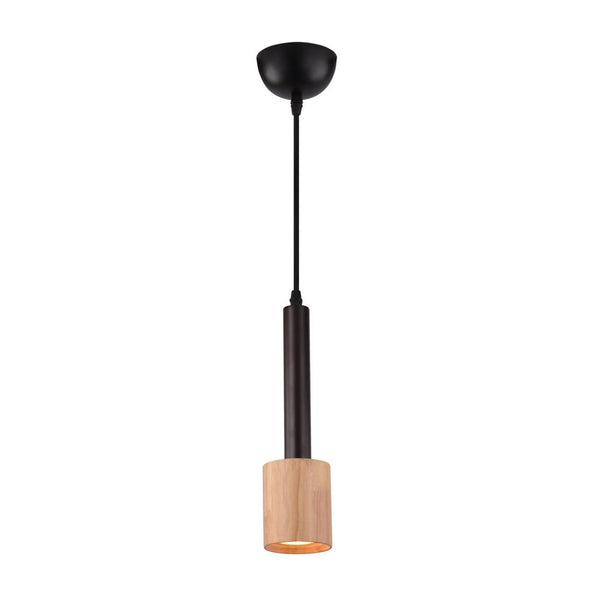
When metal enters the composition, it brings contrast: the Tantal, a contemporary wooden tube, drops to 130 cm with a GU10 spotlight. For a living room, compare with the wooden light fittings for the living room, which show the same family of materials in other volumes.
Jute and light colours in a white room
On a white wall, jute warms without darkening: keep a light shade and a simple shape. A hallway gains a welcoming light, in the spirit of the hallway pendants. For a more graphic, more pared-back effect, the designer LED pendants and the Nordic style give two opposite directions, to be decided before fixing the ceiling rose.
Does jute cloth rot?
Jute fears humidity: in a very damp room or in contact with water, the fibre can go mouldy and lose its shape. In a dry interior, a jute pendant lasts for years without any problem. Most models are IP20, intended for indoor use; those rated IP54 accept a sheltered outdoor area.
Jute pendant in a damp room
A poorly ventilated bathroom, a cellar or a utility room should be avoided. If the room stays damp, a non-fibrous material that can be wiped with a cloth is better, as in the modern LED pendants. Jute, on the other hand, drinks in moisture and keeps the marks.
IP20 or IP54: what it changes in everyday use
IP20 means protected against solid objects, with no protection against water: this is the common case in a kitchen, living room or bedroom. IP54 adds protection against splashes. Only one model in the selection is rated IP54, with an integrated LED that cannot be replaced.
How to install and care for a jute pendant?
The pendant is fixed to the ceiling like a classic light fitting, then the cable length is adjusted before choosing the bulb: most often an E27 socket, E14 for a three-point light fitting, GU10 for a tube, without exceeding the wattage stated on the product sheet. Cleaning is done dry, with a cloth or a soft brush vacuum.
Which socket and which bulb wattage?
The majority of jute pendants are E27, with a screw bulb compatible with LED and 60 W maximum per bulb. The Elissa three-point light fitting uses E14, 40 W maximum per bulb. The Tantal tube takes a GU10 spotlight, 50 W maximum per bulb. A warm-temperature LED, around 2700 K, remains consistent with the effect of the fibre.
Cleaning a jute pendant without damaging it
Never water or product: the fibre drinks it in and keeps the marks. A dry cloth or a soft brush is enough for the dust settled between the threads. The 2-year warranty covers the selection, not humidity damage, which comes under the conditions of use.
| Model | Shape | Materials | Socket | Protection | Dimensions |
|---|---|---|---|---|---|
| Cordella | Dome | Jute, rope, plastic, wood | Integrated LED | IP54 | 38.6 x 22 cm |
| Nash Laiton | Glass and braided rope | Steel, glass, jute, ceramic | E27 | IP20 | Ø 25.4 cm, H 55.5 cm |
| Rosberella | Spherical | Jute, plastic | E27 | IP20 | H 140 cm, Ø 50 cm |
| Livdanara | Oval | Jute, metal | E27 | IP20 | H 110 cm, W 38 cm, D 38 cm |
| Nonna | Openwork bell | Crocheted jute, plastic | E27 | IP20 | H 100 cm, W 27 cm, D 27 cm |
| Tantal | Tube | Wood, jute, steel | GU10 | IP20 | H 130 cm, W 7.5 cm, D 7.5 cm |
How does ordering a jute pendant work?
First identify the room, the shape and the socket, then compare the product sheets: dimensions, materials, protection rating and maximum wattage. The current price is shown on each product sheet, and stock is updated. Payment is secure, delivery is tracked, and returns are provided for if the shape does not suit once the light fitting is hung.
The Designix customer service team answers questions on choosing the diameter or the socket before ordering, for example if you are hesitating between an E27 and a three-point E14. To compare the same use in glass, metal or wood, the full lighting collection gives an overview.
What is the difference between linen and jute?
Both are plant fibres, but linen is finer and softer, with a smooth and often lighter appearance. Jute is thicker and more rustic, with a visible weave and a dry feel. In a shade, linen softens the light, jute filters it and marks the shadows more strongly.
What are the advantages and disadvantages of textile jute?
On the plus side: a plant material, a texture that warms the light, a light weight and an easy match with wood, rattan or ceramic. On the minus side: the fibre fears humidity, cannot be washed and traps dust. The shades also vary from one shade to another, which is visible when two models are side by side.
What is the lifespan of a jute cloth?
It depends mainly on humidity and dust, not on the passing of time. A jute pendant kept dry, dusted regularly and never washed with water lasts for years indoors. In a damp room or outdoors without shelter, the fibre degrades much faster.
Does jute cloth rot?
Jute degrades in a permanently damp environment: mould, stains and loss of shape of the fibre. In a dry room, a jute pendant does not deteriorate for this reason. The IP20 models are intended for indoor use; a sheltered outdoor area requires an IP54 rating.
Which pendant to choose?
Start from the room and the light you want: a dome or openwork bell above a table to light widely, a ball or oval in a bedroom for low light. Then come the socket (E27, E14, GU10), the protection rating and the colour, from natural beige jute to white and brown.




